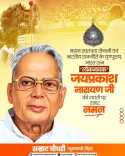
Nitish Kumar pays tribute to JP Narayan on birth anniversary
Synopsis
Former Bihar CM Nitish Kumar on October 11, 2026 paid tribute to Jayaprakash Narayan on his birth anniversary, honouring the Bharat Ratna-awarded freedom fighter and architect of the Total Revolution as an enduring inspiration for democracy and social justice.
Key Takeaways
Nitish Kumar posted a tribute to Jayaprakash Narayan on his birth anniversary, October 11, 2026 .
He described JP Narayan as a great freedom fighter, socialist leader, and the architect of the Total Revolution ( Sampurna Kranti ) movement.
Jayaprakash Narayan was born on October 11, 1902 in Sitabdiara, Bihar and was awarded the Bharat Ratna in 1999 .
JP's 1974–75 movement against corruption directly led to the declaration of the Emergency in 1975 and India's first non-Congress government in 1977 .
Nitish Kumar's own political tradition through Janata Dal (United) is rooted in the socialist stream that emerged from the JP movement.
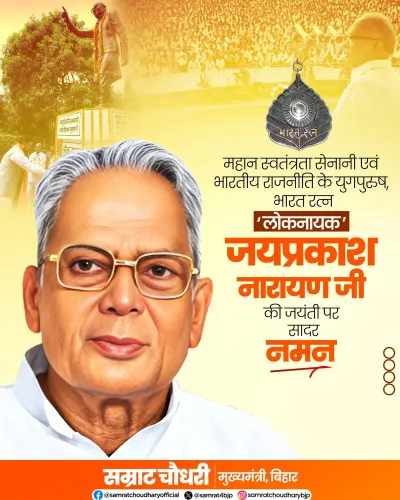
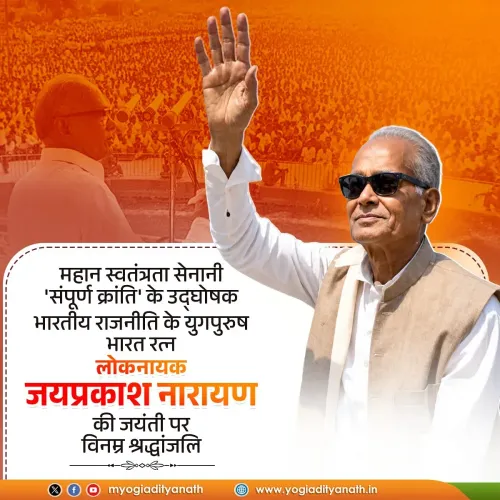
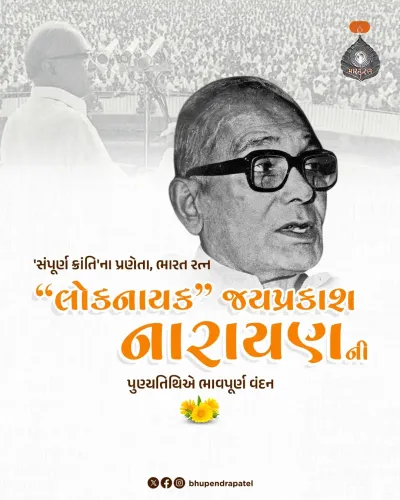
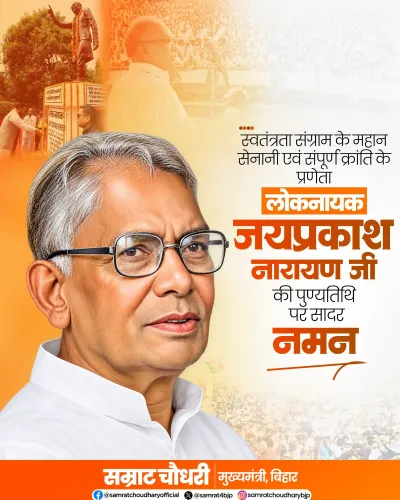
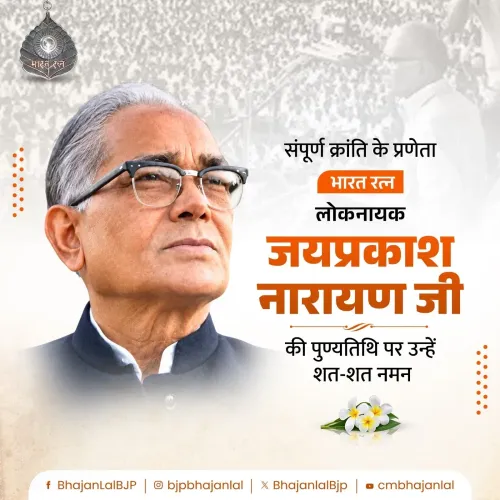
On the birth anniversary of one of India's most consequential democratic voices, former Bihar Chief Minister Nitish Kumar paid homage to Jayaprakash Narayan — the man whose 'Total Revolution' movement reshaped Indian politics — on Sunday, October 11, 2026.
In his post, Nitish Kumar described Jayaprakash Narayan as a 'mahan swatantrata senani, prakhar samajwadi neta, sampurna kranti ke praneta' — 'a great freedom fighter, a fierce socialist leader, and the architect of Total Revolution' — and offered him a hundredfold salute on his birth anniversary. He noted that JP Narayan 'united society against injustice with an unshakeable faith in democracy,' and that 'his ideas continue to inspire us toward building an equal and just society.'
Who was Jayaprakash Narayan and why Bihar remembers him differently
Jayaprakash Narayan, born October 11, 1902, in Sitabdiara, Bihar, was awarded the Bharat Ratna — India's highest civilian honour — in 1999, a year after his death. Known universally as 'Loknayak' (People's Leader), he moved from active Marxism in the 1930s to Gandhian Sarvodaya philosophy by the 1950s, embodying a restless search for a politics rooted in conscience rather than power.
His defining moment came in 1974–75, when he led the JP Movement — a mass uprising of students and citizens against corruption and authoritarianism — that ultimately triggered the declaration of the Emergency in 1975 and, after its lifting, the formation of the Janata Party government in 1977: India's first non-Congress central government. Bihar was the crucible of that movement, and its political DNA has carried JP's imprint ever since.
Nitish Kumar's own political lineage rooted in the JP movement
The tribute carries particular weight coming from Nitish Kumar. His own political formation — through the Janata Dal tradition and the socialist stream of Indian politics — traces directly back to the JP movement's legacy. As the national president of Janata Dal (United) and Bihar's longest-serving Chief Minister, Nitish Kumar has consistently invoked JP's ideals of social justice and democratic accountability as the philosophical backbone of his governance model.
That lineage is not merely rhetorical. The socialist bloc that emerged from the JP movement eventually gave rise to the regional parties — including JD(U) — that have defined Bihar's political landscape for four decades. For Nitish Kumar, remembering JP is also, in a very real sense, remembering the movement that made his own politics possible.
Jayaprakash Narayan's call for a politics of values over a politics of power remains the sharpest lens through which Bihar's leaders are still measured — and on his birth anniversary, that standard is once again quietly on the table.
Point of View
Nitish Kumar aligns himself with a moral tradition that transcends electoral cycles. In Bihar's political culture, where JP's memory remains a living reference point rather than a historical footnote, such tributes serve a dual function: honouring a genuine icon while reinforcing the speaker's claim to his inheritance. It is a reminder that in the socialist belt of north India, political identity is still partly constructed through whom you choose to remember, and how.
NationPress
11 Oct 2026
Frequently Asked Questions
Who was Jayaprakash Narayan and why is he called Loknayak?
Jayaprakash Narayan was a freedom fighter, socialist leader, and social activist born on October 11, 1902 in Sitabdiara, Bihar. He earned the title 'Loknayak' (People's Leader) for his mass movement against authoritarianism in 1974–75, which united students and citizens across India against corruption and emergency rule.
What was the Total Revolution movement led by JP Narayan?
The Total Revolution or 'Sampurna Kranti' was a 1974–75 mass uprising led by Jayaprakash Narayan, beginning in Bihar, demanding the removal of corruption and the restoration of democratic values. It directly precipitated the declaration of the Emergency in 1975 and the formation of India's first non-Congress government in 1977.
When was Jayaprakash Narayan awarded the Bharat Ratna?
Jayaprakash Narayan was awarded the Bharat Ratna, India's highest civilian honour, in 1999, a year after his death in 1979.
Why did Nitish Kumar pay tribute to Jayaprakash Narayan?
Nitish Kumar, as JD(U) national president and former Bihar Chief Minister, posted a tribute on JP Narayan's birth anniversary on October 11, 2026. His political tradition is directly rooted in the JP movement's socialist legacy, making the tribute both personal and ideological.
What is Jayaprakash Narayan's connection to Bihar politics today?
Bihar was the birthplace and crucible of JP Narayan's Total Revolution movement. The regional parties that dominate Bihar today, including JD(U), emerged from the Janata Dal tradition that grew out of that movement, making JP's legacy a living reference point in the state's political culture.