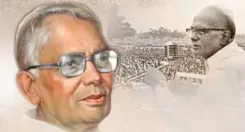
CM Samrat Choudhary pays tribute to JP Narayan on birth anniversary
Synopsis
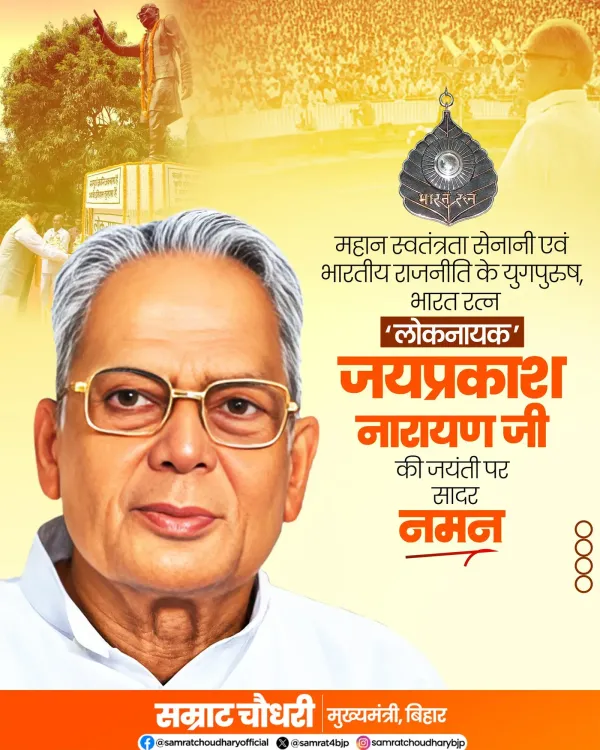
Bihar Chief Minister Samrat Choudhary honoured Bharat Ratna Loknayak Jayaprakash Narayan on his birth anniversary, calling the freedom fighter's dedication, sacrifice, and commitment to public welfare a timeless inspiration for India.
Key Takeaways
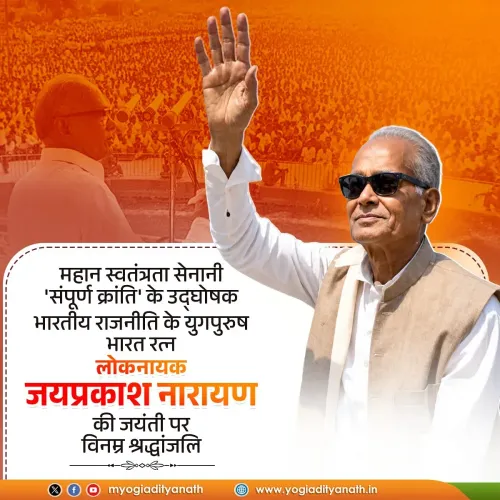
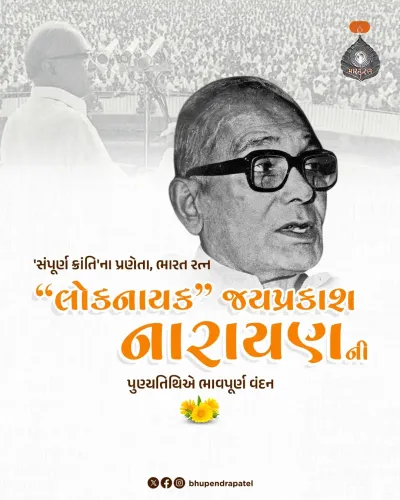
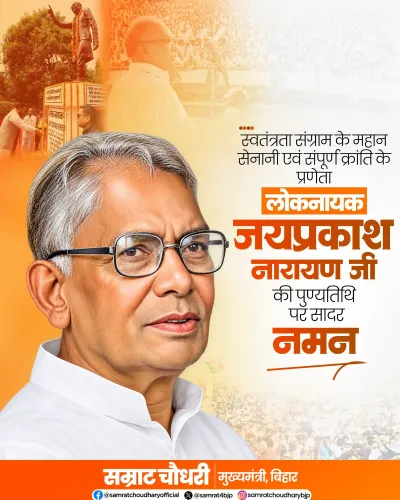
Bihar CM Samrat Choudhary paid tribute to Bharat Ratna Loknayak Jayaprakash Narayan on his birth anniversary, October 11, 2026 .
JP Narayan was born on October 11, 1902 , in Sitab Diara, Bihar , and is revered as a pioneer of India's freedom movement and democratic values.
He led the landmark 1974 Total Revolution (Sampurna Kranti) movement, challenging authoritarian governance during the Emergency era.
JP was posthumously awarded the Bharat Ratna in 1999 , India's highest civilian honour.
CM Choudhary described JP's legacy of 'dedication, sacrifice, and commitment to public welfare' as a permanent source of national inspiration.
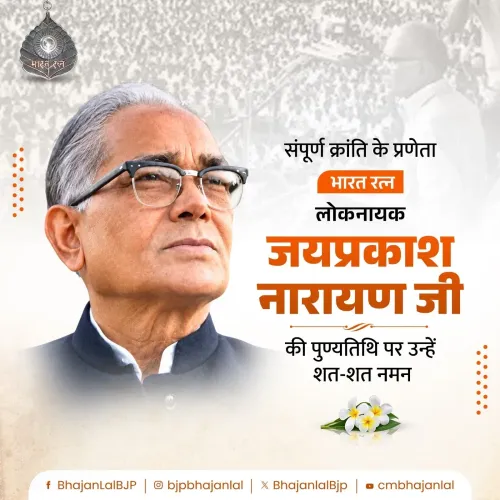
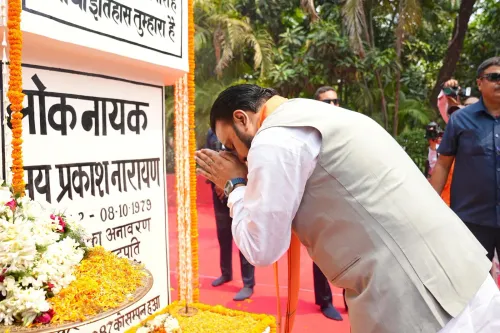
On the birth anniversary of one of India's most consequential democratic voices, Bihar Chief Minister Samrat Choudhary offered tribute to Bharat Ratna Loknayak Jayaprakash Narayan on Sunday, October 11, 2026, honouring the freedom fighter's enduring legacy of public service and democratic values.
Posting in Hindi, CM Choudhary wrote: 'भारत रत्न लोकनायक जयप्रकाश नारायण जी की जयंती पर उन्हें कोटि-कोटि नमन' — 'Heartfelt salutations to Bharat Ratna Loknayak Jayaprakash Narayan on his birth anniversary.' He added that Narayan's 'dedication to the nation, sacrifice, and commitment to public welfare will forever inspire the people of this country.'
Who was Loknayak Jayaprakash Narayan?
Jayaprakash Narayan, born on October 11, 1902, in Sitab Diara, Bihar, was a towering figure in India's independence movement and later became the face of the 1974 'Total Revolution' (Sampurna Kranti) movement that challenged authoritarian rule during the Emergency era. Known widely as 'JP' or 'Loknayak' — meaning 'People's Leader' — he galvanised an entire generation of Indians around democratic accountability and grassroots governance. He was posthumously awarded the Bharat Ratna, India's highest civilian honour, in 1999.
For Bihar, JP is not merely a historical figure — he is a moral cornerstone. His birthplace and legacy carry particular resonance in the state's political culture, and leaders across party lines regularly invoke his name as a symbol of principled public service.
Why Bihar's CM marking this day carries weight
CM Choudhary's tribute underscores the bipartisan reverence JP commands in Bihar's political landscape. The BJP-led NDA government in Bihar has consistently sought to align itself with JP's legacy of democratic reform and anti-corruption — values that transcend ideological lines. The anniversary is observed across Bihar with official events, seminars, and community gatherings each year.
JP's philosophy of 'Sampurna Kranti' — total revolution — continues to be cited in contemporary debates around electoral reform, decentralisation of power, and citizen-led governance. His life remains a reference point whenever Indian democracy faces stress tests.
As Bihar remembers its most celebrated son today, the tribute is a reminder that some legacies are too large for any single party to claim — and too important for any government to ignore.
Point of View
Grassroots accountability, and citizen empowerment — is ideologically fluid enough to be claimed across the political spectrum, making annual tributes both a genuine act of reverence and a calculated exercise in political positioning. For a state where JP's memory is deeply personal and civic, no government in Patna can afford to let the anniversary pass in silence. The tribute also signals Bihar's continued centrality in India's broader narrative of democratic resilience.
NationPress
11 Oct 2026
Frequently Asked Questions
When is Jayaprakash Narayan's birth anniversary?
Jayaprakash Narayan was born on October 11, 1902 , and his birth anniversary is observed every year on October 11.
Why is Jayaprakash Narayan called Loknayak?
'Loknayak' means 'People's Leader' in Hindi. JP Narayan earned this title for his lifelong dedication to grassroots democracy, anti-corruption movements, and his leadership of the 1974 Total Revolution movement.
Was Jayaprakash Narayan awarded the Bharat Ratna?
Yes. Jayaprakash Narayan was posthumously awarded the Bharat Ratna , India's highest civilian honour, in 1999 .
What was Jayaprakash Narayan's connection to Bihar?
JP Narayan was born in Sitab Diara, Bihar , and remains one of the state's most celebrated sons. His legacy deeply shapes Bihar's political culture and civic identity.
What was the Total Revolution movement led by JP Narayan?
The Total Revolution (Sampurna Kranti) was a 1974 mass movement led by JP Narayan that called for comprehensive social, political, and economic reform, and became a major force challenging the government of the day, ultimately influencing the end of the Emergency period in India.