How Do Anganwadi Workers Contribute to a Healthy Generation for Viksit Bharat?
Click to start listening
Synopsis
Gujarat Chief Minister Bhupendra Patel underscores the vital role of Anganwadi workers in nurturing a healthier generation for Viksit Bharat 2047. With the appointment of over 9,000 workers, the state aims to enhance maternal nutrition, child health, and early education, aligning with Prime Minister Modi's vision of nation-building through Nari Shakti.
Key Takeaways
- Anganwadi workers are essential for childhood development.
- Over 9,000 workers have been appointed in Gujarat.
- The state has more than 53,000 Anganwadi centres.
- Government initiatives support maternal nutrition and child health.
- Women’s empowerment is a key focus in the new appointments.
Ahmedabad, Dec 4 (NationPress) The Chief Minister of Gujarat, Bhupendra Patel, emphasized on Thursday that the responsibility for fostering a healthy generation leading to Viksit Bharat 2047 largely lies with Anganwadi workers, who are pivotal in molding the minds of the youth and embedding essential values from an early age.
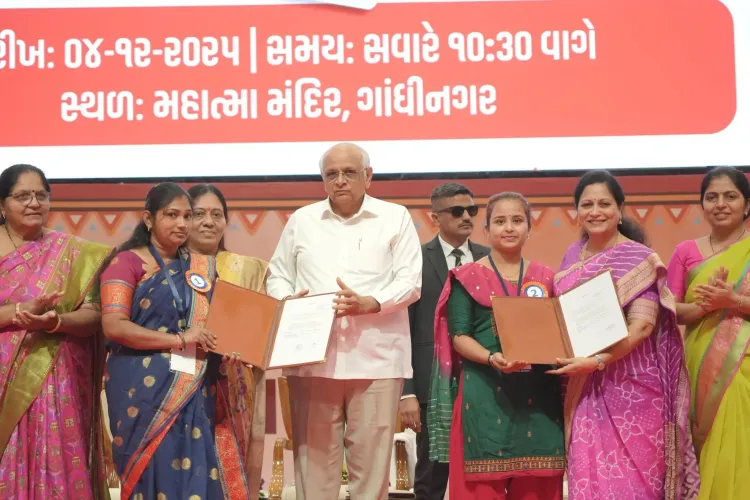
During a state-level event held at Mahatma Mandir in Gandhinagar, Chief Minister Patel handed out appointment letters to over 9,000 Anganwadi workers and helpers, in attendance with Minister of Women and Child Development Manisha Vakil.
In his address, the Chief Minister reiterated that Anganwadis serve as the foundational stone in childhood development, asserting that the onus of cultivating a healthy populace for Viksit Bharat @2047 significantly falls on Anganwadi workers.
He highlighted that the vision of Prime Minister Narendra Modi regarding nation-building through Nari Shakti underpins the state government's dedication towards maternal nutrition, child health, and early education.
CM Patel noted that Gujarat boasts over 53,000 operational Anganwadi–Nandghar centres, a transformation propelled by the leadership of the Prime Minister.
During the event, he also inaugurated and laid the foundation for more than 170 new Anganwadi centres and outlined plans to establish over 10,000 new Nandghars in the upcoming years.
He remarked that Anganwadi workers, akin to Mother Yashoda, play an instrumental role in shaping young personalities and instilling core values.
Additionally, he emphasized the state's welfare initiatives such as fortified flavored milk for tribal children under the Dudh Sanjivani Yojana, protein-rich diets for pregnant women, Poshan Sudha, Take-Home Ration, Mukhyamantri Matrushakti Yojana, and Mukhyamantri Paushtik Alpahar Yojana, which benefit over 41 lakh children from Anganwadis to primary schools.
In her address, Minister Manisha Vakil congratulated the newly appointed workers, indicating that they are not just entering government service but are joining a mission to fortify the future of Gujarat's children.
She stated that the values, nutrition, and foundational education provided by Anganwadi workers would mold the future of the state.
Labeling the day as historic and commendable for Gujarat, she mentioned that the new roles have empowered women with local employment opportunities, marking a significant advancement in women's empowerment.
The letters of appointment symbolize not merely jobs but a promise to cultivate a healthier and more educated generation.
Dr. Vakil remarked that Anganwadi centres have evolved into energy hubs for children and represent the most fundamental unit of social development, ensuring that government schemes and benefits effectively reach the grassroots level. District-level ceremonies were also conducted for recruits from Rajkot, Surat, and Vadodara.
Dr. Vakil explored stalls displaying nutrition services, pre-primary education initiatives (Pa Pa Pagli), digital innovations, and Poshan Sangam.
Rakesh Shankar, Secretary of the Women and Child Development Department, presented an overview of government projects aimed at enhancing the health, nutrition, and education of pregnant women, lactating mothers, and children in Gujarat.
ICDS Commissioner Ranjitkumar Singh delivered the vote of thanks.
Point of View
The emphasis on Anganwadi workers reflects a broader commitment to community health and education. The alignment with Prime Minister Modi’s vision of empowering women signifies a strategic approach to socio-economic development. This initiative not only benefits individual families but also contributes to the overall growth of the nation, ensuring that the future workforce is healthy, educated, and capable.
NationPress
04/12/2025
Frequently Asked Questions
What is the role of Anganwadi workers?
Anganwadi workers play a crucial role in early childhood development by providing nutrition, education, and health services to children and mothers.
How many Anganwadi workers were appointed?
Over 9,000 Anganwadi workers and helpers were appointed in the recent state-level ceremony.
What initiatives support maternal nutrition and child health?
Initiatives like the Dudh Sanjivani Yojana, Mukhyamantri Matrushakti Yojana, and Poshan Sudha aim to enhance maternal nutrition and child health.
What impact do Anganwadi centres have?
Anganwadi centres serve as vital hubs for children's health and education, ensuring that government schemes reach those in need.
What is Viksit Bharat 2047?
Viksit Bharat 2047 refers to the vision for a developed India by the year 2047, emphasizing health, education, and overall social progress.