CM Majhi Marks 2 Years With 152 Industrial Projects Worth ₹3.12 Lakh Crore
Synopsis
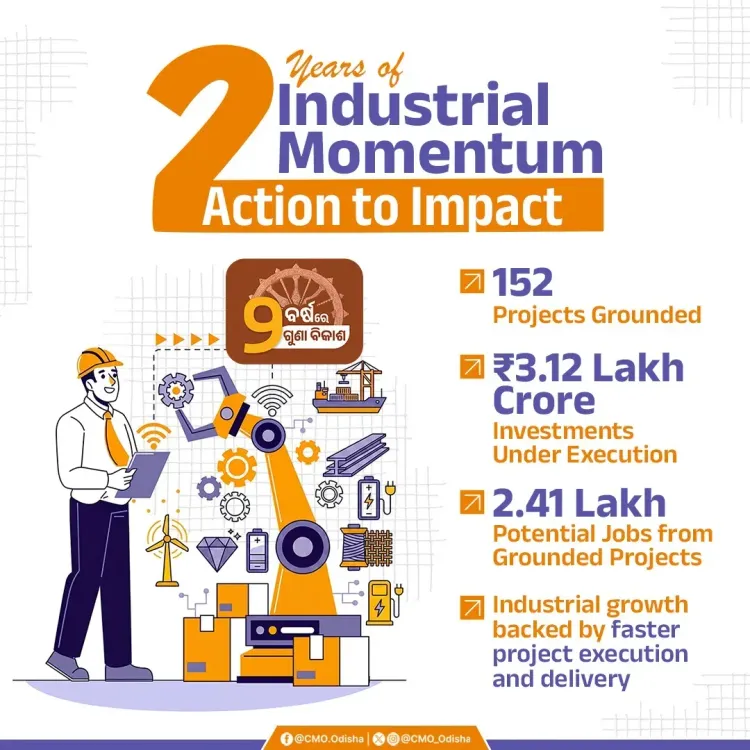
The Chief Minister's Office of Odisha announced on 18 June 2026 that 152 industrial projects worth ₹3.12 lakh crore are now on the ground under CM Mohan Charan Majhi's two-year-old government, with a stated employment potential of 2.41 lakh jobs as the state pursues its Samruddha Odisha vision.
Key Takeaways
152 industrial projects worth ₹3.12 lakh crore are currently under implementation in Odisha, according to the Chief Minister's Office.
The projects carry a stated employment potential of 2.41 lakh jobs.
The announcement marks two years of the BJP government led by Chief Minister Mohan Charan Majhi , who took office in June 2024 .
The government frames its industrial strategy under the Samruddha Odisha (Prosperous Odisha) vision, focused on converting mineral wealth into downstream manufacturing.
Odisha's approach parallels similar mineral-to-manufacturing strategies in neighbouring states Chhattisgarh and Jharkhand .
Verified project completion rates and actual employment numbers are expected to be scrutinised at forthcoming state budget sessions and investment conclaves.
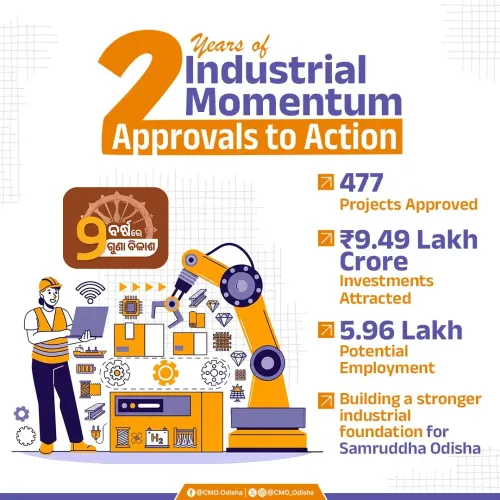
The Chief Minister's Office of Odisha on Thursday, 18 June 2026, highlighted that 152 industrial projects worth ₹3.12 lakh crore are currently under implementation across the state, marking two years of the BJP government led by Chief Minister Mohan Charan Majhi. The announcement underscores the administration's claim of converting investment commitments into on-ground industrial activity, with an estimated employment potential of 2.41 lakh jobs.
Context
The post, shared on the official CMO Odisha account, declared: 'Confidence becomes meaningful only when it delivers results.' It positioned the 152 projects as proof that investment pledges made at earlier conclaves are now translating into 'factories, opportunities and jobs.' The message was framed around the hashtag #2YearsofLokankaSarakar — marking two years of the current state government — alongside #BikasharaDharaOdishaSara and #2YearsOfIndustrialMomentum, signalling a coordinated government communication effort around the anniversary milestone.
Policy Backdrop
Mohan Charan Majhi became Odisha's Chief Minister in June 2024, making him the first BJP leader to hold the post after the party's decisive victory in the state assembly elections. His government inherited a pipeline of industrial projects and MoUs that had been anchored through investment summits under the previous administration, and subsequently moved to accelerate their ground-level execution.
Odisha has long sought to leverage its substantial mineral wealth — particularly iron ore, bauxite, and coal — by developing downstream manufacturing industries rather than exporting raw resources. The current administration has framed this industrial push under the vision of a 'Samruddha Odisha' (Prosperous Odisha), a phrase that has appeared consistently in official communications as the governing economic objective.
Stakeholders and Impact
The primary beneficiaries of this industrial momentum, if the stated employment potential is realised, would be Odisha's youth workforce. The state government has repeatedly cited job creation as the central metric of industrial success, and the figure of 2.41 lakh employment opportunities is presented as the human dividend of the ₹3.12 lakh crore investment pipeline.
Industrial investors — particularly in steel, aluminium, and allied manufacturing sectors — stand as the other key stakeholder group. Odisha's approach mirrors strategies adopted by neighbouring mineral-rich states such as Chhattisgarh and Jharkhand, which have similarly pursued value-addition through downstream industries to capture a larger share of the economic returns from their natural resource base.
What's Next
The state government's credibility on this industrial narrative will be tested at upcoming budget presentations and any follow-up investment conclaves, where independent assessments of project completion rates and verified employment generation numbers are expected to emerge. Analysts and opposition parties will likely scrutinise the distinction between projects 'on the ground' — meaning under construction or in early operation — and those that have reached full commercial production and are actively employing workers at the projected scale.
As Odisha approaches the midpoint of the current government's five-year term, the pace at which these 152 projects move from construction to commissioning will determine whether the 'unprecedented industrial growth' narrative holds through the next electoral cycle.
Point of View
Designed to pre-empt the standard opposition charge that MoU-era numbers rarely materialise. However, the gap between construction-phase projects and fully operational, job-generating factories remains the critical variable that independent observers will press on. Odisha's industrial trajectory also carries regional significance: if the state successfully demonstrates a minerals-to-manufacturing conversion model, it could set a benchmark that reshapes investment competition across eastern India.
NationPress
19 Sept 2026
Frequently Asked Questions
How many industrial projects are currently on the ground in Odisha in 2026?
According to the Chief Minister's Office of Odisha, 152 industrial projects worth ₹3.12 lakh crore are currently under implementation in the state as of June 2026.
How many jobs will Odisha's new industrial projects create?
The Odisha government has stated that the 152 on-ground projects carry an employment potential of 2.41 lakh jobs, though independently verified employment figures are yet to be released.
Who is the Chief Minister of Odisha in 2026?
Mohan Charan Majhi is the Chief Minister of Odisha. He took office in June 2024 as the first BJP leader to hold the post, following the party's victory in the 2024 state assembly elections.
What is Samruddha Odisha?
Samruddha Odisha means 'Prosperous Odisha' and is the overarching economic vision of the current BJP state government, focused on transforming investment momentum and mineral resources into lasting industrial and employment growth.
How long has the BJP government been in power in Odisha?
The BJP government under Chief Minister Mohan Charan Majhi completed two years in office in June 2026 , an anniversary the government marked with the hashtag #2YearsofLokankaSarakar .