Odisha CMO Highlights Mukhyamantri Annapurna Yojana Food Push

Synopsis
The Chief Minister's Office of Odisha on 20 July 2026 highlighted the Mukhyamantri Annapurna Yojana, a state scheme providing additional free monthly rice to eligible BPL households, framing food access as a fundamental right and a cornerstone of good governance in the state.
Key Takeaways
The Chief Minister's Office of Odisha publicly spotlighted the Mukhyamantri Annapurna Yojana on 20 July 2026 .
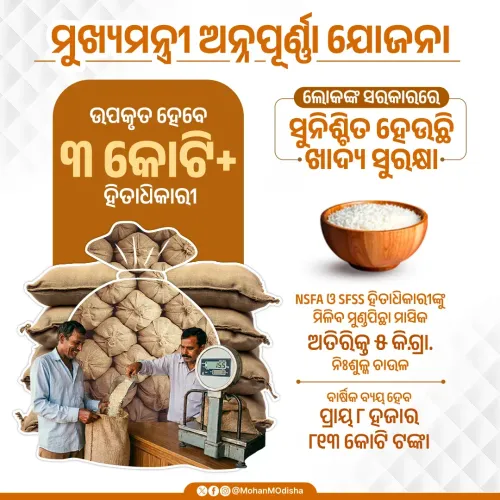
The scheme provides additional free rice every month to eligible beneficiaries over and above central PDS allocations.
The initiative is framed as a rights-based measure ensuring food security and fundamental rights of poor households in Odisha .
The scheme is positioned as part of a broader social security mission rooted in poverty alleviation, public service, and good governance .
It builds on Odisha's participation in the National Food Security Act, 2013 framework, adding a state-funded layer of grain support.
Upcoming state budget allocations and central NFSA revisions will determine the scheme's future scale and beneficiary coverage.
The Chief Minister's Office of Odisha on Monday, 20 July 2026, spotlighted the Mukhyamantri Annapurna Yojana, describing it as a 'purposeful step' by the Odisha government to secure food rights and basic entitlements for every eligible beneficiary in the state. The post underscored that the scheme is actively delivering additional free rice every month to qualifying households, framing it as a pillar of social protection built on the values of poverty alleviation, public service, and good governance.
Context
The CMO's post, written in Odia, states that the Mukhyamantri Annapurna Yojana is an 'abhimukh' — or forward-looking — initiative aimed at guaranteeing the food security and fundamental rights of all eligible beneficiaries across the state. It adds that the scheme ensures the 'swabhiman' (self-respect) and 'samriddhi' (prosperity) of every family by supplementing their monthly grain entitlement at no cost.
The announcement reinforces the Odisha government's long-standing positioning of food access as a rights-based entitlement rather than a discretionary benefit, consistent with the language of the National Food Security Act, 2013.
Policy Backdrop
Odisha has been an active participant in India's central public distribution system since the implementation of the National Food Security Act, 2013, which identified priority households for subsidised foodgrain supply. The Mukhyamantri Annapurna Yojana goes a step further by layering an additional state-funded rice entitlement on top of the central allocation, a model several Indian states have adopted to address local poverty metrics and seasonal food stress.
This approach reflects a broader federal pattern where state governments augment central PDS coverage to claim enhanced welfare outcomes and directly serve below-poverty-line families who may fall through gaps in the central framework. Odisha's eastern geography and historically high rural poverty rates have made food security a recurring legislative and budgetary priority for successive administrations.
Stakeholders and Impact
The primary beneficiaries of the Mukhyamantri Annapurna Yojana are BPL (below poverty line) families and other eligible poor households across Odisha. By providing additional free rice on a monthly basis, the scheme is designed to reduce the nutritional and financial burden on the state's most economically vulnerable citizens.
Social security schemes of this nature also carry downstream economic effects: reduced household expenditure on staple food frees up limited income for health, education, and livelihood needs, potentially reinforcing the dignity and self-sufficiency that the CMO's post explicitly invokes.
What's Next
Observers will watch the Odisha state budget for allocations that sustain and potentially expand the Mukhyamantri Annapurna Yojana's beneficiary coverage. Any revision to the central NFSA beneficiary lists — expected to follow the next national census exercise — could also trigger a recalibration of the state scheme's reach.
The government's continued public communication around the scheme signals an intent to keep food security at the centre of its governance narrative, with further announcements likely as the scheme's implementation milestones are reviewed in upcoming assembly sessions.
Point of View
The messaging elevates the scheme beyond a transactional food subsidy into a rights-and-dignity narrative, which carries political as well as policy weight. With the next national census poised to reset NFSA beneficiary lists, Odisha's proactive communication around its own scheme suggests the government is hedging against potential disruptions in central allocations. The move also signals that food security will remain a live electoral and governance issue in the state well into the next budget cycle.
NationPress
20 Oct 2026
Frequently Asked Questions
What is the Mukhyamantri Annapurna Yojana in Odisha?
The Mukhyamantri Annapurna Yojana is an Odisha government scheme that provides additional free rice every month to eligible below-poverty-line and priority households, supplementing the rice they already receive under the central public distribution system.
Who are the beneficiaries of Mukhyamantri Annapurna Yojana?
The scheme targets eligible poor households in Odisha, primarily BPL families and other priority beneficiaries identified under the state's food security framework.
How does Mukhyamantri Annapurna Yojana differ from the central PDS?
While the central PDS under the National Food Security Act, 2013 provides subsidised foodgrain, the Mukhyamantri Annapurna Yojana is a state-funded addition that gives qualifying beneficiaries extra rice at no cost each month.
What did the Odisha CMO say about Annapurna Yojana on 20 July 2026?
The Chief Minister's Office of Odisha described the scheme as a 'purposeful step' to guarantee food security and fundamental rights for all eligible beneficiaries, emphasising that it ensures the self-respect and prosperity of every family through regular free rice distribution.
Will the Mukhyamantri Annapurna Yojana be expanded in Odisha?
No official expansion announcement has been made, but observers are watching the Odisha state budget and any revisions to the central NFSA beneficiary lists, which could prompt the government to scale up coverage in future legislative sessions.