Owaisi Challenges SP's Anti-BJP Credentials, Backs New Front
Synopsis
AIMIM president Asaduddin Owaisi invokes Akhilesh Yadav's own call for Dalit-Muslim strategic voting to argue SP's four consecutive losses to BJP disqualify it, and that the Samajik Parivartan Morcha now holds the real power to stop BJP in Uttar Pradesh.
Key Takeaways
Owaisi quotes Akhilesh Yadav's own statement that Dalits and Muslims should vote for whichever party can defeat BJP.
He argues SP failed to stop BJP in four consecutive elections: 2014, 2017, 2019, and 2022 .
Owaisi claims the Samajik Parivartan Morcha (Social Change Front) now holds the real electoral power to block BJP.
The nature and formal composition of the Samajik Parivartan Morcha has not been confirmed in established public records.
Uttar Pradesh's 80 Lok Sabha seats make Dalit-Muslim vote coordination a central variable in national electoral outcomes.
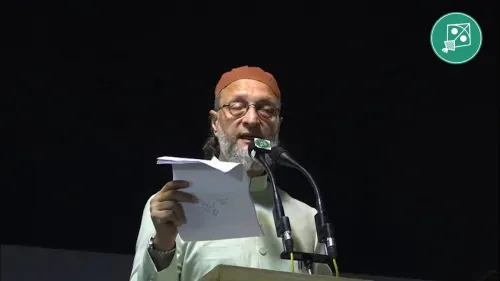
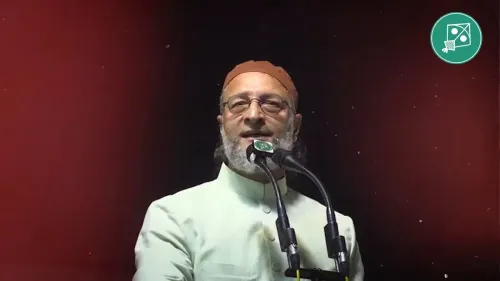
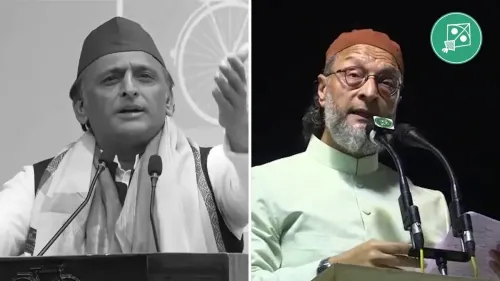
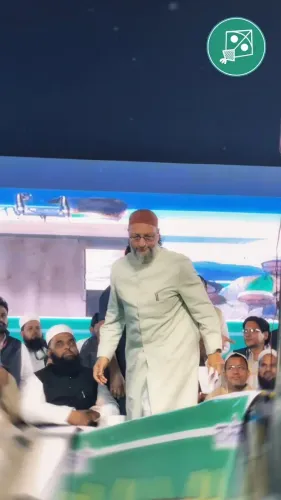
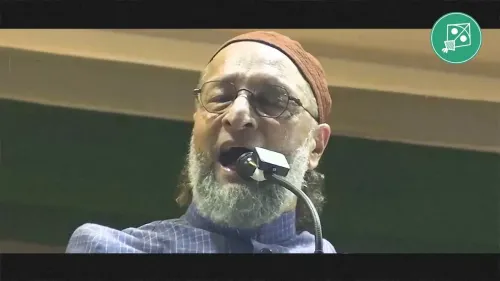
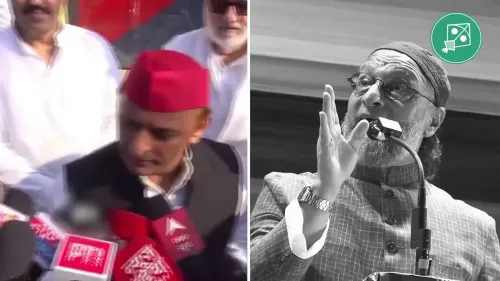
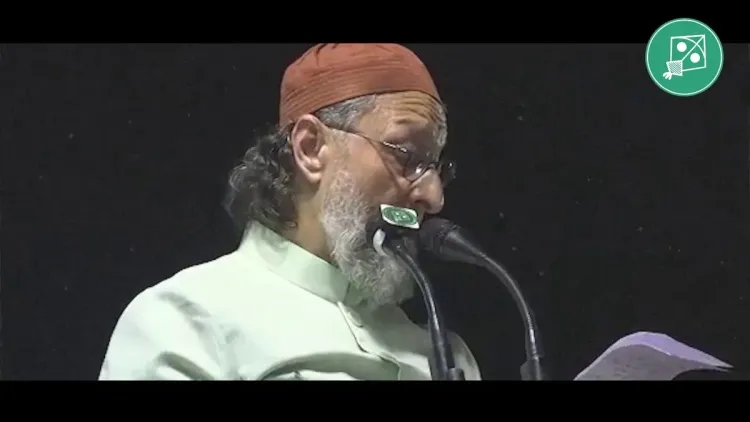
AIMIM president Asaduddin Owaisi has turned Samajwadi Party chief Akhilesh Yadav's own words into a pointed political challenge — arguing that SP's repeated failures against BJP in Uttar Pradesh disqualify it as the natural home for Dalit and Muslim votes, and that a grouping he calls the 'Samajik Parivartan Morcha' (Social Change Front) now holds the real power to stop BJP's electoral machine.
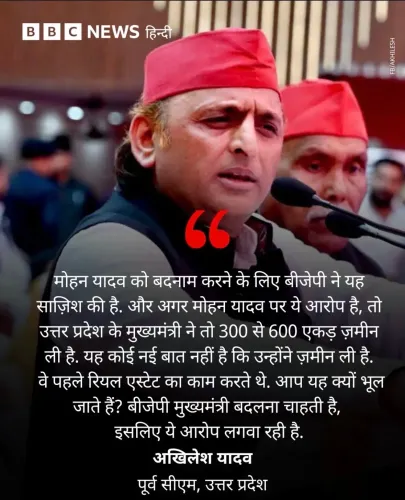
Posting on X on 16 November 2026, Owaisi wrote in Hindi: 'Ab to Akhilesh ne bhi keh diya hai ki jo party BJP ko hara sakti hai, Dalit aur Musalman usi ko vote dein.' — 'Now even Akhilesh has said that Dalits and Muslims should vote for whichever party can defeat BJP.' Owaisi's response was surgical: if that is the standard, he argued, then SP — which fell short in 2014, 2017, 2019, and 2022 — has already disqualified itself.Four Elections, Four Failures: Owaisi's Case Against SP
The statistical scaffolding Owaisi erects is hard to dismiss on its face. In the 2017 Uttar Pradesh assembly elections, BJP swept to power, routing the SP government that had run the state for five years. In 2019, BJP dominated UP's Lok Sabha seats even as opposition parties attempted vote-consolidation alliances. And in 2022, despite a sharper SP campaign and high turnout in Yadav-Muslim constituencies, BJP held on to form government again. Four bites at the apple, and the same outcome each time — that is Owaisi's argument compressed to its sharpest edge.
The critique lands inside a well-worn debate in UP opposition politics: whether the Yadav-Muslim social coalition that powered SP's earlier victories has the structural breadth to actually flip a state-level majority. Critics of SP have long argued it mobilises its base but fails to expand into Dalit communities, leaving a durable ceiling on its vote share. Owaisi is now making that criticism explicit and electoral.
The 'Samajik Parivartan Morcha' Claim
The more assertive half of Owaisi's post is the claim that the 'Samajik Parivartan Morcha' — the Social Change Front — now holds the 'real power' to stop BJP. The nature, composition, and formal standing of this grouping remain unconfirmed in established public records; Owaisi does not elaborate on its structure or allied parties in this post. What is clear is that AIMIM is positioning the front as a credible alternative vehicle for strategic voting by Dalit and Muslim constituencies — the two groups Akhilesh himself identified as decisive.
The rhetorical move is classic Owaisi: use the rival's own framing to undercut him. If the only criterion is 'who can beat BJP', and SP demonstrably has not, then the conversation about where those votes go is — in Owaisi's telling — wide open.
What It Means for the Anti-BJP Opposition Space in UP
Uttar Pradesh, with its 80 Lok Sabha seats and outsized role in national politics, remains the central battlefield of Indian electoral arithmetic. The question of how Dalit and Muslim voters coordinate — or fragment — their choices has shaped every UP result since 2014. Owaisi's broadside matters less as a definitive answer and more as a pressure point: it forces SP to defend its record rather than simply claim the mantle of the premier anti-BJP force.
For now, Owaisi has drawn the battle lines clearly — and dared Akhilesh's party to answer the scoreboard.Point of View
Owaisi is not just criticising a rival but actively contesting the narrative that SP is the default consolidation point for Muslim and Dalit voters. The move fits a broader AIMIM pattern of challenging SP's claim to Muslim political representation by pointing to measurable electoral outcomes rather than identity affiliation. Whether the unverified Samajik Parivartan Morcha can translate this rhetorical opening into organisational ground is the critical test that will determine if this is strategy or posturing.
NationPress
16 Nov 2026
Frequently Asked Questions
What did Owaisi say about Akhilesh Yadav and BJP?
Owaisi used Akhilesh Yadav's own statement — that Dalits and Muslims should vote for whichever party can beat BJP — to argue that SP disqualifies itself because it has failed to defeat BJP in four straight elections: 2014, 2017, 2019, and 2022.
What is the Samajik Parivartan Morcha that Owaisi mentioned?
Owaisi refers to a grouping called the Samajik Parivartan Morcha (Social Change Front) as holding the 'real power' to stop BJP, but its formal structure and allied parties have not been confirmed in established public records.
Has SP actually failed to defeat BJP in UP elections?
Yes — BJP won the 2017 and 2022 Uttar Pradesh assembly elections defeating SP-led opposition, and dominated UP's Lok Sabha seats in 2014 and 2019 despite various opposition alliance efforts.
Why does AIMIM target SP's record with Muslim and Dalit voters?
AIMIM has consistently challenged SP's claim to be the primary vehicle for Muslim political aspirations, arguing that four consecutive electoral losses demonstrate SP cannot reliably convert Dalit-Muslim support into BJP defeats.
Why do Dalit and Muslim votes matter so much in Uttar Pradesh politics?
Uttar Pradesh sends 80 MPs to the Lok Sabha — the most of any state — making it decisive in national elections, and Dalit plus Muslim voters together constitute a significant share of the electorate whose coordination or fragmentation has shaped every UP result since 2014.