What did Philosopher Acharya Prashant share during his Patna visit?
Click to start listening
Synopsis
Acharya Prashant's inaugural dialogue in Patna at the historic Bapu Auditorium captivated thousands despite frigid temperatures. His insights on Vedanta, women's rights, and self-reliance resonated deeply with attendees, showcasing his profound impact on the audience.
Key Takeaways
- Acharya Prashant's dialogue in Patna drew nearly five thousand attendees.
- He emphasized the role of Vedanta in empowering women.
- Participants were engaged in discussions about self-reliance and personal growth.
- His teachings resonate with a diverse audience from various regions.
- Acharya Prashant continues to inspire through his extensive writing and public engagements.
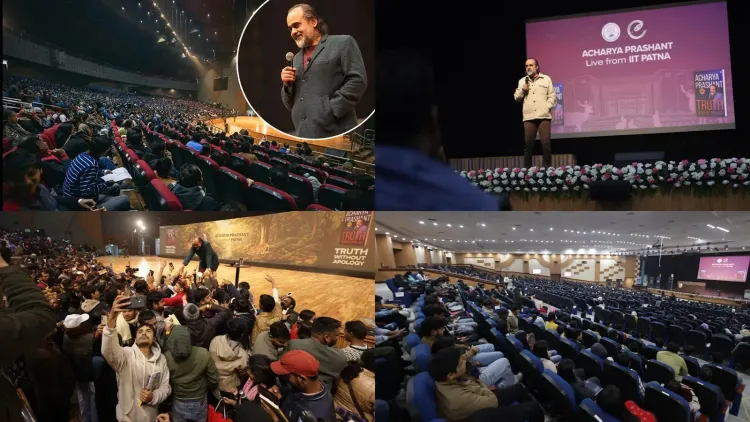
Patna, Jan 18 (NationPress) On January 16, Acharya Prashant's inaugural dialogue in Patna at the historic Bapu Auditorium near Gandhi Maidan was an event to remember. The session extended well beyond its planned duration, lasting nearly four hours. In spite of the frigid temperatures, nearly five thousand attendees remained engaged until late into the night.
After the session, a queue stretching a kilometre formed for book signings, continuing past midnight. Numerous participants were delighted to receive signed copies of Truth Without Apology and other publications.
This was Acharya Prashant's first public event in Patna. Attendees came not just from various districts of Bihar, but also from Jharkhand, Uttar Pradesh, and even Nepal. The auditorium, which accommodates five thousand people, was completely filled. Organizers commented that such a warm reception had been rarely seen in recent times.
Acharya Prashant is a distinguished alumnus of IIT Delhi and IIM Ahmedabad, having cleared the civil services examination, and is the author of over 160 books. He is also the founder of the PrashantAdvait Foundation.
Currently, more than 150,000 participants are enrolled in his educational programmes covering the Gita, Upanishads, Buddhist texts, and various Indian and Western scriptures. In 2025, he received the “Outstanding Contribution for National Development” (OCND) award from the IIT Delhi Alumni Association.
During his talk, Acharya Prashant elaborated on the connection between Vedanta and women, declaring Vedanta as a true supporter of women's rights. He emphasized that only a philosophy that liberates individuals from bodily identification can provide real freedom for women.
He attributed the primary causes of women's suffering to lack of education and religious superstitions. Citing temple-entry movements and the freedom struggle, he discussed the original essence of Sanatan Dharma, indicating that discrimination against women in the name of religion arises not from Dharma itself, but from its misinterpretations.
In his address, Acharya Prashant expressed his connection to Purvanchal, stating that he feels equally at home in Bihar as he does in Uttar Pradesh. He pointed out the sight of young people engaging in reading and writing in libraries and cafes as evidence of a transforming Bihar.
Addressing the youth, he encouraged them not to restrict their ambitions to securing government jobs but to strive for self-sufficiency. He stated that reliance on others, whether in thought or decision-making, constitutes a person's greatest vulnerability.
Following the session, national and regional media outlets, including IANS, interviewed Acharya Prashant. He shared his perspectives on the Indian Constitution, noting that its fundamental principles—liberty, equality, fraternity, and justice—are deeply aligned with Vedantic philosophy.
He asserted that these values do not require external imports; what is essential is to comprehend and embody them.
On January 17, Acharya Prashant visited the IIT Patna campus for his eighth address at an IIT in recent months, having previously spoken at IITs in Delhi, Goa, Hyderabad, Kharagpur, Madras, Mumbai, and Bhubaneswar. He has plans to address five more IIT campuses in the coming month.
The session at IIT Patna commenced with a verse from the Kath Upanishad. Acharya Prashant remarked that self-proclaimed guardians of religion have misguided society through incorrect interpretations of sacred texts.
He clarified that the Bhagavad Gita is not merely a manual for ritual worship but a practical guide for living correctly. During the Q&A segment, one student raised a concern about climate change and consumption patterns, while another candidly discussed physical attraction and self-control during student life.
Acharya Prashant addressed these inquiries head-on. The event concluded with enthusiastic book signings involving students and other attendees.
Over two consecutive days, these events attracted impressive turnout from two distinct groups: the general public at Bapu Auditorium and technical students at IIT Patna. Acharya Prashant is set to address students at IIT Delhi on January 18.
Point of View
Acharya Prashant's engagement in Patna encapsulates a significant cultural moment. His ability to draw thousands underscores a growing interest in philosophical discourse among the youth. The themes he addresses are timely and relevant, reflecting broader societal shifts towards empowerment and self-sufficiency.
NationPress
21/01/2026
Frequently Asked Questions
Who is Acharya Prashant?
Acharya Prashant is a renowned philosopher, IIT Delhi and IIM Ahmedabad alumnus, author of over 160 books, and the founder of the PrashantAdvait Foundation.
What topics did he discuss in Patna?
He spoke about Vedanta, women's rights, education, and self-reliance, emphasizing the need for personal empowerment.
How many people attended the event?
Nearly five thousand people attended the event at the Bapu Auditorium.
Where did Acharya Prashant visit after Patna?
He visited the IIT Patna campus for his eighth address at an IIT.
What is the significance of Acharya Prashant's teachings?
His teachings emphasize the importance of philosophical understanding in addressing societal issues, especially concerning women's empowerment and self-reliance.