PIB fact-check: India power grid stable, 229 GW demand met on May 2
Synopsis
A viral social media post claimed India's power grid was on the brink — the PIB Fact Check unit says otherwise. With 229 GW of peak demand met in full on 2 May and coal stocks at 53.702 million tonnes, the government is pushing back hard against what it calls a deliberate attempt to spread panic during peak summer season.
Key Takeaways
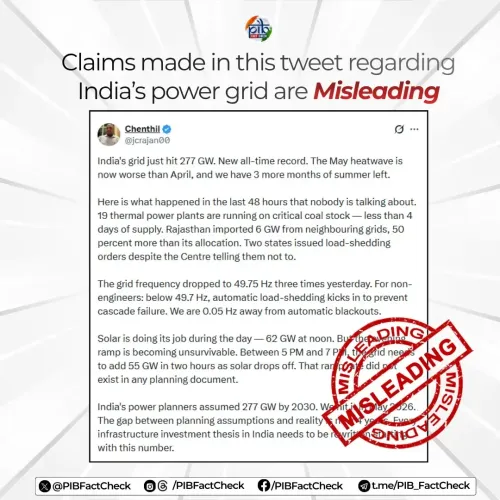
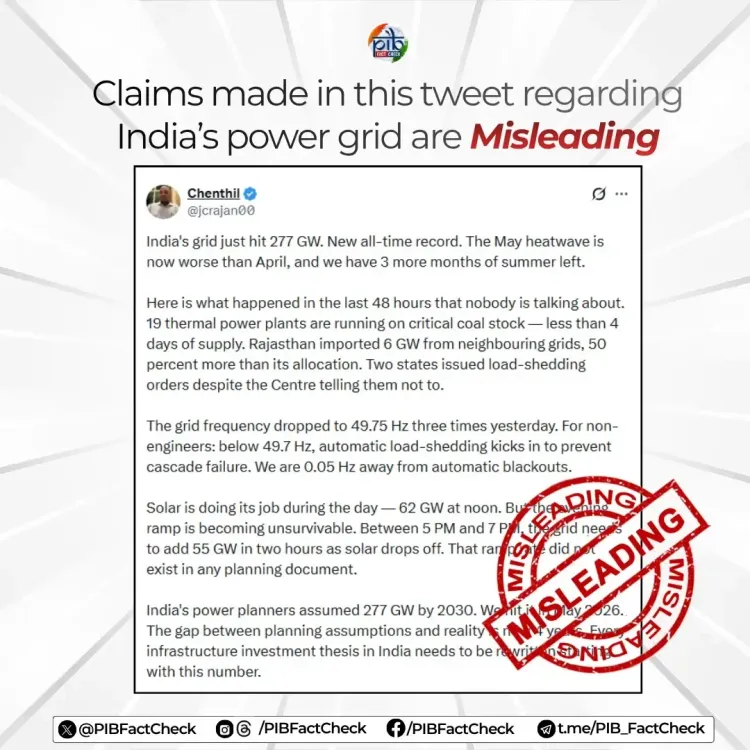
The PIB Fact Check unit on 4 May 2026 dismissed viral social media claims of a severe India power crisis as "misleading" .
Peak power demand of 229 GW recorded on 2 May 2026 was fully met with zero shortfall .
Total coal stock at thermal power plants stands at 53.702 million tonnes , deemed sufficient for operational needs.
Frequency control defence mechanisms are in place to prevent grid instability, cascading failures, or blackouts.
Citizens can report misleading content to PIB via WhatsApp (+91 8799711259) or email (factcheck@pib.gov.in) .
The Press Information Bureau (PIB) Fact Check unit on Sunday, 4 May 2026, dismissed as "misleading" a viral social media post claiming that India was facing a severe power crisis and imminent grid failures due to coal shortages. The government asserted that the country's power system remains fully stable and that peak demand was met without any shortfall.
What the Government Said
According to official data cited by the PIB, the maximum peak power demand recorded on 2 May 2026 stood at 229 GW, and this demand was met entirely without any deficit. Authorities emphasised that there has been no disruption in electricity supply across the country.
The PIB further stated that the total coal stock available with thermal power plants currently stands at 53.702 million tonnes — sufficient to meet operational requirements. The government added that coal supplies are being closely monitored and managed to ensure uninterrupted power generation.
Grid Stability and Frequency Controls
Refuting claims about grid instability and frequency fluctuations, the PIB said that existing frequency control defence mechanisms provide sufficient operational margins to maintain secure grid operations. These systems are designed to automatically stabilise the grid and prevent cascading failures or blackouts.
The statement noted that grid operations, including distribution, are being handled in accordance with well-established protocols, and that robust planning and coordination among various stakeholders have ensured smooth functioning even during periods of high demand.
Summer Demand and Proactive Planning
India typically witnesses a surge in electricity demand during the summer months due to the widespread use of cooling appliances. The government said it has taken proactive measures — including advance fuel stocking and capacity planning — to handle seasonal demand spikes efficiently. This comes amid a broader national push to ensure energy security as temperatures rise across multiple states.
Curbing Misinformation
Officials urged citizens to rely only on verified information and to avoid sharing unsubstantiated claims that could generate unnecessary public panic. The PIB Fact Check unit has encouraged people to report misleading content related to the government through its official WhatsApp number (+91 8799711259) and email (factcheck@pib.gov.in). Notably, this is part of a broader, ongoing effort by the Centre to counter viral misinformation on social media platforms, particularly during high-stakes periods such as election seasons and national emergencies.
With summer demand expected to climb further in the coming weeks, authorities have indicated that supply-side preparedness will continue to be a priority.
Point of View
But it also underscores a growing vulnerability: viral misinformation about critical infrastructure can move markets, trigger hoarding, and erode public trust faster than any official clarification can travel. The PIB Fact Check unit is doing necessary work, yet the deeper question is why such claims find fertile ground. India's power sector has a genuine history of seasonal stress — the 2022 coal crisis was real — which means the public's susceptibility to these narratives is not irrational. Transparency around real-time grid data, made publicly accessible, would do more to inoculate against misinformation than reactive fact-checks alone.
NationPress
3 Oct 2026
Frequently Asked Questions
Is India facing a power crisis in May 2026?
No, according to the PIB Fact Check unit, India is not facing a power crisis. Peak demand of 229 GW on 2 May 2026 was fully met, and coal stocks at thermal power plants stand at 53.702 million tonnes with no supply disruption reported.
What was India's peak power demand on 2 May 2026?
India's maximum peak power demand on 2 May 2026 was 229 GW, and this was met entirely without any deficit, according to official government data cited by the PIB.
How much coal stock do India's thermal power plants have?
Thermal power plants in India currently hold a total coal stock of 53.702 million tonnes, which the government says is sufficient to meet ongoing operational requirements and prevent any disruption to power generation.
What mechanisms prevent grid failures in India?
India's grid is equipped with frequency control defence mechanisms that provide operational margins to automatically stabilise the grid and prevent cascading failures or blackouts, according to the PIB statement.
How can citizens report misleading power-related information?
The PIB Fact Check unit has asked citizens to report misleading government-related content via WhatsApp at +91 8799711259 or by email at factcheck@pib.gov.in.