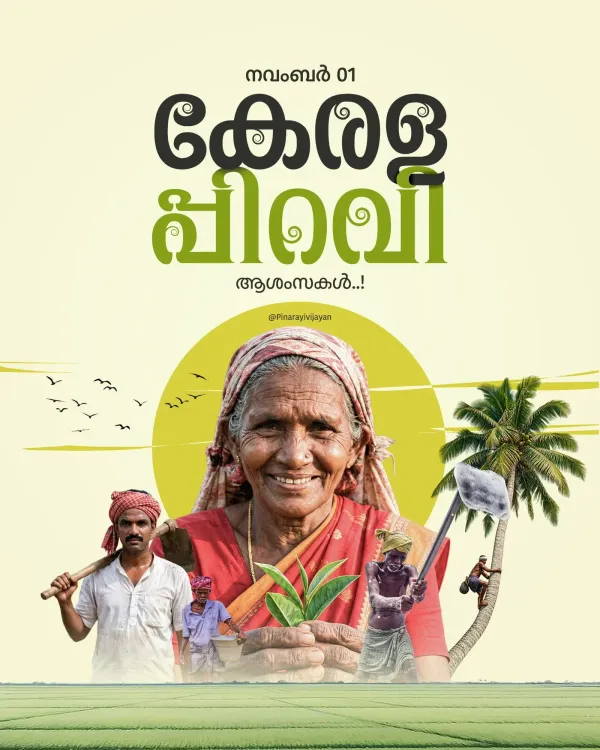
CM Pinarayi greets Kerala on 70th Piravi, invokes secular unity
Synopsis
On Kerala's 70th formation day, Chief Minister Pinarayi Vijayan called Aikya Kerala a realised dream of secularism and fraternity, invoking Renaissance values and left-led reforms, and urged Keralites to resist divisive politics under the Navakeralam banner.
Key Takeaways
Kerala Piravi falls on 1 November , marking the state's formation under the States Reorganisation Act of 1956 on linguistic lines.
CM Pinarayi Vijayan framed the anniversary not merely as a cultural milestone but as a mandate for secularism, brotherhood, and democratic values.
He invoked the Kerala Renaissance and left-led social reforms as twin pillars of the 'Kerala model' that must be carried forward.
The post closes with an explicit call to resist 'the politics of division,' a recurring LDF counter-narrative to communal polarisation.
The hashtag #NavaKeralam ties historical pride to the ruling alliance's current development programme.
Seventy years after a unified Malayalam-speaking state was born from years of mass agitation, Kerala Chief Minister Pinarayi Vijayan marked Kerala Piravi on 1 November 2026 with a message that frames the occasion as far more than a linguistic milestone — it is, he argues, the living proof of a society built on secularism, fraternity, and democratic values.
Writing in Malayalam on X, the Chief Minister offered greetings to all Keralites — 'ഹൃദയം നിറഞ്ഞ കേരളപ്പിറവി ആശംസകൾ' ('heartfelt Kerala Piravi greetings') — before broadening his message into a statement of political philosophy. 'Aikya Kerala is not merely a state founded on our language and culture,' he wrote. 'It is a dream we have realised — of a society that upholds secularism, brotherhood, and democratic values.'
The Aikya Kerala legacy Pinarayi draws on
Kerala came into existence on 1 November 1956 through the States Reorganisation Act, which redrew India's internal boundaries on linguistic lines. The Aikya Kerala movement — a sustained campaign for a unified Malayalam-speaking territory — had spent decades pressing for exactly this outcome, merging Travancore-Cochin with the Malabar coast. The date is observed annually as Kerala Piravi, or the 'birth of Kerala.'
Within a year of formation, Kerala elected the world's first communist government through the ballot box in 1957, ushering in land reforms and a rapid expansion of public education. That early experiment seeded what analysts would later call the 'Kerala model' — unusually high literacy, healthcare, and social development indicators relative to per-capita income — a legacy the Left Democratic Front (LDF) has long claimed as its own inheritance.
Renaissance values and the 'Kerala model' as a political claim
Vijayan's post also invokes the Kerala Renaissance — the 19th-and-20th-century social reform wave led by figures such as Sree Narayana Guru that challenged entrenched caste hierarchies and laid an egalitarian social foundation. He calls on Keralites to carry this combined legacy of Renaissance values and left-led progress 'forward with greater strength.'
The message closes on an explicitly political note: resist 'the politics of division,' he writes, and march together toward a 'developed and progressive Kerala.' The hashtag #NavaKeralam — the LDF government's banner programme for a new phase of development — anchors the post in present-day governance ambition, not just historical memory.
Secularism as a recurring annual counter-narrative
The framing is deliberate and consistent. Each Kerala Piravi, the CPI(M)-led government uses the anniversary to restate its claim as custodian of the state's secular, egalitarian character — positioning the 'Kerala model' as a conscious counter to what LDF leaders describe as communal polarisation elsewhere in India. This year's message from Vijayan sits squarely within that annual tradition, coupling pride in statehood with a warning against divisive politics, and renewing the LDF's promise of a welfare-oriented, progressive path ahead.
As Kerala enters the seventieth year of its existence, the Chief Minister's message is a reminder that the state's founding story is never simply historical — it remains, for the ruling alliance, the most powerful argument for its continued governance.
Point of View
The Renaissance, the 1957 communist government — into a living political argument for the LDF's present governance. By explicitly naming 'the politics of division' as the threat to be resisted, the post stakes out Kerala's secular identity as a contrast to national political trends without naming any opponent directly. The Navakeralam hashtag ensures the message is not purely nostalgic but tethered to a forward-looking policy agenda, reinforcing the LDF's dual claim as both guardian of the past and architect of the future. Ahead of an eventual state election cycle, such annual framing consolidates the ruling alliance's ideological brand among its core progressive and minority-community vote banks.
NationPress
1 Nov 2026
Frequently Asked Questions
What is Kerala Piravi and when is it celebrated?
Kerala Piravi ('birth of Kerala') is celebrated on 1 November every year to mark the formation of the state in 1956 under the States Reorganisation Act, which unified Malayalam-speaking regions into a single state.
What did CM Pinarayi Vijayan say on Kerala Piravi 2026?
Chief Minister Pinarayi Vijayan said Aikya Kerala is not merely a linguistic state but a realised dream of secularism, brotherhood, and democratic values. He called on Keralites to resist divisive politics and march together toward a developed, progressive Kerala.
What is the Aikya Kerala movement?
The Aikya Kerala movement was a sustained campaign by Malayalam-speaking people to unify the regions of Travancore-Cochin and Malabar into a single state. It succeeded with the States Reorganisation Act of 1956 .
What is the Kerala model of development?
The Kerala model refers to the state's unusually high social development indicators — including literacy, healthcare access, and life expectancy — relative to its per-capita income, a pattern shaped by land reforms, public education, and welfare policies from the 1957 communist government onward.
What is Navakeralam?
Navakeralam ('New Kerala') is the banner development programme of the LDF government under Chief Minister Pinarayi Vijayan, aimed at a new phase of infrastructure, social welfare, and economic progress in the state.