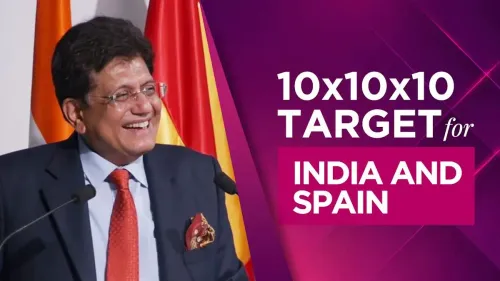
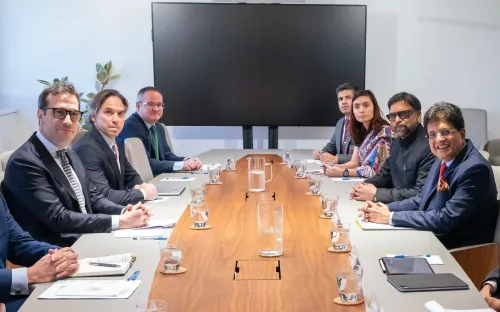
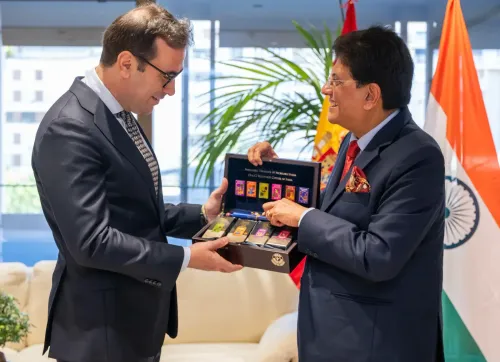
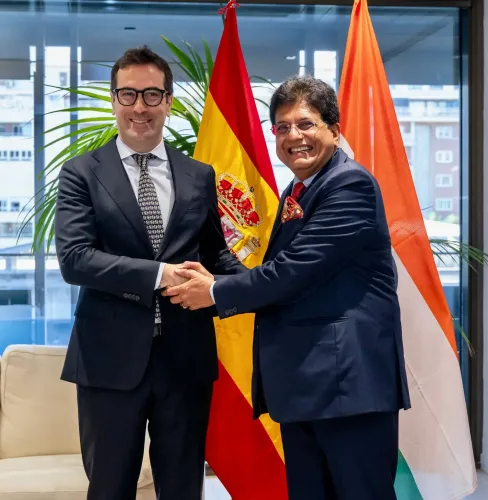
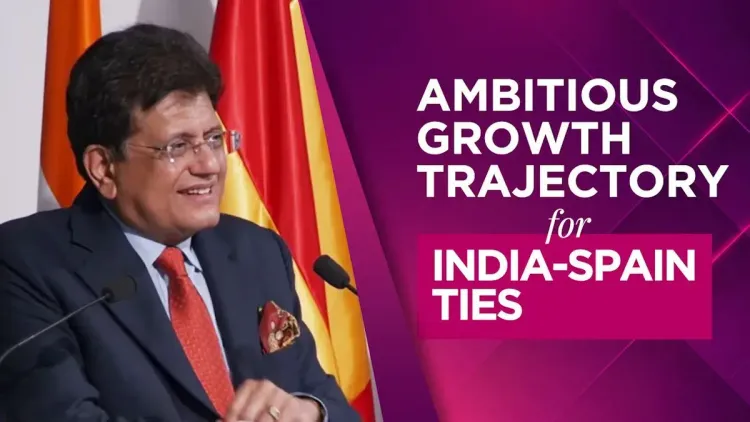
Piyush Goyal flags India-Spain ties in manufacturing, rail, culture
Synopsis
Union Commerce Minister Piyush Goyal on 13 July 2026 outlined eight priority areas — including advanced manufacturing, mobility, railways, sustainability, innovation, arts, science, and culture — for deeper India-Spain bilateral engagement, signalling a comprehensive partnership push.
Key Takeaways
Piyush Goyal on 13 July 2026 publicly identified eight domains for India-Spain collaboration: advanced manufacturing, mobility, railways, sustainability, innovation, arts, science, and culture.
Spain is an EU member with established expertise in high-speed rail, renewable energy, and automotive sectors — areas that align with India's industrial priorities.
India-Spain bilateral ties were last formally elevated during PM Modi's 2017 Madrid visit , which produced agreements on infrastructure and renewable energy.
Spanish firms have previously engaged with India's Dedicated Freight Corridor and high-speed rail feasibility projects.
The engagement fits India's broader strategy of deepening ties with select EU nations to secure technology access and reduce supply-chain dependence.
The India-Spain Joint Economic Commission is the formal mechanism expected to translate these stated priorities into concrete outcomes.
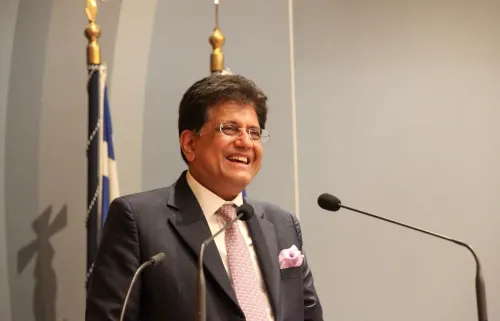
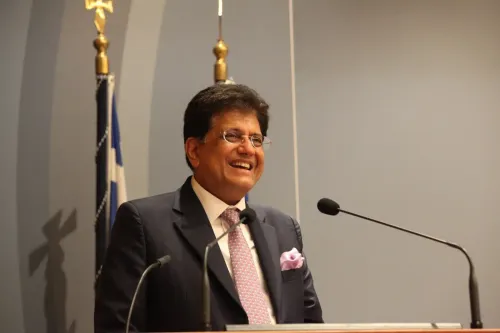
Union Commerce and Industry Minister Piyush Goyal on Monday, 13 July 2026 outlined a broad framework for deeper India-Spain collaboration, citing advanced manufacturing, mobility, railways, sustainability, innovation, arts, science, and culture as priority areas for bilateral engagement.
Context
Minister Goyal's post arrives as India actively works to deepen economic and technological ties with select European Union member states. Spain, an EU economy with established strengths in high-speed rail, renewable energy, and automotive manufacturing, has emerged as a natural partner for New Delhi as it pursues technology access and market diversification.
The minister's enumeration of eight distinct domains — from advanced manufacturing to culture — signals that the engagement is being framed as comprehensive rather than narrowly commercial.
Policy Backdrop
India-Spain bilateral ties received a significant push when Prime Minister Narendra Modi visited Madrid in 2017, yielding agreements on infrastructure, renewable energy, and cultural cooperation. Spanish firms have also participated in India's Dedicated Freight Corridor and high-speed rail feasibility studies, with companies exploring rolling-stock solutions for Indian rail networks.
India's production-linked incentive schemes and its Green Hydrogen Mission align closely with Spain's industrial expertise in clean energy and mobility. Railways, one of the areas Goyal specifically named, has been a recurring thread in India-Spain technical cooperation for over a decade.
Broader India-EU trade negotiations, which resumed formally in 2022 after a near-decade hiatus, provide a multilateral backdrop against which bilateral engagements with individual EU members such as Spain carry added strategic weight.
Stakeholders and Impact
Indian manufacturers stand to benefit from technology partnerships with Spanish firms in sectors such as high-speed rail, wind energy, and automotive components. Spain's strengths complement India's ambitions under schemes designed to boost domestic production in capital-intensive industries.
Spanish technology and infrastructure companies gain access to one of the world's fastest-growing large economies, with particular opportunity in railways modernisation and sustainability projects. Cultural and scientific exchanges — also flagged by Goyal — serve as soft-power anchors that sustain long-term bilateral goodwill alongside commercial agreements.
The explicit mention of arts, science, and culture alongside hard industrial sectors suggests a whole-of-relationship approach, potentially encompassing academic exchanges, museum collaborations, and people-to-people connectivity programmes.
What's Next
Observers will watch for concrete outcomes through the India-Spain Joint Economic Commission, the formal bilateral mechanism for tracking cooperation commitments. Any progress on a bilateral investment facilitation or trade agreement would mark a significant step beyond the existing framework.
With India positioning itself as a global manufacturing hub and Spain seeking to expand its footprint in high-growth Asian markets, the partnership carries the potential to move from stated intent to binding commercial and institutional arrangements in the near term.
Point of View
The minister is framing the India-Spain partnership as strategic rather than transactional, a posture consistent with New Delhi's wider effort to cultivate multiple EU anchors as the India-EU free trade agreement negotiations grind forward. Railways and sustainability stand out as the areas with the most concrete project history, making them the likeliest candidates for near-term deliverables. The inclusion of arts and culture alongside hard industrial sectors suggests India is deploying soft-power tools deliberately to build durable bilateral consensus.
NationPress
14 Jul 2026
Frequently Asked Questions
What areas did Piyush Goyal mention for India-Spain collaboration?
Minister Piyush Goyal cited advanced manufacturing, mobility, railways, sustainability, innovation, arts, science, and culture as priority areas for greater India-Spain collaboration.
What is the current state of India-Spain bilateral relations?
India and Spain maintain growing trade and cultural ties, with a formal push dating to PM Modi's 2017 Madrid visit. Spanish firms have been involved in India's freight corridor and high-speed rail feasibility projects.
How does Spain fit into India's broader European engagement strategy?
Spain is part of India's effort to deepen ties with select EU member states to access advanced technology in areas such as railways, clean energy, and manufacturing, reducing dependence on single-source suppliers.
What is the India-Spain Joint Economic Commission?
The India-Spain Joint Economic Commission is the formal bilateral mechanism through which both countries track and advance cooperation commitments across trade, investment, and technology.
What role does railways play in India-Spain cooperation?
Railways has been a recurring area of India-Spain technical cooperation for over a decade, with Spanish companies exploring rolling-stock solutions and participating in feasibility studies for high-speed rail projects in India.