PM Modi on Constitution Day outlines NDA record, raps obstruction
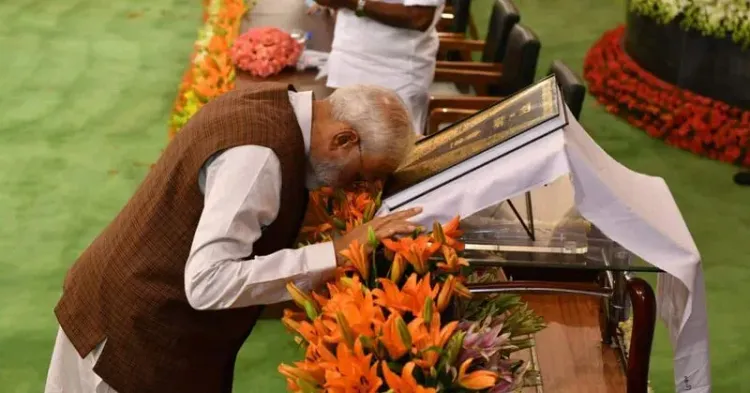
Synopsis
On Constitution Day, Prime Minister Narendra Modi outlined an Op-Ed on the uniqueness of India's charter, the NDA's record on social justice, and a charge that a long-ruling party became an obstructionist force.
Key Takeaways
Prime Minister Narendra Modi on 26 November 2026 flagged an Op-Ed on Constitution Day covering uniqueness of the charter and the Constituent Assembly.
He said the Constitution is an inseparable part of his journey and listed NDA steps to strengthen it and boost social and economic justice.
He accused those who ruled India for five decades of trampling the Constitution.
He said one party had devolved from Virodh Paksh (opposition) to Avrodh Paksh (obstruction).
The Constituent Assembly adopted the Constitution on 26 November 1949 ; the NDA instituted Constitution Day in 2015 .
The government has previously framed the 2019 abrogation of Article 370 as completing Jammu and Kashmir's constitutional integration.
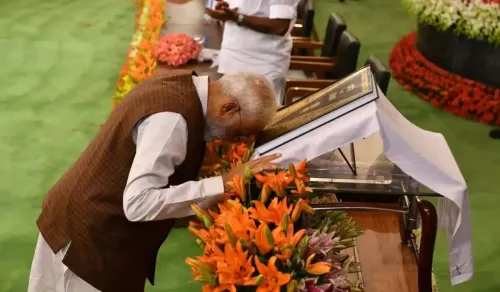
On 26 November 2026 in New Delhi, Prime Minister Narendra Modi marked Constitution Day with an opinion piece that treats India's founding charter as both personal compass and political battlefield. He listed the uniqueness of the Constitution and the Constituent Assembly, credited the NDA with strengthening the text and boosting social and economic justice, and accused those who ruled for five decades of trampling it.
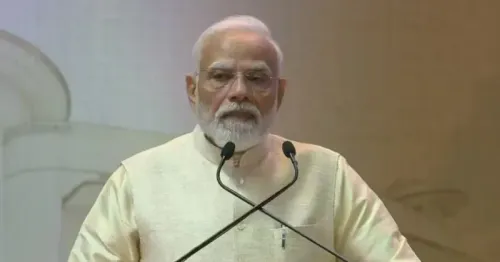
In the post, he said the Op-Ed highlights the uniqueness of the Constitution and Constituent Assembly, how the Constitution of India is an inseparable part of his journey, ways the NDA government has strengthened the Constitution, and efforts towards boosting social and economic justice. He added that he had highlighted 'how the Constitution was trampled over by those who ruled the nation for 5 decades' and 'how one party has devolved from being a Virodh Paksh to Avrodh Paksh'. English and Hindi versions were linked.
Why 26 November sits at the centre of this argument
India's Constituent Assembly sat from 1946 to 1949 and adopted the Constitution on 26 November 1949. The document came into force on 26 January 1950, the date now marked as Republic Day. Constitution Day as a national observance is newer: the NDA government formally instituted it in 2015.
That calendar choice matters. It places the ruling coalition beside the founding moment every year and gives the Prime Minister a fixed platform to contrast post-2014 governance with the Congress-led decades after independence.
The NDA's constitutional record, as the government tells it
Since taking office in 2014, Prime Minister Modi has repeatedly framed constitutional fidelity as central to his political narrative. The 2019 abrogation of Article 370 was presented by the government as completing the constitutional integration of Jammu and Kashmir. Measures on social justice and institutional reform have been cited in the same breath, positioning the BJP as custodian of B.R. Ambedkar's vision.
The themes listed for this year's piece follow that arc: uniqueness of the founding assembly, a personal claim on the text, NDA action on the charter, and a social-and-economic-justice ledger. The post does not enumerate individual laws; it sets the political frame.
From Virodh Paksh to Avrodh Paksh
Virodh Paksh is the Hindi phrase for a parliamentary opposition. Avrodh Paksh twists it into a party of blockage. The contrast points at the Indian National Congress, which led governments for most of the first five decades after independence and now occupies the opposition benches.
The same contrast has run through election campaigns and Independence Day addresses. Opposition parties are likely to answer, and any social-justice or constitutional bill in the winter session will test whether the charge of obstruction sticks or rebounds.
Constitution Day was designed to honour a text. This year the Prime Minister turned it into a question of who may speak in its name — a question that will not stay on a webpage.
Point of View
The 2015 creation of Constitution Day, and the 2019 Article 370 decision are braided into a single claim: that the NDA is completing the founding project rather than bending it for power. The Avrodh Paksh line tries to convert legislative delay into a character charge against the principal opposition. How that lands in the winter session will matter more than the webpage itself.
NationPress
26 Nov 2026
Frequently Asked Questions
When is Constitution Day celebrated in India?
Constitution Day, or Samvidhan Diwas, is observed every year on 26 November, the date the Constituent Assembly adopted the Constitution in 1949. Republic Day on 26 January marks when the Constitution came into force in 1950.
What did PM Modi say on Constitution Day 2026?
In a 26 November 2026 post, Prime Minister Narendra Modi said his Op-Ed covers the uniqueness of the Constitution and Constituent Assembly, his personal link to the charter, NDA steps to strengthen it, social and economic justice, alleged trampling of the Constitution over five decades, and one party's shift from Virodh Paksh to Avrodh Paksh.
What does Avrodh Paksh mean?
Avrodh Paksh is a play on Virodh Paksh, the Hindi term for a parliamentary opposition, and suggests a party that blocks rather than opposes within democratic bounds. Prime Minister Modi used it for one unnamed party, a contrast that points at the Indian National Congress.
When did India start observing Constitution Day?
The NDA government formally instituted Constitution Day observances in 2015. The Constitution itself was adopted on 26 November 1949 and came into force on 26 January 1950.
What was the Constituent Assembly of India?
The Constituent Assembly sat from 1946 to 1949 and drafted and adopted the Constitution of India on 26 November 1949. Prime Minister Modi cited its uniqueness as a central theme of his Constitution Day Op-Ed.