Pradhan Highlights Yuva Sangam's Role in Living NEP 2020
Synopsis
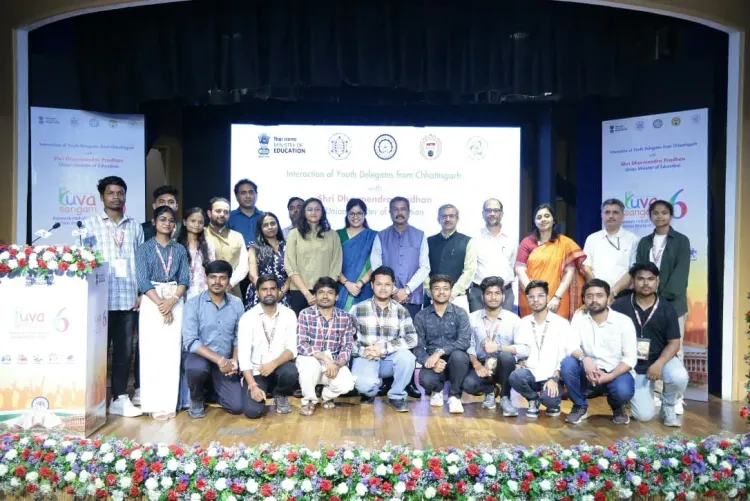
Union Education Minister Dharmendra Pradhan highlighted how Yuva Sangam, the student exchange arm of Ek Bharat Shreshtha Bharat, is translating NEP 2020's experiential learning vision into practice, praising a Chhattisgarh cultural programme and linking youth mobility to the Viksit Bharat 2047 goal.
Key Takeaways
Union Education Minister Dharmendra Pradhan praised a Chhattisgarh -themed cultural programme held under the Yuva Sangam initiative on 11 June 2026 .
Yuva Sangam is the flagship student exchange component of Ek Bharat Shreshtha Bharat , launched in 2023 , pairing students from different states for immersive cultural visits.
Ek Bharat Shreshtha Bharat was formally launched by Prime Minister Modi on 31 October 2015 to promote national integration through state pairings.
National Education Policy 2020 , approved on 29 July 2020 , emphasises experiential and multidisciplinary learning as a departure from rote-based education.
Pradhan linked the programme to the Viksit Bharat 2047 vision, framing youth cultural exchange as a pillar of long-term national development.
The Ministry of Education is expected to announce the next phase of Yuva Sangam pairings ahead of the 2026-27 parliamentary session .
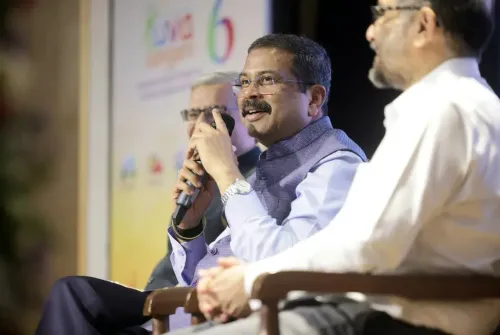
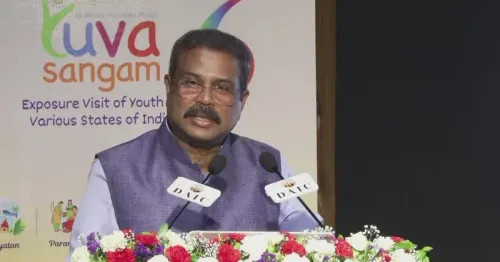
Union Education Minister Dharmendra Pradhan on Thursday, 11 June 2026, praised a cultural programme rooted in Chhattisgarh's heritage that was held as part of the Yuva Sangam initiative, saying young participants had moved beyond textbooks to experience the spirit of the National Education Policy 2020 first-hand.
Context
Posting on X, Minister Pradhan wrote that the cultural programme at the event 'भारत की विविधता में एकता की भावना को सुंदर रूप से प्रदर्शित किया' — 'beautifully showcased the spirit of unity in India's diversity.' He added that through Yuva Sangam, young participants had 'lived' the values of NEP 2020 through experiences rather than merely reading about them. The post was tagged to the official handles of the Ministry of Education and the Ek Bharat Shreshtha Bharat Yuva Sangam programme.
Pradhan further stated that Yuva Sangam is providing youth with 'a wonderful opportunity to understand and connect with different regions of the country,' carrying forward the #EkBharatShreshthaBharat spirit. He linked this to the broader government goal of enabling young Indians to develop their talent, skills, and capabilities under NEP 2020.
Policy Backdrop
Ek Bharat Shreshtha Bharat was formally launched by Prime Minister Narendra Modi on 31 October 2015 as a cultural integration initiative that pairs states to promote mutual understanding among citizens. Yuva Sangam was announced in 2023 as the flagship student exchange component of the programme, sending students from one paired state to visit and experience the culture, geography, and institutions of another.
The National Education Policy 2020, approved by the Union Cabinet on 29 July 2020, replaced the National Policy on Education 1986. A central pillar of NEP 2020 is experiential and multidisciplinary learning — moving students away from rote instruction toward real-world engagement. The Ministry of Education has in successive years directed states to align EBSB activities with these goals, treating youth mobility as both a cultural and a human-capital investment.
Chhattisgarh, a central Indian state known for its tribal heritage and rich folk arts traditions, has been among the states featured in EBSB pairings. The cultural programme praised by Pradhan drew on this heritage to illustrate India's diversity.
Stakeholders and Impact
The primary beneficiaries of Yuva Sangam are college and university students across paired states, who gain immersive exposure to regions they might otherwise never visit. State education departments are responsible for nominating participants and coordinating with the Ministry of Education to operationalise each exchange cohort.
Minister Pradhan invoked the Viksit Bharat 2047 vision — the government's goal of a fully developed India by the centenary of independence — saying that India's 'yuva shakti' (youth power) would 'resolve the problems of India and the world in the coming years and realise the resolve of Viksit Bharat 2047.' This framing positions student exchange and experiential education not merely as cultural enrichment but as instruments of long-term national development.
What's Next
The Ministry of Education is expected to announce the next phase of Yuva Sangam state pairings, with parliamentary updates on NEP 2020 state-level adoption anticipated during the 2026-27 budget session. The pace at which states integrate EBSB activities into their academic calendars will be a key indicator of how deeply the experiential-learning mandate of NEP 2020 is taking root at the ground level. Chhattisgarh's participation in the current cohort may serve as a reference model for other states with strong folk and tribal cultural identities.
Point of View
Coherent youth-development narrative. By invoking Viksit Bharat 2047, the minister signals that student exchange is no longer positioned as a soft cultural initiative but as a measurable input into India's human-capital pipeline. The Chhattisgarh hook also serves a political purpose: it highlights a BJP-governed state's cultural contribution to a national programme, reinforcing Centre-state alignment on the education agenda. For observers tracking NEP 2020 implementation, the frequency of such ministerial endorsements suggests the government is building a communications scaffold around experiential learning to pressure states into faster adoption.
NationPress
26 Oct 2026
Frequently Asked Questions
What is Yuva Sangam and how does it work?
Yuva Sangam is a student exchange programme under the Ek Bharat Shreshtha Bharat initiative, announced in 2023, that sends students from one paired state to visit and experience the culture, institutions, and geography of another state in India.
What is Ek Bharat Shreshtha Bharat?
Ek Bharat Shreshtha Bharat is a cultural integration programme launched by Prime Minister Narendra Modi on 31 October 2015. It pairs Indian states to promote mutual understanding, cultural exchange, and national unity among citizens, especially youth.
How is Yuva Sangam connected to NEP 2020?
NEP 2020 emphasises experiential and multidisciplinary learning beyond textbooks. The Ministry of Education has aligned Yuva Sangam with these goals, using cross-state student visits as a practical instrument for the experiential education mandate outlined in the policy.
What is Viksit Bharat 2047?
Viksit Bharat 2047 is the Indian government's vision for a fully developed nation by 2047, the centenary of independence. Education Minister Pradhan has framed youth skilling and cultural exchange programmes as building blocks toward achieving this goal.
What role does Chhattisgarh play in the Yuva Sangam programme?
Chhattisgarh, known for its tribal heritage and folk arts, has been featured as a paired state in EBSB exchanges. A cultural programme based on Chhattisgarh's traditions was highlighted by Minister Pradhan as an example of how the programme showcases India's unity in diversity.