Pradhan at Bhopal Sammelan: 12 Years of Modi Govt Milestones
Synopsis
Union Education Minister Dharmendra Pradhan joined Madhya Pradesh CM Mohan Yadav and BJP state president Hemant Khandelwal at a Bhopal sammelan marking 12 years of the Modi government, highlighting education expansion, women's empowerment schemes, and the Viksit Bharat 2047 vision.
Key Takeaways
The Viksit Bharat Sankalp Sammelan was held at Kushabhau Thakre Auditorium, Bhopal on 13 June 2026 , organised by BJP Madhya Pradesh .
Union Education Minister Dharmendra Pradhan , MP CM Dr Mohan Yadav , and BJP MP President Hemant Khandelwal were among the key attendees.
The event marked 12 years of the Modi government , framed around welfare for the poor, education expansion, and national integration milestones.
Pradhan highlighted growth in IITs, AIIMS, and medical colleges and rising participation of girls in STEM and startups as key achievements.
The Lakhpati Didi initiative and Article 370 abrogation and Ram Mandir construction were cited as defining milestones of the 12-year period.
The sammelan is part of the BJP's ongoing outreach toward the #ViksitBharat 2047 developed-nation goal.
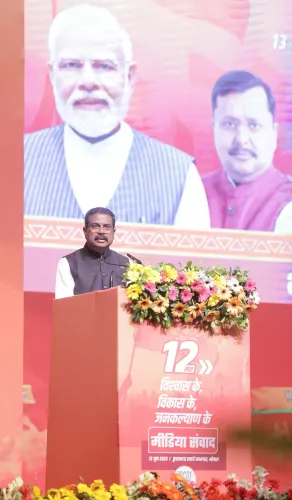
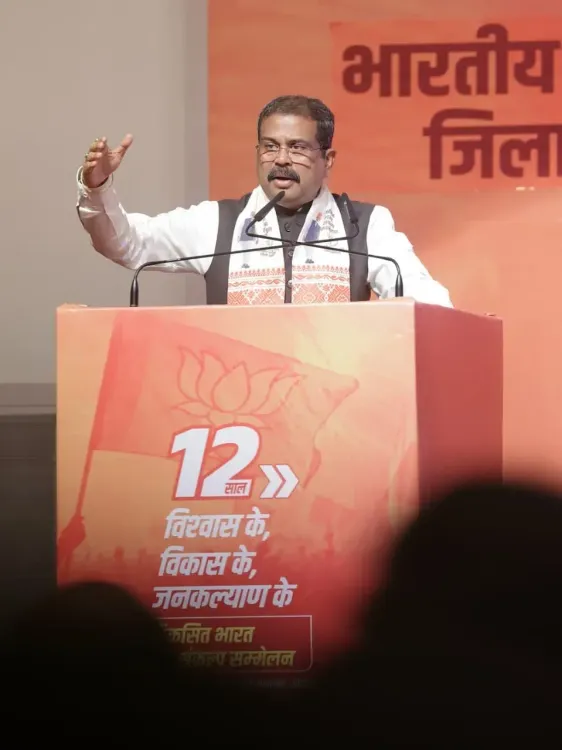
Union Education Minister Dharmendra Pradhan addressed the 'Viksit Bharat Sankalp Sammelan' organised by BJP Madhya Pradesh at Kushabhau Thakre Auditorium, Bhopal, on Saturday, 13 June 2026, marking 12 years of the Narendra Modi-led government's welfare and governance record. The event was also attended by Madhya Pradesh Chief Minister Dr Mohan Yadav and BJP Madhya Pradesh President Hemant Khandelwal, among other senior leaders.
Context
Pradhan's post, written in Hindi, described the sammelan as a celebration of 'garīb kalyāṇ aur jan kalyāṇ ke 12 varṣoṃ kī gauravpūrṇa yātrā' — 'a glorious 12-year journey of welfare for the poor and the people.' He framed the past decade-plus as a transition from 'instability and mistrust' to new heights of development and public welfare, anchored in the BJP's governing motto 'Sabka Saath, Sabka Vikas, Sabka Vishwas aur Sabke Prayas' ('Together with all, development for all, trust of all, and effort of all').
The Bhopal gathering is part of a wider pattern of state BJP units organising high-profile events to link local outreach with the national Viksit Bharat 2047 vision — the government's long-term goal of achieving developed-nation status by the centenary of Indian independence.
Policy Backdrop
Pradhan highlighted expansion in higher education and healthcare infrastructure, pointing to a notable increase in the number of IITs, AIIMS, and medical colleges over the past 12 years as evidence of new opportunities created for the youth. While precise figures were not cited in the post, multiple new IITs and AIIMS were approved and established between 2015 and 2022, significantly expanding seats in premier technical and medical institutions.
The minister also referenced the Lakhpati Didi initiative — a women's economic empowerment programme under DAY-NRLM aimed at enabling rural self-help group members to earn an annual income of at least one lakh rupees — and growing participation of girls in STEM education and the startup ecosystem as markers of progress toward an Aatmanirbhar Bharat (self-reliant India).
Pradhan additionally cited the abrogation of Article 370 in August 2019, which ended Jammu and Kashmir's special constitutional status, and the construction and inauguration of the Ram Mandir in Ayodhya in January 2024 — following the 2019 Supreme Court verdict — as landmark decisions reflecting the government's political will. The National Education Policy (NEP) 2020, approved in July 2020, was part of the same broader reform arc, introducing multidisciplinary education and early childhood care frameworks.
Stakeholders and Impact
Pradhan's address explicitly named four key constituencies the government claims to have served: women (nari shakti), farmers (kisaan), youth (yuva), and labourers (shramik). He said each of these groups has become a participant in the 'development journey,' with the Viksit Bharat Sankalp Yatra — launched in November 2023 — having been designed to saturate awareness and delivery of central welfare schemes at the district level across India.
The event in Bhopal served as a state-level anchor for this narrative, with the presence of Chief Minister Dr Mohan Yadav underlining Madhya Pradesh's role in executing central education, health, and rural development programmes. The sammelan format allows the BJP to consolidate its governance record ahead of the 2029 general election cycle.
What's Next
Additional state-level Viksit Bharat Sankalp events are expected across BJP-governed states as the party continues to build a 12-year governance narrative. Key milestones to watch include further IIT and AIIMS seat expansions or new medical-college approvals in the next Union Budget, progress on NEP 2020 implementation, and the government's Lakhpati Didi targets — all of which will be central to the BJP's outreach as the country moves toward the #ViksitBharat 2047 goal.
Point of View
Women's empowerment, and constitutional decisions such as the Article 370 abrogation reflects the party's dual-track messaging: welfare delivery for the poor and decisive action on long-standing ideological commitments. The Viksit Bharat 2047 framing gives the BJP a forward-looking anchor that extends the political conversation well beyond any single electoral cycle. Whether these milestones translate into voter consolidation in a state like Madhya Pradesh — where the BJP retained power in late 2023 — will depend on how effectively scheme delivery reaches the last mile.
NationPress
24 Sept 2026
Frequently Asked Questions
What is the Viksit Bharat Sankalp Sammelan held in Bhopal?
The Viksit Bharat Sankalp Sammelan in Bhopal was an event organised by BJP Madhya Pradesh on 13 June 2026 at Kushabhau Thakre Auditorium to mark 12 years of the Modi government's welfare and governance record, attended by Union Minister Dharmendra Pradhan, CM Mohan Yadav, and BJP state president Hemant Khandelwal.
What is the Viksit Bharat 2047 vision?
Viksit Bharat 2047 is the Indian government's long-term national goal to achieve developed-country status by 2047, the centenary of Indian independence, promoted through central and state-level outreach events and welfare scheme saturation drives.
What is the Lakhpati Didi scheme?
Lakhpati Didi is a women's economic empowerment initiative under the DAY-NRLM programme that aims to help rural self-help group members earn an annual income of at least one lakh rupees, cited by Pradhan as a key milestone of the Modi government's 12-year record.
How many IITs and AIIMS were set up under the Modi government?
Multiple new IITs and AIIMS were approved and established between 2015 and 2022, significantly expanding seats in premier technical and medical institutions, though exact figures were not specified in Pradhan's post and precise numbers remain unverified.
What is Dharmendra Pradhan's role in the BJP government?
Dharmendra Pradhan is the Union Minister of Education in the Modi government, a senior BJP leader, and a former Union Petroleum Minister who has been a key voice on education policy, including the rollout of the National Education Policy 2020.