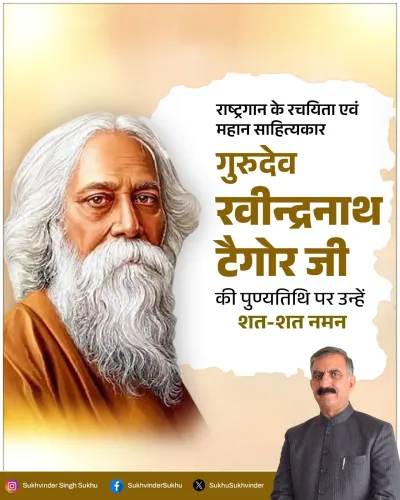
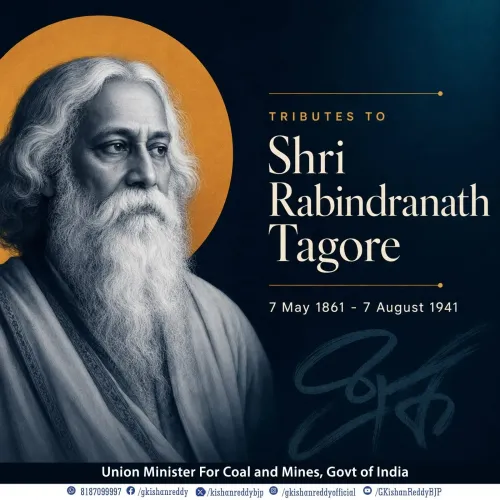
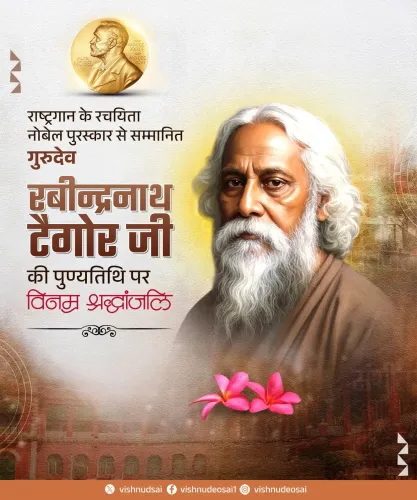
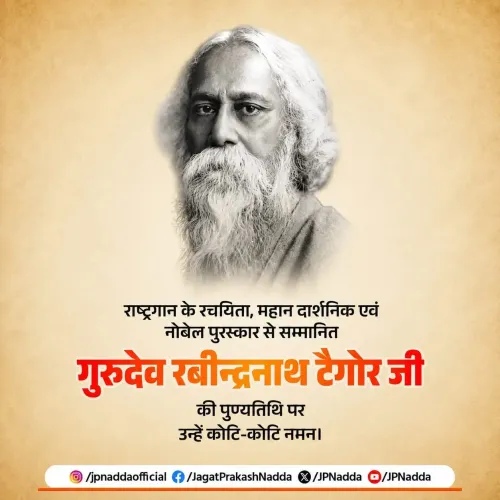
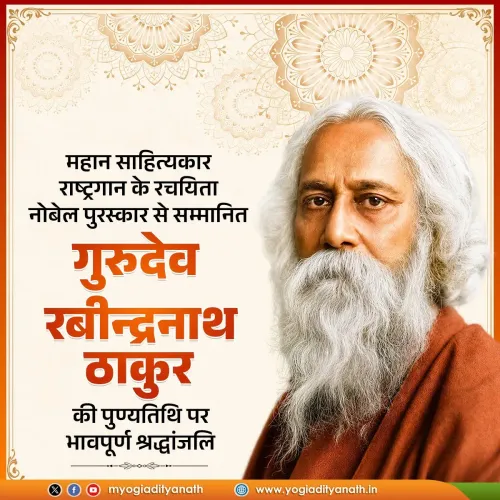
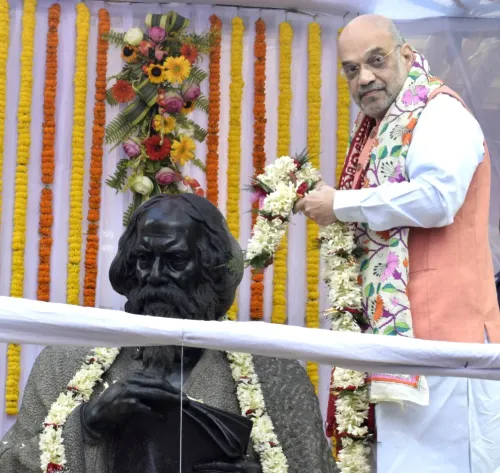
Pradhan pays tribute to Tagore on death anniversary
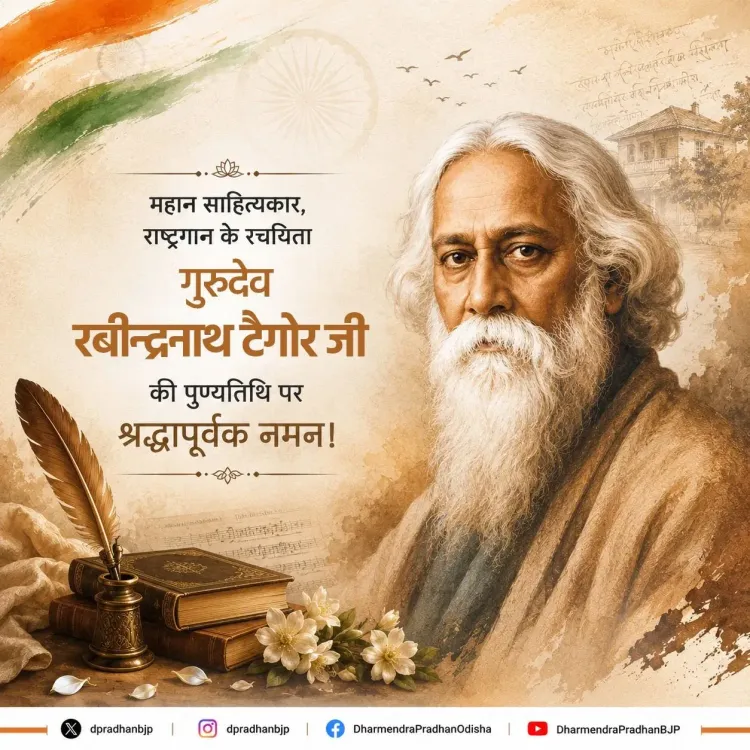
Synopsis
Union Education Minister Dharmendra Pradhan honoured Rabindranath Tagore on his death anniversary, praising the Nobel laureate's philosophy of life-linked education and his role in expressing India's cultural soul — themes that resonate with the ongoing rollout of NEP 2020.
Key Takeaways
Dharmendra Pradhan paid tribute to Rabindranath Tagore on his death anniversary on 7 August 2026 .
Tagore composed India's national anthem Jana Gana Mana and won the Nobel Prize in Literature in 1913 .
He founded an experimental school at Shantiniketan in 1901 , which became Visva-Bharati University in 1921 .
Pradhan specifically highlighted Tagore's concept of linking education to life as 'equally relevant today.' The tribute aligns thematically with the Ministry of Education's implementation of National Education Policy 2020 , which draws on experiential and holistic learning traditions.
On the death anniversary of Rabindranath Tagore, Union Education Minister Dharmendra Pradhan offered a solemn tribute to the poet-philosopher who gave India its national anthem and a vision of education that still challenges the status quo. The homage, posted on 7 August 2026, was brief in words but dense in implication — coming from the minister overseeing the country's most sweeping education reform in decades.
Pradhan described Tagore as the composer of the national anthem, a kavi-guru (poet-sage) who 'gave expression to the soul of India through his creativity and ideas.' He noted that Tagore's works carry a rare convergence of patriotism, human sensitivity, nature and spiritual consciousness — and that his concept of linking education to life remains 'equally relevant today.'
The philosopher who built a school under the open sky
Tagore's educational legacy is not metaphor — it is brick, mortar and curriculum. In 1901 he founded an experimental school at Shantiniketan, West Bengal, rooted in the belief that learning divorced from nature and lived experience is learning half done. That school grew into Visva-Bharati University in 1921, an institution that became a global symbol of India's intellectual confidence before independence. Tagore's Nobel Prize in Literature in 1913 — the first awarded to an Asian — amplified that vision to the world.
His philosophy was radical for its time: classrooms outdoors, arts woven into academics, Indian cultural traditions placed alongside Western thought rather than beneath it. Visva-Bharati still carries that DNA, and it sits, not coincidentally, under the administrative oversight of the Ministry of Education.
Why an Education Minister's tribute carries extra weight
Annual tributes to Tagore from education ministers are a fixture of India's public calendar. But Pradhan's invocation carries a specific resonance in the era of the National Education Policy 2020, which his ministry has been implementing. NEP 2020 explicitly draws on indigenous pedagogical traditions — experiential learning, mother-tongue instruction, holistic development — ideas Tagore championed a century before any policy document named them. When Pradhan calls Tagore's concept of life-linked education 'equally relevant today,' he is, at minimum, pointing at the same north star his ministry claims to follow.
Tagore's insistence on the global spread of Indian culture also finds an echo in contemporary policy discourse around soft power and the internationalisation of Indian higher education — another active Ministry of Education priority.
A poet who died in 1941 still shapes the language of India's education debate. That, more than any ministerial tribute, is the measure of his relevance.
Point of View
Tagore — universalist, Nobel laureate, composer of the national anthem — is a rare figure who bridges ideological divides and lends civilisational legitimacy to policy priorities. The tribute is unlikely to generate political friction, but it quietly reinforces the ministry's narrative that modern education reform is a continuation of India's own philosophical heritage.
NationPress
21 Sept 2026
Frequently Asked Questions
Why is Rabindranath Tagore's death anniversary observed on 7 August?
Rabindranath Tagore passed away on 7 August 1941 , and his death anniversary — known as Rabindra Tirohaan — is observed annually on this date with tributes from cultural, literary and government circles across India.
What did Dharmendra Pradhan say about Rabindranath Tagore?
Pradhan described Tagore as the composer of India's national anthem and a poet-sage who gave expression to the soul of India, praising his convergence of patriotism, human sensitivity, nature and spiritual consciousness, and calling his vision of life-linked education equally relevant today.
What is Rabindranath Tagore's connection to Indian education?
Tagore founded an experimental school at Shantiniketan in 1901 based on the philosophy of linking education to life and nature. It evolved into Visva-Bharati University in 1921 , which remains one of India's most distinctive institutions of higher learning.
How is Tagore's educational philosophy connected to NEP 2020?
The National Education Policy 2020 emphasises experiential learning, holistic development and mother-tongue instruction — principles Tagore championed a century earlier at Shantiniketan, making him a frequently cited philosophical ancestor of India's current education reform.
What Nobel Prize did Rabindranath Tagore win?
Tagore won the Nobel Prize in Literature in 1913 , becoming the first Asian to receive the award, largely recognised for his poetry collection Gitanjali .