Is PRAGATI Steering the Timely Execution of Mega Projects in J&K?
Click to start listening
Synopsis
Discover how the PRAGATI initiative is transforming Jammu and Kashmir's development landscape! Chief Secretary Atal Dulloo reveals the impressive outcomes of this platform driving mega projects, fostering collaboration, and resolving long-standing issues. This article delves into the significant advancements and future outlook for the region's infrastructure.
Key Takeaways
- PRAGATI is a transformative governance initiative in J&K.
- Over 61 projects are currently under monitoring.
- The Udhampur-Srinagar-Baramulla Rail Link has received renewed focus.
- Completion of 15 major projects has already been achieved.
- Collaboration between departments is key to project success.
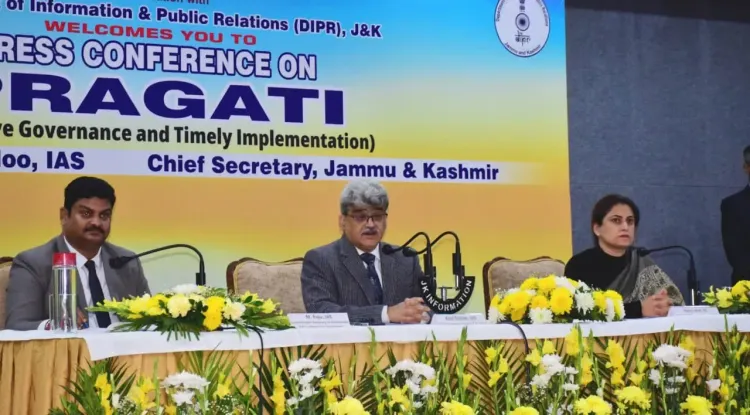
Jammu, Jan 5 (NationPress) The Chief Secretary of Jammu and Kashmir, Atal Dulloo, announced on Monday that the Pro-Active Governance and Timely Implementation (PRAGATI) initiative is significantly facilitating the advancement of large-scale projects in the region.
He emphasized the transformative influence of the PRAGATI platform in accelerating major development initiatives throughout J&K, asserting that it serves as a crucial tool for addressing long-standing challenges and guaranteeing the prompt execution of large-scale endeavors.
During a press conference, the Chief Secretary highlighted the importance of PRAGATI@50, remarking that this technology-based governance system has effectively initiated numerous projects that had been delayed for years due to inter-departmental obstacles and procedural hold-ups.
As a notable case, he referenced the Udhampur-Srinagar-Baramulla Rail Link (USBRL) project, which, despite being launched in 1995, had seen little advancement for almost 25 years.
“After being prioritized under PRAGATI for close oversight, the project gained significant traction due to improved inter-departmental collaboration and direct involvement from the highest levels, including the Prime Minister,” he stated.
He shared that all projects exceeding an investment of Rs 500 crore are under the scrutiny of the Prime Minister’s Group (PMG), led by the Cabinet Secretary, while the most critical projects are directly evaluated by the Prime Minister in PRAGATI meetings.
Further elaborating, the Chief Secretary mentioned that the PMG is currently overseeing 61 projects in Jammu and Kashmir, with a total investment exceeding Rs 4.12 lakh crore, covering essential sectors such as connectivity, energy, and social infrastructure.
Among these, 15 projects with a budget of Rs 69,000 crore have been finalized, while the others are in various stages of progress.
He specifically noted that 15 major projects are under the direct observation of the Prime Minister via the PRAGATI platform, facilitating swift resolutions of challenges related to land acquisition, financial issues, and ensuring timely compensation for affected families.
The Chief Secretary indicated the impressive efficacy of this mechanism, revealing that out of 59 issues concerning J&K discussed in previous PRAGATI meetings, 57 have been resolved, positioning the union territory among the top performers nationally, supported by diligent district-level follow-ups by the administration.
On the tangible results achieved, he mentioned that six high-impact projects worth approximately Rs 53,000 crore have been completed in Jammu & Kashmir under PRAGATI monitoring. These projects include the Udhampur–Srinagar–Baramulla Rail Link, the Kishanganga Hydroelectric Project with its transmission line, AIIMS Jammu, the challenging Banihal segment of NH-44, and the Alsteng–Kargil–Khaltse–Leh transmission line.
Additionally, he noted that nine more projects being tracked under PRAGATI are advancing well. This includes the Delhi–Amritsar–Katra Expressway Corridor, AIIMS Awantipora, the Pakul Dul Hydroelectric Project, the expansion of 4G mobile connectivity under USOF, and various energy and connectivity projects throughout the union territory.
In closing the briefing, the Chief Secretary reaffirmed the government's dedication to fully executing the directives issued via the PRAGATI mechanism at the Union Territory level.
He stressed that by capitalizing on this platform, the UT is on track to maintain its current momentum, ensuring that all development initiatives are results-driven and completed within their designated timelines.
The press conference was attended by several senior officials including the Commissioner Secretary of Information, M. Raju; Director Information, Nitish Rajora; Director of PIB Jammu, Neha Jalali; Joint Director Information Headquarters, Zahoor Ahmad Raina; Joint Director Information Jammu, Deepak Dubey, and other dignitaries from the Directorate of Information and Public Relations (DIPR).
Point of View
The proactive measures taken under the PRAGATI initiative highlight a commendable approach towards governance and infrastructure development. The focused oversight and direct involvement of leadership in resolving critical issues reflect a robust commitment to enhancing the quality of life in Jammu and Kashmir.
NationPress
06/01/2026
Frequently Asked Questions
What is PRAGATI?
PRAGATI stands for Pro-Active Governance and Timely Implementation, a governance initiative aimed at expediting the execution of major projects in Jammu and Kashmir.
How many projects are monitored under PRAGATI?
Currently, 61 projects with a cumulative investment of over Rs 4.12 lakh crore are being monitored under the PRAGATI initiative.
What is the significance of the USBRL project?
The Udhampur-Srinagar-Baramulla Rail Link is a key infrastructure project that faced delays for decades but has gained momentum under the PRAGATI platform.
What are the key sectors affected by PRAGATI?
Key sectors impacted by PRAGATI include connectivity, energy, and social infrastructure, contributing to the overall development of Jammu and Kashmir.
How does PRAGATI ensure timely execution of projects?
PRAGATI facilitates enhanced inter-departmental coordination and involves direct monitoring by the Prime Minister, helping resolve issues quickly and efficiently.