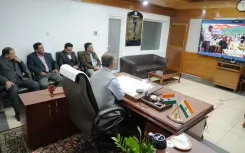
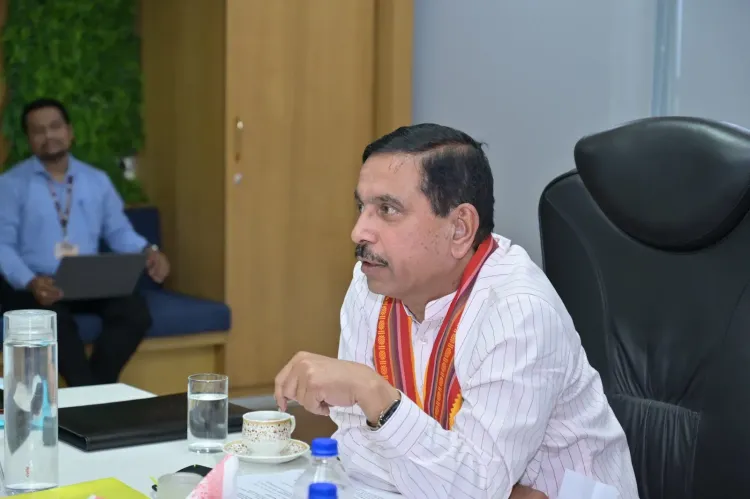
Pralhad Joshi chairs IIT Dharwad review, eyes Viksit Bharat
Synopsis
Union Minister Pralhad Joshi chaired a review meeting at IIT Dharwad on 24 October 2026, highlighting the institute's world-class infrastructure and its growing role as a hub for innovation and regional development in North Karnataka under the Viksit Bharat vision.
Key Takeaways
Union Minister Pralhad Joshi chaired a review meeting at IIT Dharwad on 24 October 2026 to assess academic progress, research initiatives, and infrastructure development.
IIT Dharwad was established in 2016 as one of six new IITs announced to expand premier technical education to non-metro regions of India.
The minister linked the institution's growth directly to the central government's Viksit Bharat vision of a developed India by 2047 .
IIT Dharwad is described as rapidly emerging as a hub for innovation, entrepreneurship, and regional growth in North Karnataka .
Joshi credited Prime Minister Narendra Modi 's leadership for 'unprecedented momentum' in India's technical education sector.
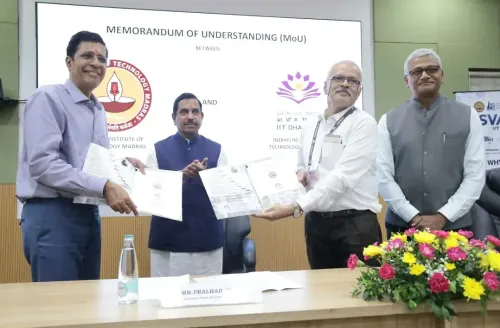
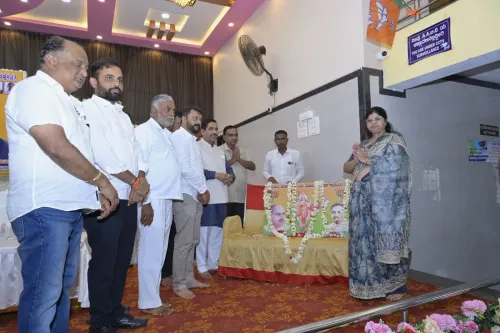
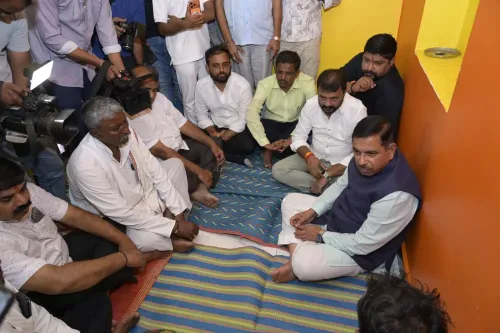
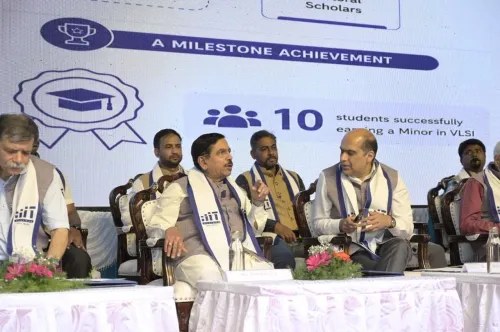
A top Union Minister walked into IIT Dharwad's green campus on Saturday, 24 October 2026 and sat down for a hard look at how far the institution has come — and how much further it needs to go. Union Minister Pralhad Joshi, who represents the Dharwad constituency in Parliament, chaired a review meeting covering the institute's academic progress, research initiatives, and infrastructure development.
Posting in both Kannada and English, Joshi framed the visit squarely within the government's larger ambition: 'ವಿಕಸಿತ ಭಾರತದ ಕನಸನ್ನು ನನಸಾಗಿಸುವಲ್ಲಿ ಉನ್ನತ ಶಿಕ್ಷಣ ಸಂಸ್ಥೆಗಳ ಪಾತ್ರ ಅತ್ಯಂತ ಪ್ರಮುಖವಾಗಿದೆ' — 'To realise #ViksitBharat, premier institutions play a crucial role.' The message was pointed: IIT Dharwad is not just an engineering college, it is a strategic lever for North Karnataka's transformation.
From a six-IIT expansion to a regional innovation hub
IIT Dharwad was established in 2016 as one of six new Indian Institutes of Technology announced by the central government to spread premier technical education beyond India's traditional metros. The decision was deliberate — put a world-class institution in a region that had historically been on the periphery of Karnataka's development story. A decade on, the institute has built out world-class infrastructure, a green campus, and state-of-the-art laboratories, according to Joshi's post.
The minister described the institution as 'rapidly emerging as a hub for innovation, entrepreneurship, and regional growth' — language that maps directly onto the Centre's stated blueprint of using IITs as anchors for local economic ecosystems. Successive Union Budgets have directed continued funding toward new IITs for exactly this purpose: regional equity in higher education and human capital formation outside the metro belt.
North Karnataka's long wait for a seat at the table
North Karnataka has historically trailed the southern districts of the state in educational infrastructure and investment. The presence of an IIT in Dharwad — Joshi's own constituency — is therefore both a policy win and a political signal. The minister's emphasis on 'holistic development' and 'a fresh dimension' for the region underlines the argument that institutional investment, not just industrial policy, is what lifts a region's long-term trajectory.
The review meeting itself — assessing academic output, research pipelines, and development milestones — is consistent with how the Centre has sought to hold newer IITs accountable as they mature past their founding phase. The students and researchers of North Karnataka are the most direct stakeholders; the broader innovation ecosystem — startups, industry tie-ups, and local talent pipelines — stands to gain as the institute deepens its footprint.
As India's 2047 Viksit Bharat deadline draws the policy conversation forward, every IIT review like this one is a checkpoint. The question is no longer whether these institutions can be built — they have been. The question is whether they can be scaled into genuine engines of regional transformation before the deadline arrives.
Point of View
The optics of personally chairing a progress review reinforce the political ownership of a nationally funded institution. The Viksit Bharat framing is also significant: by anchoring the IIT narrative to a 2047 deadline, the government converts routine institutional oversight into a forward-looking, mission-driven story. The real test will come in measurable research output, startup formation rates, and industry partnerships from North Karnataka — metrics that will either validate or complicate the rhetoric.
NationPress
24 Oct 2026
Frequently Asked Questions
When was IIT Dharwad established?
IIT Dharwad was established in 2016 as one of six new Indian Institutes of Technology approved by the central government to expand access to premier technical education across different states.
Why did Pralhad Joshi visit IIT Dharwad?
Union Minister Pralhad Joshi chaired a review meeting at IIT Dharwad on 24 October 2026 to assess the institute's academic progress, research initiatives, and development, framing it as part of the Viksit Bharat vision.
What is Viksit Bharat and how does IIT Dharwad relate to it?
Viksit Bharat is the Indian government's vision for a fully developed India by 2047 . Joshi's post positions IIT Dharwad as a key institution helping realise this goal by training future technology leaders and spurring innovation in North Karnataka .
What is IIT Dharwad known for?
IIT Dharwad is known for its world-class infrastructure, green campus, and state-of-the-art laboratories. It is rapidly being recognised as a hub for innovation, entrepreneurship, and regional development in North Karnataka .
How is the central government supporting new IITs?
The central government has directed continued funding toward new IITs, including IIT Dharwad , through successive Union Budgets with the goal of promoting regional equity in higher education and developing local innovation ecosystems.