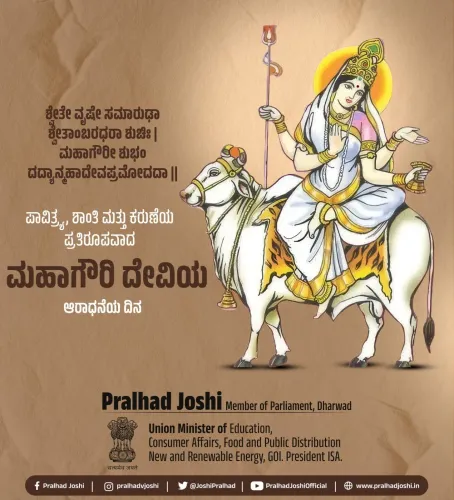
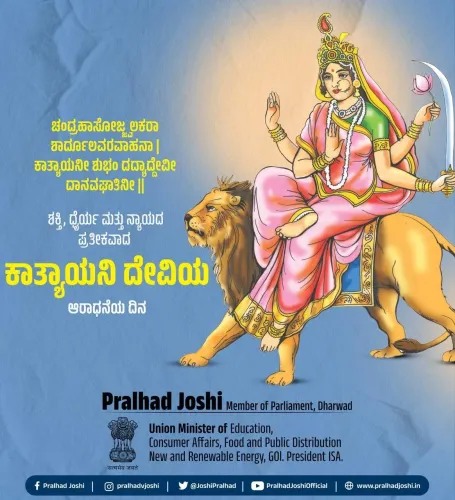
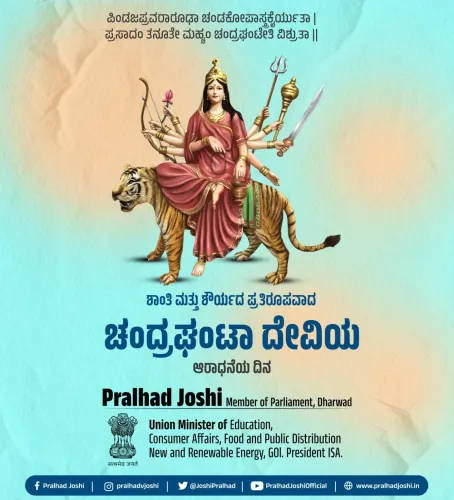
Pralhad Joshi extends Dasara and Vijayadashami wishes
Synopsis
Union Minister Pralhad Joshi marked Vijayadashami 2026 with a Kannada post invoking Goddess Narayani and celebrating Dasara as the festival of dharma's triumph over adharma, calling on all to exchange banni and stand together like gold.
Key Takeaways
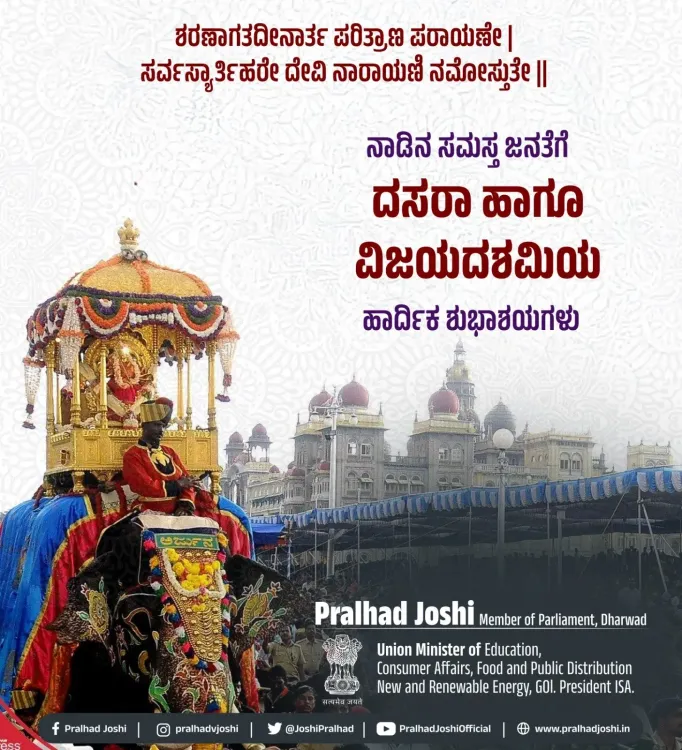
Union Minister Pralhad Joshi posted Dasara and Vijayadashami greetings in Kannada on October 20, 2026 .
He opened with a Sanskrit shloka from the Devi Mahatmya saluting Goddess Narayani as protector of the suffering.
Vijayadashami is described as the day marking victory of dharma over adharma , truth over falsehood, and light over darkness.
He used the traditional Kannada Dasara idiom of banni exchange , urging unity and goodwill.
Dasara is Karnataka's premier cultural festival, culminating in the famous Mysuru procession on Vijayadashami.
On the morning of Vijayadashami 2026, Union Minister Pralhad Joshi invoked the divine with a Sanskrit shloka before extending warm festival greetings to the people of Karnataka — blending devotion, cultural pride, and the age-old promise of light over darkness.
Posting in Kannada on October 20, 2026, Joshi opened with the verse 'Sharanagata dinaarta paritraana paraayane | Sarvasya aartihare devi Naaraayani namostute' — a salutation to Goddess Narayani as the protector of the surrendered and the suffering, drawn from the Devi Mahatmya. He then addressed all citizens of the state, writing that Vijayadashami is 'the sacred day that proclaims the victory of dharma over adharma, truth over falsehood, and light over darkness.'
Karnataka's most celebrated festival, in the minister's own words
Joshi expressed hope that the Dasara celebrations — which he described as upholding the state's rich culture, heritage, and pride — would bring 'new enthusiasm and vitality to everyone's lives.' He signed off with a warm Kannada idiom: 'Naavu-neevu banni togond bangaaradangu iroona' — 'Let us all come together and be like exchanged gold' — a traditional Dasara custom of exchanging the auspicious banni (Shami) leaves as a symbol of goodwill.
Dasara holds a singular place in Karnataka's cultural calendar. The festival, observed across ten days of Navaratri, reaches its peak on Vijayadashami with the grand Mysuru Dasara procession — one of India's most iconic state celebrations — featuring a caparisoned elephant carrying the golden howdah through the streets of the royal city.
Why Vijayadashami resonates beyond the ritual
Across India, Vijayadashami marks the day Lord Rama defeated Ravana and, in the eastern tradition, the day Goddess Durga slew the demon Mahishasura. In Karnataka specifically, the Mysore royal family's centuries-old tradition of Dasara turned a religious occasion into a statement of statecraft and cultural identity — a legacy that the state continues to celebrate with full official pageantry.
Senior political leaders routinely mark Dasara with public greetings, but Joshi's choice to open with a Sanskrit devotional verse and close with a distinctly Kannada folk idiom underlines his Karnataka roots. As a BJP senior from Hubli-Dharwad, his dual identity as a Union Minister and a proud Kannadiga shapes both the language and the register of such posts.
As the banni leaves change hands across Karnataka today, the festival's ancient message — that good ultimately prevails — finds its annual, luminous renewal.
Point of View
These seasonal posts serve as low-stakes, high-visibility affirmations of cultural belonging. The use of the regional language also signals that federal ministers are expected to maintain local-language visibility ahead of state political cycles.
NationPress
20 Oct 2026
Frequently Asked Questions
What did Pralhad Joshi post on Vijayadashami 2026?
Union Minister Pralhad Joshi posted Dasara and Vijayadashami greetings in Kannada on October 20, 2026, opening with a Sanskrit shloka honouring Goddess Narayani and closing with a traditional Kannada banni-exchange idiom calling for unity.
What is the significance of Vijayadashami in Karnataka?
Vijayadashami is the final and most auspicious day of Navaratri, celebrating the triumph of good over evil. In Karnataka it is marked by the grand Mysuru Dasara procession, one of India's most famous cultural events, featuring a royal elephant carrying a golden howdah.
What does the Sanskrit shloka Joshi quoted mean?
The shloka — 'Sharanagata dinaarta paritraana paraayane, Sarvasya aartihare devi Naaraayani namostute' — is from the Devi Mahatmya and means: 'O Goddess who is devoted to protecting those who have surrendered and are suffering, who removes the pain of all, O Devi Narayani, salutations to you.'
What is the banni exchange tradition on Dasara?
On Vijayadashami, Kannadigas traditionally exchange leaves of the banni (Shami) tree as a symbol of goodwill and prosperity. Joshi referenced this custom with the phrase 'let us come together and be like exchanged gold.'
Who is Pralhad Joshi?
Pralhad Joshi is a senior BJP leader from Karnataka and currently serves as Union Minister of Consumer Affairs, Food and Public Distribution, and Minister of New and Renewable Energy in the Government of India.