CM Mann's Mission Aarambh Brings WhatsApp to Punjab's Anganwadis
Synopsis
Punjab's Mission Aarambh, led by CM Bhagwant Singh Mann, is using WhatsApp to deliver weekly activity calendars, daily learning videos, and interactive quizzes to parents, while equipping Anganwadi workers with digital tools to strengthen early childhood education across the state.
Key Takeaways
Mission Aarambh connects parents and Anganwadi workers through WhatsApp to improve early childhood education in Punjab .
Parents receive weekly activity calendars , daily learning videos , interactive quizzes, and specially designed learning materials via WhatsApp.
Anganwadi workers are equipped with digital tools to maintain regular family engagement and support children's development.
The initiative targets children's intellectual, linguistic, social, and emotional development in the 0–6 age group .
The scheme builds on the existing ICDS infrastructure without requiring new physical centres, using low-cost digital delivery instead.
The programme aligns with the National Education Policy 2020 's emphasis on foundational early childhood care and education.
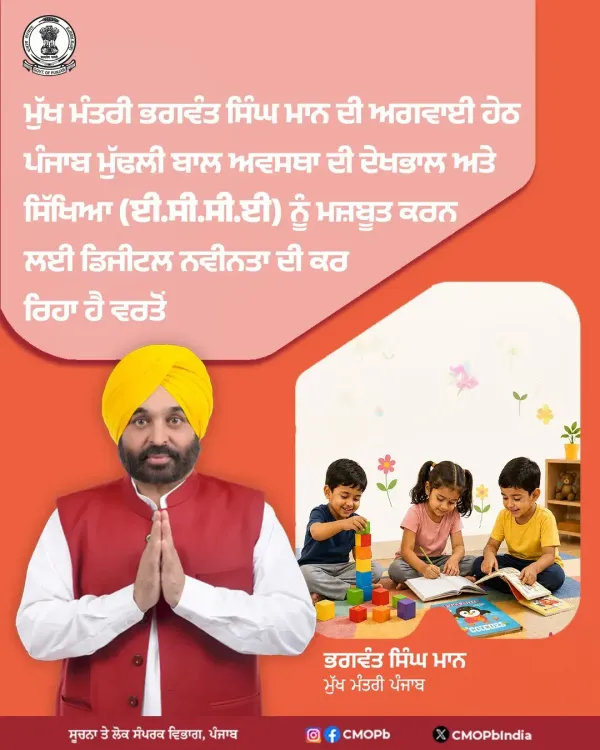
The Chief Minister's Office of Punjab announced on Monday, 13 July 2026 that Mission Aarambh, a state initiative led by Chief Minister Bhagwant Singh Mann, is transforming early childhood education across Punjab by connecting parents and Anganwadi workers through digital platforms including WhatsApp.
What Mission Aarambh Delivers
Under the initiative, parents receive a weekly activity calendar, daily learning videos, interactive quizzes, and specially designed learning materials directly on WhatsApp. The CMO described the goal as making teaching children at home 'sral, anandadayak ate prabhavshali' — simple, engaging, and effective — for families who may otherwise have limited access to structured early learning resources.
The programme also equips Anganwadi workers with digital tools to maintain regular engagement with families and support children's intellectual, linguistic, social, and emotional development. By layering digital outreach onto the existing Anganwadi network, the scheme avoids the need for new physical infrastructure.
Policy Backdrop
Anganwadi centres operate under the Integrated Child Development Services (ICDS) scheme, a Central Government programme launched in 1975 that delivers nutrition, health, and preschool education to children under six across India. The National Education Policy 2020 formally identified early childhood care and education as the foundational stage of schooling, lending policy weight to state-level efforts like Mission Aarambh.
Mobile-based parental engagement models gained traction nationally after the COVID-19 pandemic disrupted in-person preschool services, normalising WhatsApp as a delivery channel for low-income households. Punjab's AAP government, in office since March 2022, has consistently positioned digital delivery as central to its education agenda.
Stakeholders and Impact
The primary beneficiaries are children under six, their parents or guardians, and the Anganwadi workforce — frontline workers who have historically been limited to in-person centre visits. By giving workers digital tools, the scheme extends their effective reach beyond the physical Anganwadi centre and into the home environment where a child spends most of their day.
Parents gain structured, expert-guided content without needing smartphones beyond a basic WhatsApp-capable device. The interactive quizzes and daily videos are designed to make engagement low-effort and consistent, addressing one of the persistent gaps in early childhood programmes: irregular parental participation.
What to Watch
Independent assessments of learning outcomes and statewide coverage figures have not yet been released publicly. Observers will look for data on how many Anganwadi centres and families are enrolled, whether the content aligns with the national ECCE curriculum, and how outcomes are tracked in upcoming Punjab Education Department reports or budget documents. The model's scalability and replicability across other states will also be closely watched given the Central Government's push to universalise foundational learning under NEP 2020.
Point of View
Tangible digital welfare schemes targeting mothers and young families carry both policy and electoral weight. The real test, however, will be independent outcome data — parental engagement metrics and measurable learning gains — which the state has yet to publish.
NationPress
12 Oct 2026
Frequently Asked Questions
What is Mission Aarambh in Punjab?
Mission Aarambh is a Punjab government initiative under Chief Minister Bhagwant Singh Mann that uses digital platforms, primarily WhatsApp, to connect parents with Anganwadi workers and deliver early childhood education resources including weekly activity calendars, daily learning videos, and interactive quizzes.
How does Mission Aarambh use WhatsApp?
Under Mission Aarambh, parents receive weekly activity calendars, daily learning videos, interactive quizzes, and specially designed learning materials directly on WhatsApp, making home-based early learning structured and accessible without requiring new devices or apps.
Who are Anganwadi workers and what is their role in Mission Aarambh?
Anganwadi workers are frontline staff under the Central Government's Integrated Child Development Services scheme who run village-level centres for children under six. In Mission Aarambh, they are equipped with digital tools to maintain regular contact with families and guide children's intellectual, linguistic, social, and emotional development.
How does Mission Aarambh relate to the National Education Policy 2020?
The National Education Policy 2020 identified early childhood care and education as the foundation stage of schooling. Mission Aarambh operationalises that emphasis at the state level by strengthening the preschool delivery system through digital parental engagement.
What age group does Mission Aarambh target?
Mission Aarambh targets children under six years of age, the group served by Anganwadi centres under the national ICDS programme, focusing on their foundational cognitive, language, social, and emotional development.