Punjab Police hits Day 198 of Gangsteran Te Vaar, arrests cross 57,329

Synopsis
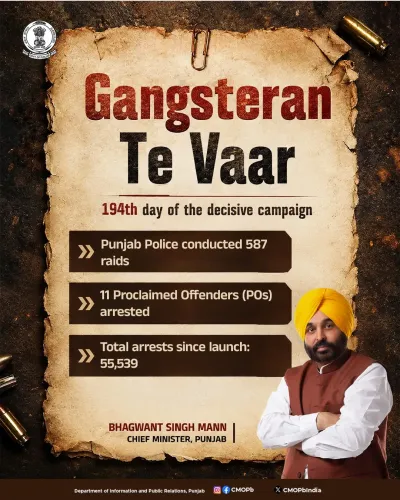
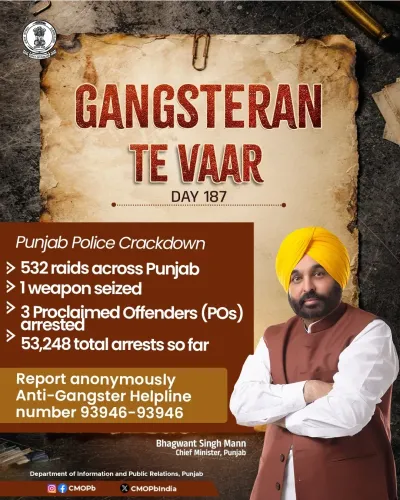
On Day 198 of Punjab's 'Gangsteran Te Vaar' campaign, police conducted 633 raids statewide, arrested individuals with two weapons, nabbed 11 Proclaimed Offenders, and pushed total campaign arrests to 57,329, the Chief Minister's Office confirmed on August 7, 2026.
Key Takeaways
Day 198 of the Gangsteran Te Vaar campaign saw 633 raids at locations linked to gangster associates across Punjab.
Cumulative arrests since the campaign's launch have reached 57,329 .
Two weapons were recovered from individuals arrested on Day 198.
11 Proclaimed Offenders (POs) — individuals who had evaded court summons — were arrested during the operation.
The campaign was launched by Chief Minister Bhagwant Mann's AAP government after taking office in March 2022 to dismantle organised crime networks in Punjab.
The drive targets gangster syndicates involved in extortion, contract killings, and narcotics trafficking, many operating across state borders.
Nearly two hundred days in, and Punjab Police shows no sign of letting up. On Day 198 of the 'Gangsteran Te Vaar' campaign, police teams fanned out across the state conducting 633 raids at locations mapped to gangster associates — arresting individuals carrying two weapons and pushing the operation's cumulative arrest tally to 57,329.
The Chief Minister's Office of Punjab confirmed the milestone on Friday, August 7, 2026, adding that 11 Proclaimed Offenders (POs) were also nabbed during the day's operations. The scale of the sweep — hundreds of raids in a single day, months into a sustained drive — signals a deliberate enforcement posture rather than a one-off crackdown.
What 'Gangsteran Te Vaar' targets and why it matters
Gangsteran Te Vaar (ਗੈਂਗਸਟਰਾਂ ਤੇ ਵਾਰ — 'Strike on Gangsters') was launched by the Bhagwant Mann-led Aam Aadmi Party government after it took office in March 2022, as part of a broader pledge to dismantle organised crime networks embedded in Punjab's social fabric. The state has long contended with syndicates running extortion rackets, contract killings, and narcotics pipelines — many operating across state lines or directing operations from inside prisons.
The campaign's approach is methodical: intelligence-led mapping of associates and safe houses, followed by coordinated raids. Arresting Proclaimed Offenders — individuals who have already evaded court summons — adds a judicial accountability dimension to what is primarily a street-level enforcement drive.
633 raids in a single day — the operational tempo
Day 198's 633 raids across identified and mapped locations illustrate the campaign's sustained operational tempo. These are not random sweeps; the CMO's phrasing — 'identified and mapped locations linked to associates' — points to an intelligence architecture built over months. Each raid feeds back into that map, potentially generating fresh leads for subsequent days.
The weapon seizures, though modest in number on this particular day, carry outsized significance: arms recovered from gangster networks are the operational currency of extortion and targeted killings. Every weapon off the street is one fewer tool available to these syndicates.
Punjab's long fight against organised crime
Successive governments in Punjab have mounted large-scale police drives against organised crime, but the longevity of Gangsteran Te Vaar — nearly 200 days of continuous operations — marks it as one of the more sustained enforcement efforts in the state's recent history. The Mann government has consistently used the campaign's rolling statistics as a public accountability measure, updating arrest tallies and raid counts through official channels.
Whether the numbers translate into a measurable reduction in gang-related incidents — extortion calls, targeted killings, narcotics flows — is the question Punjab residents and law enforcement watchers will be pressing for answers on in the months ahead. The data is accumulating. The verdict on impact is still being written.
Point of View
Making it harder to quietly wind down. At nearly 200 days and 57,000-plus arrests, the campaign has outlasted most state-level crackdowns and is now a core plank of the AAP government's law-and-order narrative ahead of future electoral cycles. The critical unanswered question is whether arrest volume correlates with disruption of criminal networks — high arrest numbers can reflect genuine dismantling of syndicates, or they can mask a pattern of low-level sweeps that leave leadership structures intact. Punjab's history of organised crime suggests the real test will come in extortion and targeted-killing data, not arrest tallies.
NationPress
21 Sept 2026
Frequently Asked Questions
What is the Gangsteran Te Vaar campaign in Punjab?
'Gangsteran Te Vaar' is a sustained anti-gangster police operation launched by the Bhagwant Mann government in Punjab after it took office in March 2022. It targets gangster networks, their associates, and criminal infrastructure involved in extortion, contract killings, and narcotics trafficking.
How many arrests have been made in Gangsteran Te Vaar so far?
As of Day 198 of the campaign on August 7, 2026, the total number of arrests since the launch stands at 57,329, according to the Chief Minister's Office of Punjab.
What happened on Day 198 of Gangsteran Te Vaar?
On Day 198, Punjab Police conducted 633 raids at identified and mapped locations linked to gangster associates, arrested individuals carrying two weapons, and also nabbed 11 Proclaimed Offenders.
Who are Proclaimed Offenders (POs) and why are they significant?
Proclaimed Offenders are individuals who have failed to appear before a court despite being summoned, and against whom a court has issued a proclamation. Arresting them adds a judicial accountability dimension to the operation, beyond street-level enforcement.
Why does Punjab have a persistent organised crime problem?
Punjab has long faced challenges from criminal syndicates engaged in extortion, targeted killings, and drug trafficking, with many groups operating across state borders or coordinating from inside prisons. Successive governments have mounted crackdowns, but the networks have proven resilient.