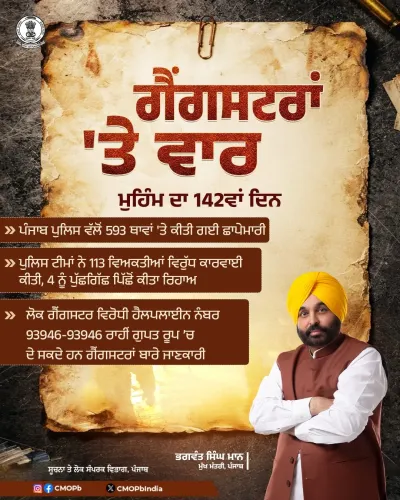
Punjab Police Hits Day 194 of Gangsteran Te Vaar, 587 Raids Conducted
Synopsis
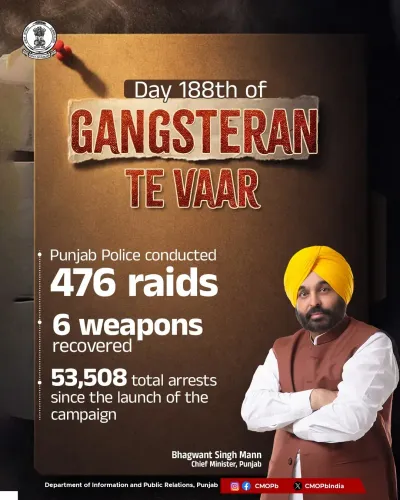
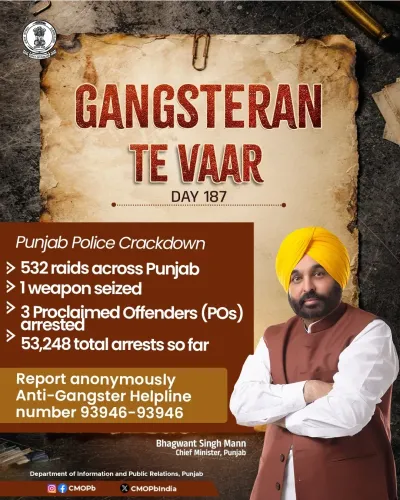
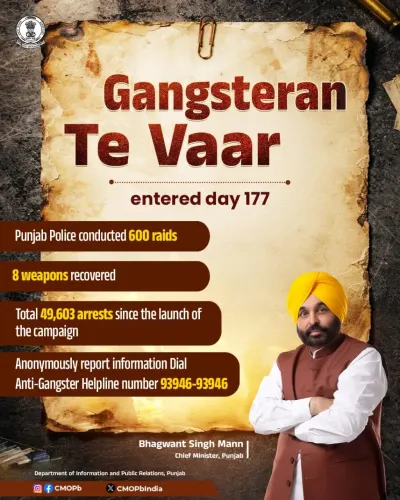
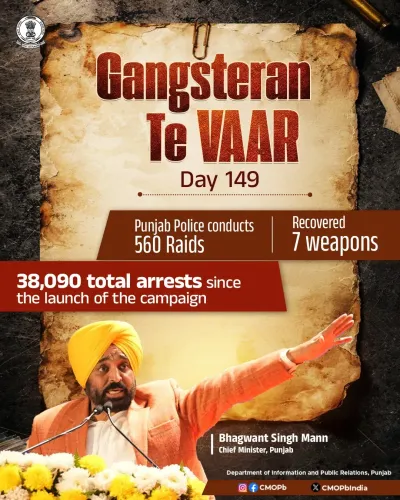
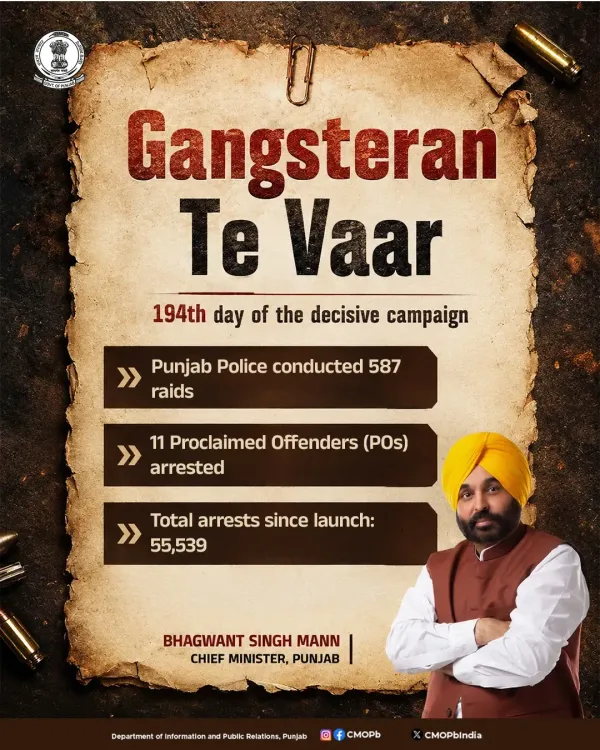
On Day 194 of Punjab's Gangsteran Te Vaar campaign, police conducted 587 raids at mapped locations linked to gangster associates, recovered two weapons, and raised total arrests to 55,539 since the drive's launch.
Key Takeaways
587 raids were conducted on Day 194 of the Gangsteran Te Vaar campaign across Punjab.
Police recovered two weapons during the day's operations.
Cumulative arrests under the campaign have reached 55,539 since its launch.
Raids targeted identified and mapped locations linked to associates of gangsters — not random sweeps.
The campaign operates under Chief Minister Bhagwant Mann's AAP government, which has maintained daily operational reporting.
Punjab's cross-border geography makes sustained anti-gangster drives a recurring and high-stakes governance priority.
Five hundred and eighty-seven raids in a single day. That is the operational tempo Punjab Police maintained on Day 194 of the state's relentless anti-gangster campaign — a number that tells you this is not a periodic crackdown but a sustained, mapped, intelligence-driven offensive.
The Chief Minister's Office of Punjab confirmed on Monday, 3 August 2026 that police teams conducted raids at identified and mapped locations linked to associates of gangsters across the state. The day's operations yielded fresh arrests and the recovery of two weapons, pushing the campaign's cumulative arrest tally to 55,539 since its launch.
What 'Gangsteran Te Vaar' has built over 194 days
The campaign — whose name translates roughly to 'Gangsteran Te Vaar' ('Strike on Gangsters') — is not a one-time blitz. It operates on a model of continuous mapping: associates of known gangsters are identified, their locations logged, and raids follow in systematic waves. Day 194 is a marker of institutional endurance, not a peak moment.
Over its run, the operation has accumulated more than 55,000 arrests — a figure that reflects both the depth of organised crime networks in the state and the scale of police mobilisation under Chief Minister Bhagwant Mann's administration. Punjab, which shares a border with Pakistan and has historically been a corridor for weapons and narcotics, has seen successive governments launch anti-gang and anti-drug drives. The current campaign represents the most sustained iteration of that effort under the Aam Aadmi Party government.
Raids mapped to gangster networks, not random sweeps
The operational language matters here. The CMO's update specifies raids at 'identified and mapped locations' — signalling that the police are working from intelligence dossiers on gangster ecosystems, not conducting blanket area searches. This associate-mapping approach targets the support infrastructure around gang leaders: safe houses, financiers, weapon suppliers, and logistics networks.
Weapon recoveries, even in small numbers, carry outsized significance in this context. Each firearm removed from a gangster associate's possession is one fewer instrument of intimidation or violence available to organised crime networks that have, in recent years, been linked to extortion calls targeting businessmen, politicians, and entertainers across Punjab and beyond.
What the daily drumbeat signals for Punjab's law-and-order politics
The CMO's choice to issue day-by-day operational updates is itself a governance signal. By publishing raid counts, arrest totals, and weapon recoveries as a running scoreboard, the Mann government is framing law enforcement as a measurable, accountable public service — not an opaque security function. Whether the numbers translate into lasting disruption of gang networks, or whether prosecutions and asset attachments follow the arrests, will be the harder test.
At 55,539 total arrests and counting, Punjab's anti-gangster campaign has become one of the longest-running and most numerically documented state-level crime operations in recent Indian governance history. The raids continue.
Point of View
Intelligence-led disruption of gang ecosystems. For the AAP government, the daily scoreboard of raids and arrests is as much a political communication strategy as it is a law-enforcement metric — demonstrating visible, quantifiable governance in a state where crime and security have historically defined electoral fortunes. The real measure of the campaign's durability, however, lies not in arrest counts but in whether prosecutions hold and whether gang networks lose operational capacity over time. Punjab's cross-border organised crime challenge means no single campaign, however sustained, can be the final word.
NationPress
17 Sept 2026
Frequently Asked Questions
What is the Gangsteran Te Vaar campaign in Punjab?
Gangsteran Te Vaar is an ongoing Punjab government anti-gangster operation that conducts daily raids on locations linked to gangster associates, aiming to dismantle organised crime networks through sustained arrests and weapon recoveries.
How many arrests have been made under Gangsteran Te Vaar?
As of Day 194 of the campaign, total arrests have reached 55,539 since the drive was launched by Punjab Police.
How many raids did Punjab Police conduct on Day 194?
Punjab Police conducted 587 raids at identified and mapped locations linked to gangster associates on Day 194 of the campaign.
What weapons were recovered in the latest Gangsteran Te Vaar raids?
Police recovered two weapons during the Day 194 operations, adding to the cumulative seizures made across the campaign's run.
Who is overseeing the Gangsteran Te Vaar campaign in Punjab?
The campaign is being conducted by Punjab Police under the state government led by Chief Minister Bhagwant Mann of the Aam Aadmi Party, with daily updates issued by the Chief Minister's Office.