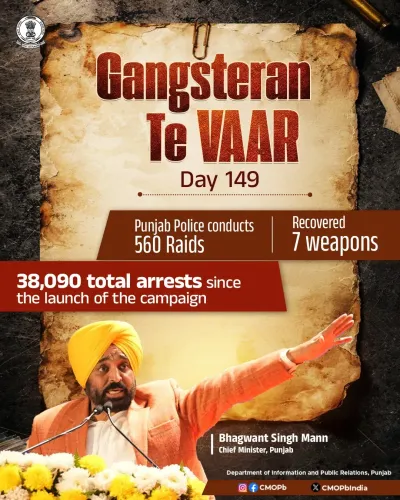
Punjab Police Hits Day 196 of 'Gangsteran Te Vaar' with 676 Raids

Synopsis
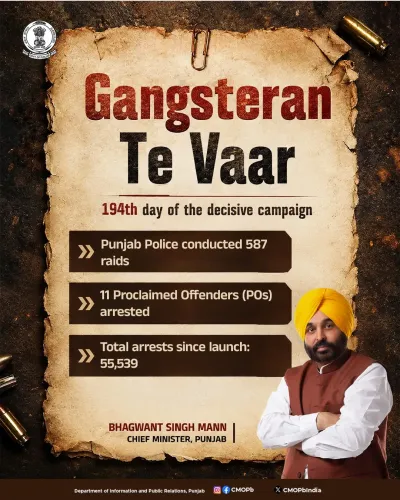
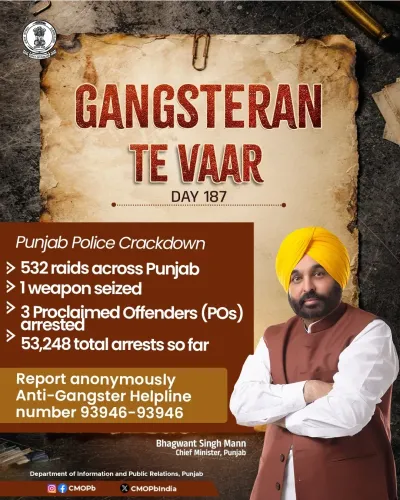
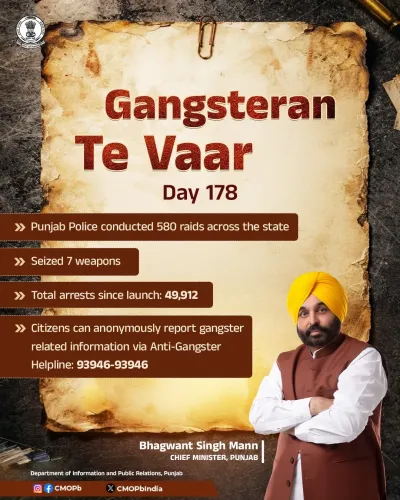
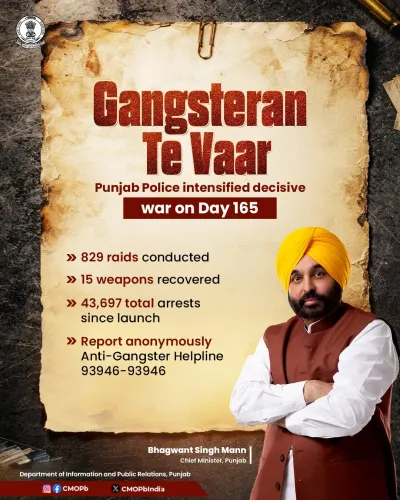
Punjab Police completed Day 196 of the 'Gangsteran Te Vaar' campaign on 5 August 2026, conducting 676 raids across the state, seizing 6 weapons, arresting 12 Proclaimed Offenders, and pushing total campaign arrests to 56,455.
Key Takeaways
676 raids were conducted across Punjab on Day 196 of the 'Gangsteran Te Vaar' campaign on 5 August 2026 .
Arrests on the day included individuals found with 6 weapons , reinforcing the intelligence-led, mapped nature of the operations.
12 Proclaimed Offenders (POs) were arrested during the day's operations.
Cumulative arrests since the campaign's launch have reached 56,455 .
The campaign, launched by the Aam Aadmi Party government under CM Bhagwant Mann , targets pre-mapped locations linked to gangster associates rather than conducting reactive sweeps.
Independent verification of the campaign's impact on gang-related crime rates remains pending.
Six hundred and seventy-six raids in a single day, weapons seized, and 12 Proclaimed Offenders hauled in — Punjab Police kept the pressure on organised crime squarely on Wednesday, 5 August 2026, as the 'Gangsteran Te Vaar' campaign crossed its 196th consecutive day of operations. The Chief Minister's Office of Punjab confirmed the milestone, pushing the campaign's cumulative arrest tally to a striking 56,455.
What Day 196 Looked Like on the Ground
Police teams fanned out across the state, targeting locations that had been pre-identified and mapped as linked to gangster associates. The day's haul included arrests of individuals found in possession of six weapons — a detail that underscores the operational intelligence driving the raids rather than random sweeps. The 12 Proclaimed Offenders arrested add to a category of fugitives the state has been systematically closing in on since the campaign launched.
The Scale Behind the Numbers
Punjab has long grappled with organised crime networks that intertwine extortion, contract killings, and drug trafficking — a nexus that successive governments have struggled to break. When the Aam Aadmi Party government under Chief Minister Bhagwant Mann came to power in 2022, dismantling these networks was a central manifesto commitment. 'Gangsteran Te Vaar' — roughly, 'Strike Against Gangsters' — is the operational expression of that pledge.
What distinguishes this campaign from earlier episodic crackdowns is its mapped, intelligence-led architecture: raids target pre-charted locations linked to gangster ecosystems rather than reacting to individual incidents. A cumulative figure of 56,455 arrests across 196 days averages to roughly 288 arrests per day — a sustained operational tempo that is difficult to maintain without structured coordination across district police units.
What the Campaign Still Needs to Prove
Raw arrest numbers are a measure of activity, not necessarily of outcome. The harder question — whether gang-related extortion calls, contract killings, and drug supply chains have actually contracted — awaits independent crime-statistics assessments or Punjab Assembly scrutiny. Cumulative arrest data from a government-run campaign is inherently self-reported, and the research base flags those figures as unverified against public records.
Still, the political signal is deliberate: the CMO Punjab is publishing day-count updates publicly, tying the government's credibility to visible, measurable momentum. That transparency is itself a governance choice — one that invites accountability as much as it claims credit.
If the numbers hold and independent data eventually corroborates the trend, 'Gangsteran Te Vaar' could become a template for sustained, intelligence-driven policing in states facing similar organised-crime pressure. Day 197 is already underway.
Point of View
Verifiable scoreboard. With Punjab elections on the horizon, sustained anti-crime optics serve a dual purpose: reassuring residents and pre-empting opposition narratives around the state's organised crime problem. The campaign's intelligence-led, mapped-location approach marks a structural shift from reactive policing, but its true impact will only be legible when independent crime-incidence data — not just arrest counts — is placed alongside the government's own figures. Until then, 'Gangsteran Te Vaar' is both a policing operation and a political performance, and the two are inseparable.
NationPress
19 Sept 2026
Frequently Asked Questions
What is the 'Gangsteran Te Vaar' campaign in Punjab?
'Gangsteran Te Vaar' is a statewide Punjab Police operation launched by the Bhagwant Mann-led AAP government targeting associates of gangsters involved in extortion, drug trafficking, and contract killings. It uses pre-mapped intelligence to conduct raids on identified locations linked to organised crime networks.
How many arrests have been made in the Gangsteran Te Vaar campaign so far?
As of Day 196 on 5 August 2026, the campaign has recorded a cumulative total of 56,455 arrests since its launch, according to the Chief Minister's Office of Punjab.
What happened on Day 196 of Gangsteran Te Vaar?
On Day 196, Punjab Police conducted 676 raids, arrested individuals possessing 6 weapons, and detained 12 Proclaimed Offenders across the state.
Who is overseeing the Gangsteran Te Vaar campaign?
The campaign is conducted by Punjab Police under the Aam Aadmi Party government led by Chief Minister Bhagwant Mann, who came to power in 2022 with a manifesto commitment to crack down on organised crime.
What are Proclaimed Offenders (POs) in the context of Punjab Police operations?
Proclaimed Offenders are individuals who have been declared fugitives by a court after failing to appear when summoned. Their arrest is a specific operational priority within the Gangsteran Te Vaar campaign.