Joshi Cites Global Praise to Fuel India's Renewable Energy Push

Synopsis
Minister Pralhad Joshi welcomed international and national praise for India's renewable energy leadership on the sidelines of the 9th ISA Assembly and BRE Summit, framing it as fresh resolve to advance clean-energy goals and deepen global sustainable-development partnerships.
Key Takeaways
Pralhad Joshi , Union Minister of New and Renewable Energy, posted on November 3, 2026 acknowledging appreciation from international and national leaders for India's renewable energy progress.
The post was tied to the 9th ISA Assembly and BRE Summit , two multilateral energy forums running concurrently.
The International Solar Alliance was co-founded by India and France at the 2015 Paris Climate Conference to scale global solar deployment.
India's updated Nationally Determined Contributions (2022) commit to 50 percent cumulative electric power from non-fossil sources by 2030 .
Joshi posted bilingually in English and Kannada, signalling both a global and a Karnataka-facing audience.
India's strategy of citing multilateral endorsements to reinforce domestic policy continuity is a recurring feature of its climate diplomacy.
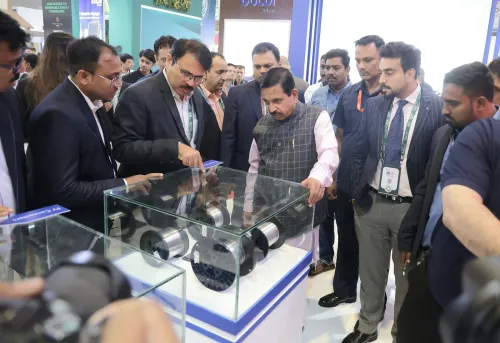
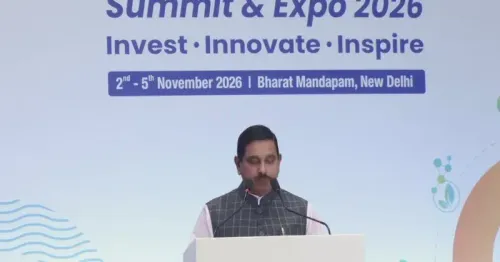
Appreciation from world leaders does not just feel good — it gets put to work. Union Minister of New and Renewable Energy Pralhad Joshi on Tuesday, November 3, 2026 said that words of recognition from international and national leaders had heartened him, and vowed that such validation would only sharpen India's resolve to advance its renewable energy journey and deepen global partnerships for a sustainable future.
Posting in both English and Kannada on the sidelines of events marked by the hashtags #9ISAssembly and #BRESummit, Joshi wrote: 'Such appreciation strengthens our resolve to advance India's renewable energy journey and deepen global partnerships for a sustainable future.' The Kannada lines — ಅಂತಾರಾಷ್ಟ್ರೀಯ ಹಾಗೂ ರಾಷ್ಟ್ರೀಯ ನಾಯಕರ ಪ್ರಶಂಸೆಯ ಮಾತುಗಳು ಅತ್ಯಂತ ಸಂತಸ ತಂದಿವೆ ('Words of appreciation from international and national leaders have brought immense joy') — mirror the English sentiment and signal that the message was crafted as much for his Karnataka constituency as for a global audience.
The ISA Stage India Has Built Over a Decade
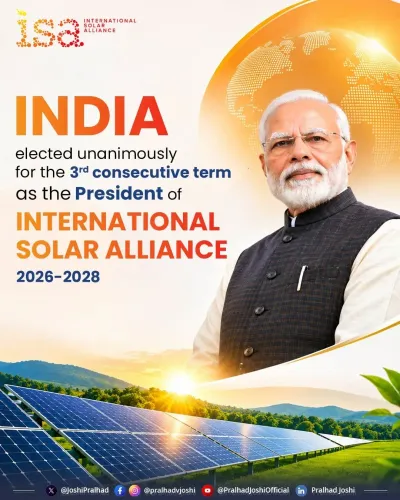
The events referenced are tied to the International Solar Alliance, the treaty-based intergovernmental body co-founded by India and France at the Paris Climate Conference in 2015. From its inception, the ISA was India's bid to lead the Global South's pivot toward solar — a forum where New Delhi could convene developing-nation partners rather than simply receive instructions from wealthier blocs. The 9th ISA Assembly marks over a decade of that institutional bet paying forward.
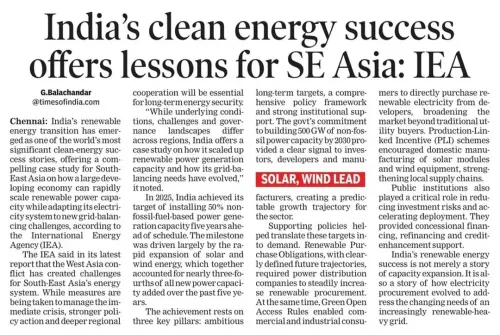
India's broader renewable ambition is codified in its updated Nationally Determined Contributions submitted in 2022, which commit the country to sourcing 50 percent of cumulative electric power from non-fossil fuels by 2030. Every high-level forum where India earns multilateral praise effectively becomes political capital at home — proof that a target set in a policy document is recognised internationally as credible and on track.
Diplomacy as Energy Strategy
What Joshi's post signals is a well-worn but effective play in India's climate diplomacy toolkit: converting external validation into domestic policy momentum. Successive governments have framed renewable capacity addition simultaneously as energy security and as climate diplomacy, and senior ministers routinely highlight foreign endorsements to reinforce continuity across political cycles. The #BRESummit hashtag, appearing alongside the ISA Assembly reference, suggests a parallel track of bilateral or regional energy engagements running concurrently — broadening the diplomatic footprint beyond the ISA's solar-specific mandate.
For Joshi specifically, the post carries dual weight: as Minister of New and Renewable Energy, he is the political face of India's clean-energy buildout; as a senior BJP leader from Karnataka, projecting global stature in his native language is also astute regional politics.
The real measure of this applause will come in the joint statements and investment pledges that emerge from these summits — and whether the diplomatic warmth translates into the technology transfers and financing pipelines India needs to hit its 2030 non-fossil target at scale.
Point of View
And inward to shore up domestic support for ambitious clean-energy targets. The 9th ISA Assembly timing is significant: it marks over a decade since India co-founded the body, and the minister's tone suggests the government sees itself as having earned the right to claim leadership, not just membership. Framing external validation as fuel for resolve — rather than as an endpoint — is also a deliberate signal that the policy momentum will continue regardless of short-term electoral cycles. The real test, as ever, is whether the applause at summits converts into the financing and technology-transfer agreements that India needs to credibly reach its 2030 non-fossil power target.
NationPress
4 Nov 2026
Frequently Asked Questions
What is the International Solar Alliance and why does India lead it?
The International Solar Alliance is a treaty-based intergovernmental organisation co-founded by India and France at the 2015 Paris Climate Conference to promote solar energy deployment among member countries. India championed it as a platform to mobilise investment and technology for sun-rich developing nations and has hosted its secretariat, cementing its leadership role in global solar diplomacy.
What is the 9th ISA Assembly?
The 9th ISA Assembly is the annual governing meeting of the International Solar Alliance's member states, where countries review progress, adopt resolutions, and set priorities for solar energy cooperation. The November 2026 edition is the ninth such gathering since the body became operational.
What is India's renewable energy target for 2030?
India's updated Nationally Determined Contributions, submitted in 2022, commit the country to achieving 50 percent of its cumulative installed electric power capacity from non-fossil fuel sources by 2030, a target also linked to its Paris Agreement obligations.
Who is Pralhad Joshi and what ministry does he head?
Pralhad Joshi is a senior BJP leader from Karnataka and serves as Union Minister of Consumer Affairs, Food and Public Distribution as well as Minister of New and Renewable Energy in the Union Cabinet. He is the political face of India's clean-energy transition at the national level.
What is the BRE Summit referenced in Joshi's post?
The BRE Summit appears to be a bilateral or regional energy forum running alongside the 9th ISA Assembly in November 2026. Specific details about its agenda and participating countries were not verifiable at the time of this report.