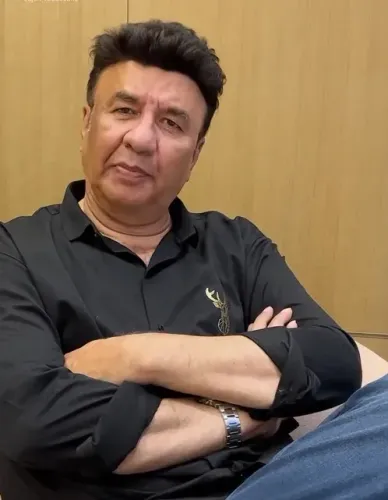
Anu Malik recalls father Sardar Malik's struggle and silent pride

Synopsis
Before the hits and the fame, Anu Malik was a young composer standing outside locked studio doors, pitching songs to producers in bathrooms. The driving force behind his hustle? Watching his father Sardar Malik silently bear hardship — and vowing to change that. The moment he gifted him a car and driver after spotting him at a bus stop has resurfaced online and struck a chord all over again.
Key Takeaways
Anu Malik spoke about his early struggles breaking into Hindi film music in a resurfaced clip with lyricist Sameer .
He described competing in an era dominated by R.D.
Burman , Kalyanji–Anandji , and Laxmikant–Pyarelal , with studios fully booked and top singers hard to access.
Malik reportedly pitched songs to producers outside Mehboob Studio and once secured a listen from a director inside a bathroom.
His primary motivation was his father Sardar Malik's silent suffering — 'I couldn't see my father's pain,' he said.
Once successful, he gifted his father a car and dedicated driver after finding him waiting at a bus stop.
Music composer Anu Malik once opened up about the relentless grind that defined his early years in Hindi film music — and the quiet, deeply personal motivation that drove him through it all: his father, veteran composer Sardar Malik. A resurfaced video clip from an old conversation with lyricist Sameer has reignited interest in this rarely heard account of one of Bollywood's most recognisable composers.
The Era of Giants
In the clip, Anu Malik paints a vivid picture of the competitive landscape he entered as a young composer. R.D. Burman, Kalyanji–Anandji, and Laxmikant–Pyarelal dominated the industry, leaving almost no room for newcomers. As Malik put it, 'R.D. Burman was the top most composer, whom we respect a lot, Kalyanji–Anandji and Laxmikant–Pyarelal, all of them were ruling. It would be a big deal if a song gets recorded in between them.' Even recording studio time was scarce — Mehboob Studio, Film Center Studio, and Famous Studio were perpetually booked, and top singers like Lata Mangeshkar, Asha Bhosle, and Kishore Kumar were nearly impossible to book.
Pitching Songs Outside Studios
Undeterred, Anu Malik would reportedly stand outside Mehboob Studio for hours, unable to gain entry. Whenever a producer appeared, he would approach them directly: 'Sir, listen to my song.' In what has since become a widely recalled anecdote in Bollywood circles, he is said to have once persuaded a director to hear his composition inside a bathroom — the only space where he could get an uninterrupted moment of the director's attention.
His Father's Silent Suffering
The emotional centrepiece of the clip is Malik's account of watching his father endure hardship. 'I couldn't see my father's sorrow, I couldn't see my father's pain. I couldn't imagine that such a big talented man was going through this,' he recalled. It was this anguish, he said, that fuelled his relentless hustle. When producers began approaching him and work started flowing in, he noticed his father observing from a distance — not with words, but with a smile. 'His smile was everything,' Malik said.
The Bus Stop Moment
One particular memory stands out in the clip. Malik recounted spotting his father Sardar Malik waiting at a bus stop after his own fortunes had turned. 'Dad, why are you at the bus stop?' he asked, before immediately buying a car and assigning a dedicated driver for his father. The gesture, simple as it was, encapsulated his journey from outsider to provider — from standing outside locked studio doors to ensuring his father never had to wait at a bus stop again.
Why the Clip Has Resurfaced
The renewed circulation of this clip reflects a broader social media appetite for personal, humanising stories from Bollywood's golden era. Anu Malik's account connects the personal to the professional in a way that resonates across generations of film music fans who grew up with both Sardar Malik's compositions and his son's later work. It is also a rare, candid look at the father-son dynamic behind one of Hindi cinema's well-known musical legacies.
Point of View
Unfiltered glimpse into the structural barriers that defined Bollywood's pre-liberalisation music economy. Studio monopolies, gatekept singer rosters, and the dominance of a handful of composer duos meant talent alone was not enough. Anu Malik's bathroom-pitch anecdote is funny on the surface, but beneath it lies a genuinely harsh reality of blocked access. The father-son dynamic here also complicates a common narrative: Malik did not simply inherit a legacy from Sardar Malik — he had to fight his own battles entirely, motivated less by ambition than by filial guilt. That distinction matters, and mainstream coverage of Bollywood nostalgia rarely surfaces it.
NationPress
4 Nov 2026
Frequently Asked Questions
What did Anu Malik say about his father Sardar Malik?
Anu Malik said he could not bear to see his father Sardar Malik, whom he described as a 'big talented man,' endure hardship silently. He recalled how his father's distant smile when things started going well for him 'was everything,' and later gifted him a car and driver after spotting him waiting at a bus stop.
What were Anu Malik's early struggles in Bollywood?
Anu Malik described waiting for hours outside Mehboob Studio in Mumbai without gaining entry, and approaching producers on the street to pitch his songs. He also reportedly once got a director to listen to his composition inside a bathroom, as that was the only way to get uninterrupted attention.
Who is Sardar Malik and how is he related to Anu Malik?
Sardar Malik was a veteran Hindi film music composer and the father of Anu Malik. Despite his own talent and standing in the industry, he went through a difficult period that his son witnessed closely and cited as his primary motivation to succeed.
Where did the resurfaced video clip of Anu Malik originate?
The clip is from an old conversation between Anu Malik and lyricist Sameer. It has recently resurfaced on the internet, drawing fresh attention to Malik's account of his early career and his relationship with his father.
Which composers dominated Hindi film music during Anu Malik's early career?
During Anu Malik's early years, the industry was dominated by R.D. Burman, Kalyanji–Anandji, and Laxmikant–Pyarelal. Recording studios were perpetually booked, and getting time with top singers like Lata Mangeshkar, Asha Bhosle, and Kishore Kumar was extremely difficult for newcomers.