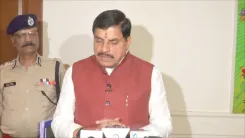
Pralhad Joshi thanks ISA members as India takes third consecutive Presidency

Synopsis
Union Minister Pralhad Joshi announced India's third consecutive assumption of the International Solar Alliance Presidency at the 9th ISA Assembly on 3 November 2026, thanking member nations and pledging to advance global solar cooperation under PM Modi's leadership.
Key Takeaways
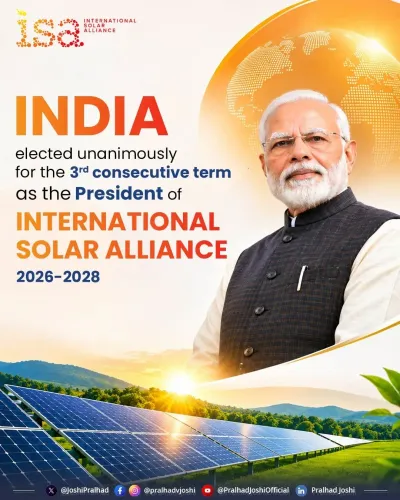
India has assumed the International Solar Alliance (ISA) Presidency for a third consecutive term, as announced by Union Minister Pralhad Joshi on 3 November 2026 .
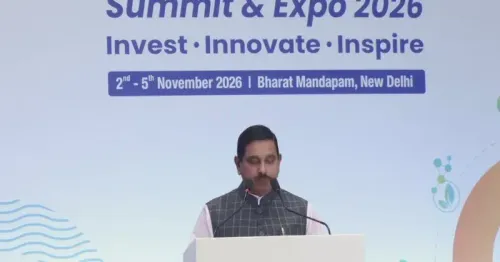
The announcement was made in the context of the 9th ISA Assembly (#9ISAssembly) , the alliance's governing body that formalises leadership transitions.
The ISA was co-founded by India and France at the COP21 summit in Paris in 2015 to scale up solar energy deployment globally.
Joshi posted his gratitude in both English and Kannada , crediting PM Narendra Modi's leadership for driving India's global solar agenda.
Consecutive ISA presidencies position India as a long-term convenor of south-south cooperation on clean energy and climate diplomacy.
New ISA programme announcements and project pipelines are expected during this presidency term ahead of future climate forums.
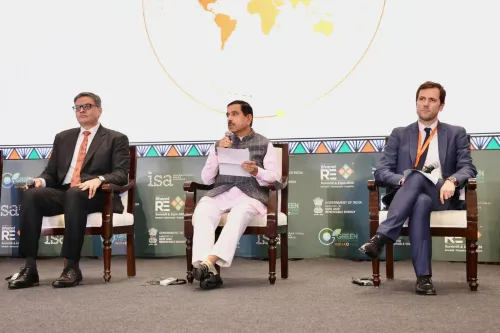
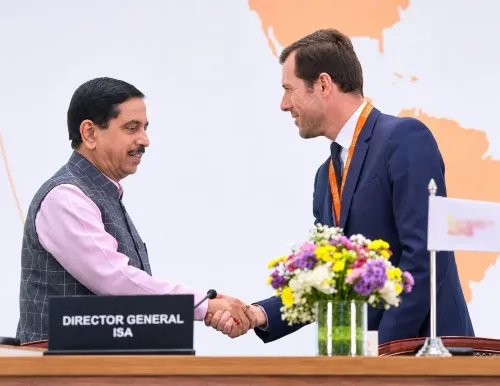
A global solar alliance, a third consecutive mandate, and a minister who doubled as diplomat — on Tuesday, 3 November 2026, Union Minister for New and Renewable Energy Pralhad Joshi posted a message of gratitude to all member nations of the International Solar Alliance (ISA) as India assumed the ISA Presidency for what he described as the third consecutive term, an acknowledgement of the trust placed in New Delhi by the alliance's global membership.
India's three-peat at the top of the ISA
Posting in both English and Kannada, Joshi conveyed his personal gratitude — 'ಹೃತ್ಪೂರ್ವಕ ಧನ್ಯವಾದಗಳು' ('heartfelt thanks') — to member nations, underscoring that the consecutive presidency signals sustained confidence in India's stewardship of the alliance. The message was pegged to the #9ISAssembly, the 9th ISA Assembly, the governing body that formalises such leadership transitions. Joshi credited Prime Minister Narendra Modi's 'visionary leadership' as the guiding force behind India's ambition to advance global solar cooperation and a 'sustainable and green future.'
From Paris 2015 to a decade-long diplomatic project
The ISA was not born overnight. India and France jointly launched it in 2015 at the COP21 summit in Paris, with a founding vision of mobilising solar energy deployment across sun-rich developing nations — particularly in Africa, South Asia, and the Pacific. Over the decade since, New Delhi has positioned the ISA as a centrepiece of its climate diplomacy, a living argument that emerging economies can lead on clean-energy multilateralism rather than merely follow. Repeated presidencies reinforce that narrative on the world stage.
Why the Presidency matters for the renewable push
Holding the ISA Presidency is not ceremonial. It places India in the chair for setting the alliance's programme priorities — from project pipelines and technology transfer to concessional financing for solar deployment in member states. The continuity of leadership, if Joshi's framing holds, allows India to pursue multi-year initiatives without the reset that comes with a change in the presiding country. Domestically, it dovetails with India's own aggressive solar capacity expansion targets, lending international credibility to commitments made at successive COP summits. For the renewable energy sector and ISA's 120-plus member nations, the presidency signals stability and a likely continuation of south-south cooperation programmes on clean energy.
The next moves to watch: fresh ISA programme announcements under this presidency term, and how Joshi deploys the role heading into upcoming global climate and energy forums.
Point of View
It serves a dual purpose: reinforcing PM Modi's international stature on green diplomacy while providing institutional scaffolding for domestic solar targets. Joshi's trilingual messaging — English for international reach, Kannada for domestic constituency signalling — reflects a minister acutely aware of both audiences. The real test of this presidency will be whether India can translate leadership optics into measurable project outcomes for smaller member states.
NationPress
4 Nov 2026
Frequently Asked Questions
What is the International Solar Alliance and who founded it?
The International Solar Alliance (ISA) is a treaty-based intergovernmental organisation founded jointly by India and France at the COP21 climate summit in Paris in 2015 . It aims to scale up solar energy deployment, particularly among sun-rich developing nations across Africa, Asia, and the Pacific.
What did Pralhad Joshi announce about India and the ISA Presidency?
Union Minister Pralhad Joshi announced on 3 November 2026 that India has assumed the ISA Presidency for a third consecutive term , thanking member nations for their trust and support at the occasion of the 9th ISA Assembly.
What is the 9th ISA Assembly?
The 9th ISA Assembly is the latest session of the International Solar Alliance's principal governing body, which brings together member nations to set policy direction, review programmes, and formalise leadership roles including the Presidency.
Why does India holding the ISA Presidency matter for renewable energy?
The ISA Presidency lets India set the alliance's programme priorities — including solar project pipelines, technology transfer, and financing for member states — aligning international leadership with its own domestic solar expansion targets and COP commitments.
What role does PM Modi play in India's solar diplomacy?
Minister Joshi credited PM Narendra Modi's 'visionary leadership' as the driving force behind India's push to advance global solar cooperation through the ISA, reflecting the government's broader framing of Modi as the architect of India's clean-energy multilateralism.