India elected ISA President 3rd time; Joshi backs global solar cooperation
Synopsis
India has been elected President of the International Solar Alliance for a third straight term — a milestone that underlines New Delhi's growing clout in global clean energy diplomacy. With a ₹225 crore commitment to the Africa Solar Facility and 3 million farmers already powered through PM-KUSUM, India is converting solar rhetoric into measurable impact at home and abroad.
Key Takeaways
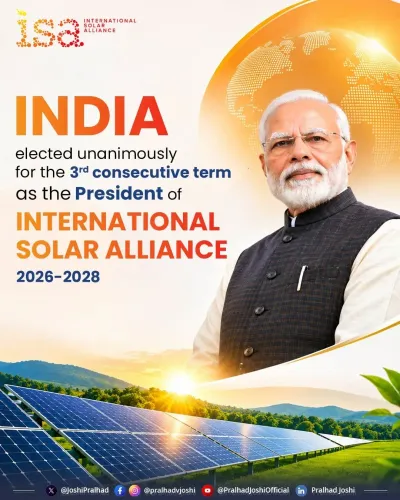
India has been elected President of the International Solar Alliance (ISA) for a third consecutive term .
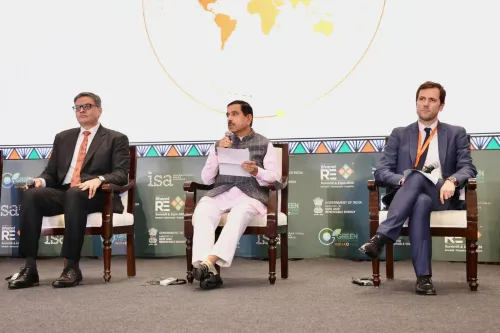
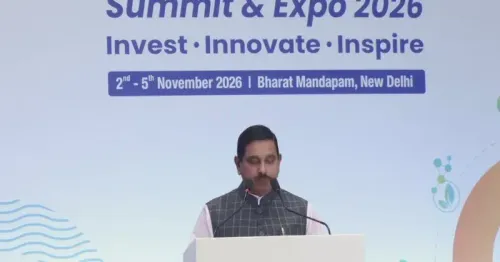
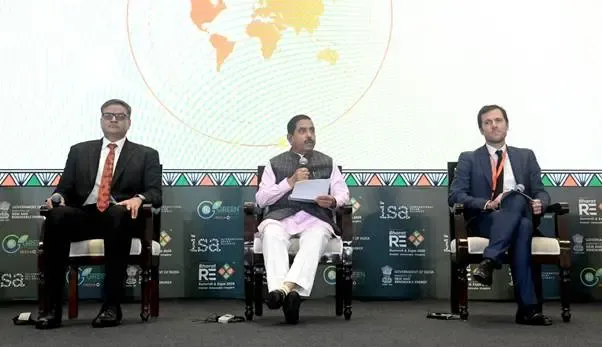
Union Minister Pralhad Joshi reaffirmed India's commitment to global solar cooperation at the Bharat Renewable Energy Summit and Expo 2026 on 3 November 2026 .
India has committed approximately ₹225 crore to the $200 million Africa Solar Facility to expand distributed renewable energy in Africa.
The $300 million Nigeria Distributed Renewable Energy Fund was cited as a model for scaling solar across the continent.
India's PM-KUSUM scheme has empowered 3 million farmers through solar-powered irrigation and income generation.
17 Solar Technology Application Resource Centres and an AI-enabled ISA Academy have been established to build global solar capacity.
Union Minister for New and Renewable Energy Pralhad Joshi on Tuesday, 3 November 2026, reaffirmed India's unwavering commitment to international solar cooperation and the equitable sharing of clean energy benefits, speaking after attending the Bharat Renewable Energy Summit and Expo 2026 in New Delhi. A key highlight of his address was India's election as President of the International Solar Alliance (ISA) for a third consecutive term.
India's Leadership at the ISA
Joshi underscored that India's renewed presidency of the ISA — a platform co-founded by India and France in 2015 — reflects a sustained national commitment to driving solar energy adoption globally. The alliance has since grown into a coalition of 130 signatory and member countries, with a particular focus on the Global South. The minister framed the moment as a transition 'from solar commitments to investments, from partnerships to projects, and from ambition to impact.'
Africa Solar Push and Key Funding Commitments
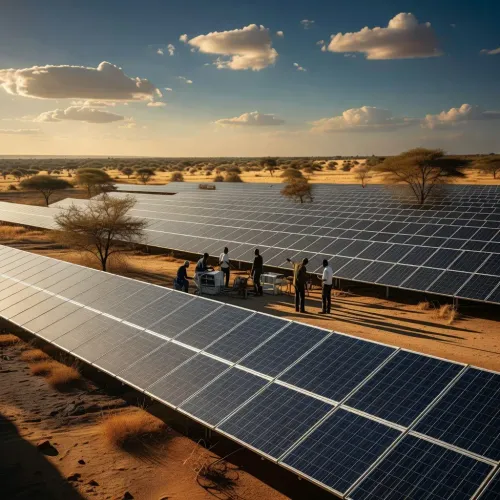
A centrepiece of the minister's remarks was India's backing of the $200 million Africa Solar Facility, which he described as a critical mechanism for unlocking investment in Africa's distributed renewable energy sector. India has committed approximately ₹225 crore to this initiative, signalling resolve to make affordable solar energy accessible to underserved communities across the continent.
Joshi also highlighted the $300 million Nigeria Distributed Renewable Energy Fund as a scalable model for rolling out distributed solar across Africa. ISA-supported programmes in Fiji, Madagascar, Comoros, and Seychelles were cited as concrete examples of solar energy strengthening livelihoods — powering healthcare facilities and schools, enabling clean drinking water access, and supporting agricultural cold storage.
Empowering Farmers Through Solar
The minister highlighted India's PM-KUSUM initiative as a domestic success story, stating that it has empowered 3 million farmers by deploying solar energy to reduce irrigation costs and generate additional income. He said the ISA is actively working to adapt this model across member countries, with a particular emphasis on Africa, positioning farmers at the centre of the energy transition.
Institutional Capacity and Technology Initiatives
Joshi pointed to the establishment of 17 Solar Technology Application Resource Centres, the Global Capability Centre–SHINE (Strategic Hub for Innovation and Execution), and an AI-enabled ISA Academy as part of a broader effort to build institutional capacity and develop skills. The focus, he said, is on harnessing emerging technologies to accelerate solar deployment across member nations.
The Guiding Vision
India's engagement in global solar diplomacy, the minister noted, is guided by the principle of 'One Sun, One World, One Grid' and the vision of 'Power to Empower' — frameworks that position solar energy not merely as a climate solution but as a driver of social equity. India's continued leadership of the ISA is expected to shape the alliance's agenda on financing, technology transfer, and rural electrification in the years ahead.
Point of View
But the real question is whether symbolic leadership is translating into bankable projects. The ₹225 crore commitment to the Africa Solar Facility is a tangible step, yet Africa's energy deficit is measured in hundreds of billions — making India's contribution a catalyst at best. The PM-KUSUM narrative is compelling domestically, but ISA's credibility with the Global South will ultimately be tested by how quickly the Nigeria Fund and similar vehicles move from announcement to actual kilowatt-hours delivered. India's 'One Sun, One World, One Grid' vision has geopolitical resonance, but execution remains the gap that critics consistently flag.
NationPress
3 Nov 2026
Frequently Asked Questions
Why has India been elected ISA President for a third consecutive term?
India has been re-elected President of the International Solar Alliance (ISA) for a third straight term, reflecting its leading role as a co-founder of the alliance and its sustained commitment to advancing solar energy globally. The ISA, co-established by India and France in 2015, now counts 130 signatory and member countries.
What is the Africa Solar Facility and how much has India committed?
The Africa Solar Facility is a $200 million initiative designed to unlock investment in Africa's distributed renewable energy sector. India has committed approximately ₹225 crore to the facility, aiming to make affordable solar energy accessible to underserved communities across the continent.
What is the Nigeria Distributed Renewable Energy Fund?
The Nigeria Distributed Renewable Energy Fund is a $300 million mechanism highlighted by Minister Pralhad Joshi as a scalable model for expanding distributed solar energy across Africa. It is intended to replicate and adapt successful approaches from smaller ISA-supported projects in countries like Fiji and Madagascar.
How has India's PM-KUSUM scheme benefited farmers?
India's PM-KUSUM initiative has empowered approximately 3 million farmers by deploying solar energy for irrigation, reducing input costs and creating additional income opportunities. The ISA is working to adapt this model for member countries, particularly in Africa.
What new ISA institutions were announced at the Bharat Renewable Energy Summit 2026?
Minister Joshi highlighted the establishment of 17 Solar Technology Application Resource Centres, the Global Capability Centre–SHINE (Strategic Hub for Innovation and Execution), and an AI-enabled ISA Academy. These institutions are aimed at strengthening skills, building capacity, and accelerating solar deployment across member nations.