Pralhad Joshi meets IEA, EU envoy at Bharat Renewable Energy Summit
Synopsis
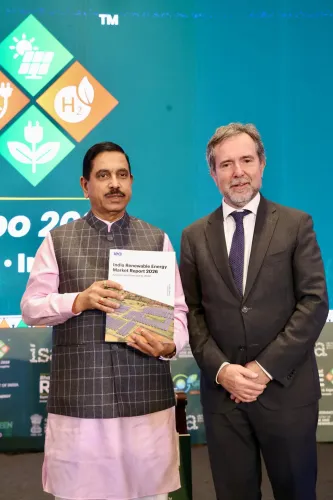
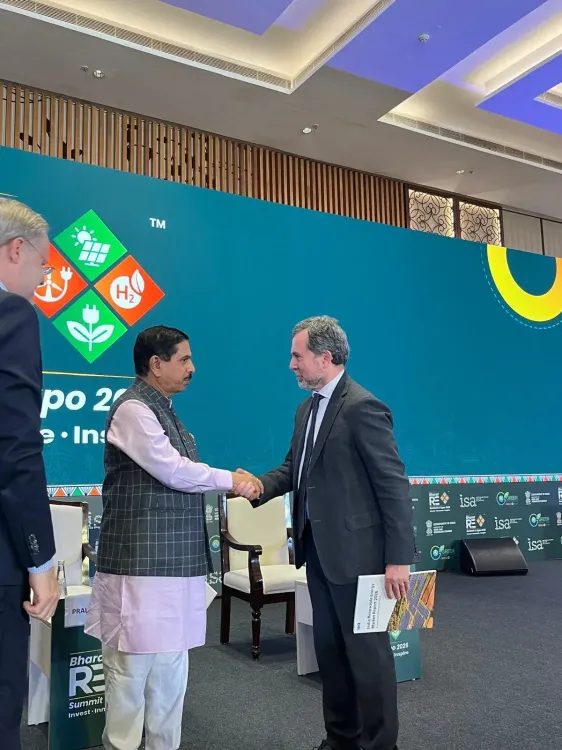
Union Minister Pralhad Joshi met IEA Renewable Energy Division Head Paolo Frankl and EU Ambassador Hervé Delphin on the sidelines of the Bharat Renewable Energy Summit 2026 Denmark Country Session, exchanging views on deepening renewable energy and clean-technology cooperation as India targets 500 GW non-fossil capacity by 2030.
Key Takeaways
Minister Pralhad Joshi met Paolo Frankl (IEA) and EU Ambassador Hervé Delphin at the Bharat Renewable Energy Summit 2026 on 3 November 2026 .
Talks focused on strengthening cooperation in renewable energy and clean technologies .
India has been an IEA associate member since 2017 , enabling structured energy policy dialogue.
The EU-India Clean Energy and Climate Partnership , launched in 2016 , underpins the diplomatic relationship on clean tech.
Denmark is a long-standing partner on wind energy and green hydrogen , providing context for the session's bilateral framing.
India is pursuing a 500 GW non-fossil capacity target by 2030 , requiring sustained international technology and investment partnerships.
At the Bharat Renewable Energy Summit 2026, the margins of a Denmark Country Session became a stage for substantive diplomacy — Union Minister Pralhad Joshi sat down on Tuesday, 3 November 2026 with two of the global clean-energy establishment's most consequential voices to press the case for deeper international cooperation.
Who was at the table and why it matters
Joshi met Mr. Paolo Frankl, Head of the Renewable Energy Division at the International Energy Agency (IEA), and H.E. Hervé Delphin, the European Union's Ambassador to India. The conversation centred on strengthening cooperation in renewable energy and clean technologies — two pillars that sit at the heart of India's 500 GW non-fossil capacity target by 2030.
The IEA is no peripheral player here. India became an associate member of the IEA in 2017, unlocking deeper data-sharing and policy dialogue on renewables. Frankl's division effectively shapes the analytical framework governments worldwide use to plan their clean-energy transitions — making his engagement with Indian leadership a signal of mutual strategic seriousness.
Denmark, the EU, and a decade of clean-energy scaffolding
The Denmark Country Session framing is deliberate. Denmark has been one of India's most active bilateral partners on wind energy and green hydrogen, and the session created a natural bridge between European technology expertise and Indian deployment ambition. Ambassador Delphin's presence added an institutional layer: the EU-India Clean Energy and Climate Partnership, launched in 2016, has structured joint research and investment flows in clean technologies for a decade, and its next chapter is evidently being shaped at precisely these kinds of sideline encounters.
Joshi posted in both English and Kannada — 'ನವೀಕರಿಸಬಹುದಾದ ಇಂಧನ ಮತ್ತು ಸ್ವಚ್ಛ ತಂತ್ರಜ್ಞಾನಗಳ ಕ್ಷೇತ್ರದಲ್ಲಿ ಸಹಕಾರವನ್ನು ಮತ್ತಷ್ಟು ಬಲಪಡಿಸುವ ಕುರಿತು ವಿಚಾರ ವಿನಿಮಯ ನಡೆಸಲಾಯಿತು' ['views were exchanged on further strengthening cooperation in the field of renewable energy and clean technologies'] — signalling that the outreach is directed not just at English-language diplomatic circuits but at his Karnataka home constituency, where clean-energy investment increasingly means jobs and infrastructure.
Where the 500 GW ambition needs partners
India's renewable push is not a solo project. Meeting the 500 GW target demands technology transfer, regulatory alignment, and capital — all of which flow more readily through relationships precisely like the ones Joshi was building on Tuesday. The IEA has consistently flagged grid integration, storage, and financing costs as the critical friction points for India's transition; Frankl's division produces the benchmarks that investors and policymakers use to price that risk. Getting that analytical firepower aligned with Indian policy priorities matters beyond symbolism.
Watch for technical working-group announcements or a joint statement emerging from the summit's closing sessions, and for the next formal round of the EU-India energy dialogue to carry the threads from this meeting forward.
Point of View
Rather than pursuing them in isolation. Engaging the IEA's Renewable Energy Division head directly links India's 500 GW target to the global analytical benchmarks that shape investor confidence. The EU connection — reinforced by the decade-old Clean Energy and Climate Partnership — keeps the door open to technology transfer and regulatory alignment that purely bilateral deals rarely deliver. For Joshi personally, the bilingual Kannada-English post signals that clean-energy diplomacy is being consciously stitched into his political identity in a state where renewable investment is fast becoming an economic development story.
NationPress
3 Nov 2026
Frequently Asked Questions
What is the Bharat Renewable Energy Summit 2026?
The Bharat Renewable Energy Summit 2026 is an Indian-hosted international summit featuring country sessions — including a Denmark session — focused on renewable energy deployment, technology partnerships and clean-energy investment.
Who is Paolo Frankl and what is his role at the IEA?
Paolo Frankl is the Head of the Renewable Energy Division at the International Energy Agency (IEA) , responsible for global analysis and policy guidance on renewable energy transitions.
What is the EU-India Clean Energy and Climate Partnership?
Launched in 2016 , the EU-India Clean Energy and Climate Partnership is a structured framework for joint research, investment and cooperation on clean technologies and climate goals between the European Union and India.
Why did India and the IEA meet at this summit?
India has been an IEA associate member since 2017 , creating an ongoing channel for policy dialogue. The summit provided an opportunity to deepen cooperation as India works towards its 500 GW non-fossil capacity target by 2030 .
What is India's 500 GW renewable energy target?
India aims to achieve 500 GW of non-fossil fuel-based electricity capacity by 2030 as part of its climate commitments, requiring significant international technology transfer, financing, and regulatory support.