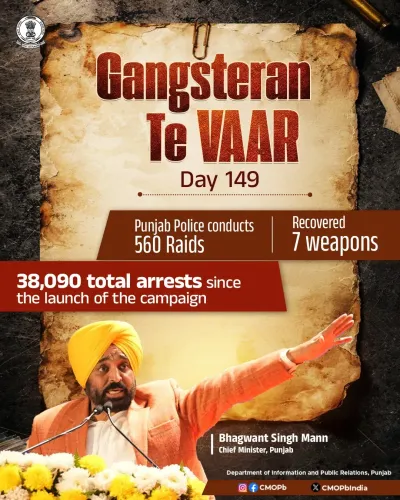
Punjab Police Raids 625 Locations on Day 171 of Gangsteran Te Vaar

Synopsis
Punjab Police raided 625 pre-mapped locations linked to gangster associates on Day 171 of the 'Gangsteran Te Vaar' campaign, arresting individuals with three weapons. Total arrests since the campaign's launch now stand at 46,357, the Chief Minister's Office of Punjab confirmed on 11 July 2026.
Key Takeaways
Punjab Police conducted 625 simultaneous raids on Day 171 of the Gangsteran Te Vaar campaign on 11 July 2026 .
All targeted locations were pre-identified and mapped, indicating an intelligence-led operational model.
Police arrested individuals and recovered three weapons during the day's operations.
Cumulative arrests since the campaign's launch have reached 46,357 .
The update was officially confirmed by the Chief Minister's Office of Punjab via its verified account.
The campaign targets not just gangsters but their wider associate networks across the entire state.
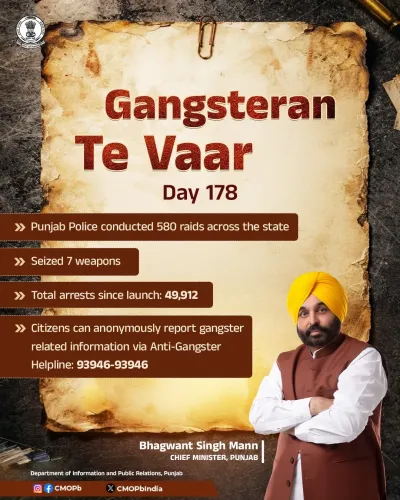
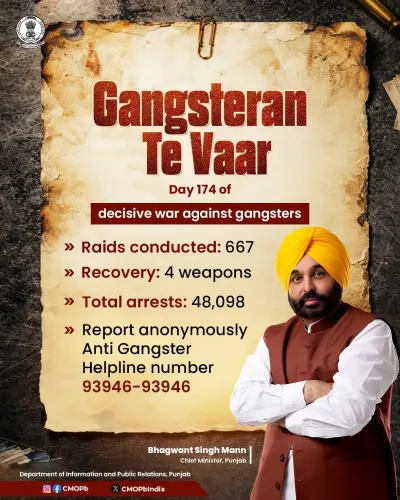
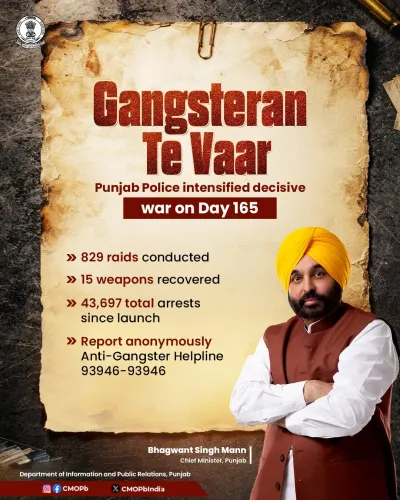
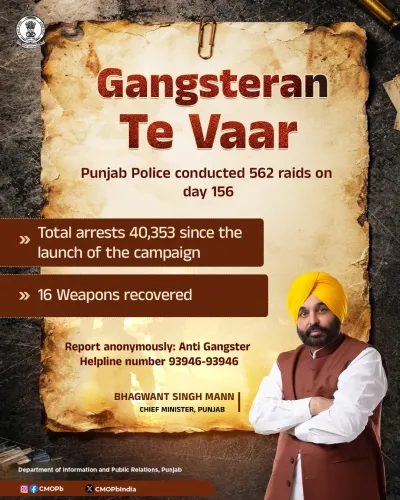
The Chief Minister's Office of Punjab announced on Saturday, 11 July 2026 that Punjab Police conducted 625 raids across the state on the 171st day of the ongoing anti-gangster drive, 'Gangsteran Te Vaar' ('War on Gangsters'), pushing total arrests since the campaign's launch to 46,357.
What Happened on Day 171
Police teams simultaneously descended on 625 identified and mapped locations linked to associates of gangsters spread across the state. The coordinated nature of the operation — targeting pre-mapped sites — reflects an intelligence-led approach rather than reactive policing. On this single day, personnel arrested individuals and recovered three weapons, adding to the campaign's cumulative seizure tally.
The CMO's official post confirmed the milestone in both Punjabi and English, stating: 'Punjab Police conducted 625 raids at identified and mapped locations linked to associates of gangsters across the state... taking the total arrests to 46,357 since the launch of the campaign.'
Context: The Gangsteran Te Vaar Campaign
The 'Gangsteran Te Vaar' campaign is an ongoing, sustained crackdown by Punjab Police targeting organised criminal networks and their support ecosystems across the state. Rather than focusing solely on named gang leaders, the drive systematically maps and raids the wider associate networks that enable gangster operations — logistics, safe houses, and weapon supply chains.
Punjab has faced persistent challenges with gang-related violence, often intertwined with drug trafficking and cross-border networks. Successive state governments since the 2010s have launched periodic anti-gangster and anti-drug operations, but the current campaign is notable for its scale and the consistency of daily operational reporting from the Chief Minister's Office.
Policy Backdrop
The decision to publicly report day-by-day statistics — raids conducted, arrests made, weapons recovered — is itself a governance choice, signalling accountability and deterrence simultaneously. Daily disclosures from the CMO Punjab keep the campaign in public view and create a running audit trail of police activity.
The use of pre-identified and 'mapped' locations indicates that intelligence gathering precedes each day's raids, suggesting coordination between district police units and state-level crime intelligence wings. The recovery of weapons, even in small numbers per day, is significant given Punjab's documented problem with illicit arms flowing through gangster networks.
Stakeholders and Impact
For ordinary Punjab residents — particularly in districts historically troubled by gang violence — the sustained tempo of raids and arrests signals continued state pressure on criminal networks. Families of those arrested, as well as communities where raids occur, are directly affected by each day's operations.
For Punjab Police, maintaining 171 consecutive days of operational activity at this scale represents a significant institutional commitment. The cumulative figure of 46,357 arrests will face scrutiny over conviction rates and the long-term dismantling of gang infrastructure, questions that the campaign's eventual audit will need to address.
What's Next
With the campaign now past its 171st day, attention will turn to outcomes beyond raw arrest numbers — including weapon and asset recovery trends, charge-sheet filing rates, and whether key gang operatives have been neutralised. Any announced expansion of the campaign's geographic scope or a formal review by the state government would be the next significant development to watch.
Point of View
357 arrests over 171 days is striking, but the campaign's true legacy will be judged on whether gang infrastructure is durably dismantled or merely disrupted temporarily. Punjab's organised crime problem has historically proven resilient to periodic crackdowns, bouncing back once operational pressure eases. The intelligence-led mapping of associate networks, if sustained, could represent a structural shift — but that conclusion requires outcome data that has not yet been placed in the public domain.
NationPress
10 Oct 2026
Frequently Asked Questions
What is the Gangsteran Te Vaar campaign in Punjab?
'Gangsteran Te Vaar' (War on Gangsters) is an ongoing Punjab Police operation that conducts daily raids on gangsters and their associate networks across the state, with cumulative arrests exceeding 46,000 as of July 2026.
How many arrests have been made in Gangsteran Te Vaar so far?
As of Day 171 on 11 July 2026, the total number of arrests made since the campaign's launch stands at 46,357, according to the Chief Minister's Office of Punjab.
How many raids did Punjab Police conduct on Day 171?
Punjab Police conducted 625 raids at identified and mapped locations linked to gangster associates across the state on Day 171 of the campaign.
What weapons were recovered during the Day 171 raids?
Police teams recovered three weapons during arrests made on Day 171 of the Gangsteran Te Vaar campaign on 11 July 2026.
Why does Punjab have a gangster problem?
Punjab has faced persistent organised crime challenges linked to drug trafficking and cross-border networks since the 2010s, prompting successive state governments to launch anti-gangster operations, of which Gangsteran Te Vaar is the current iteration.