Punjab Police hits Day 197 of 'Gangsteran Te Vaar' with 652 raids

Synopsis
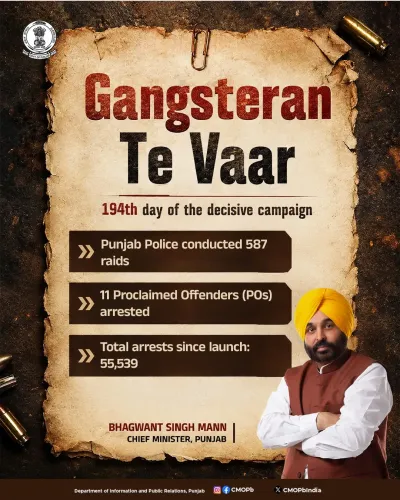
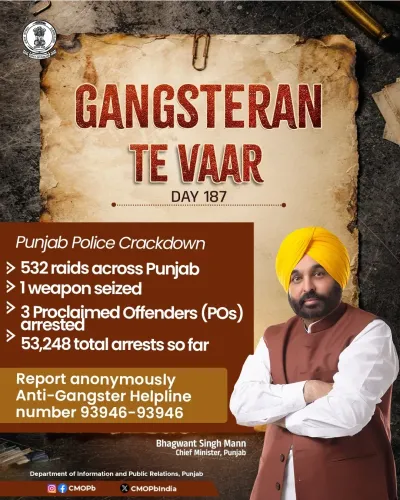
On Day 197 of Punjab's 'Gangsteran Te Vaar' campaign, police conducted 652 raids across the state, arrested 11 Proclaimed Offenders, and seized three weapons — lifting the campaign's total arrest count to 56,909 since its launch.
Key Takeaways
652 raids were conducted on Day 197 of the 'Gangsteran Te Vaar' campaign on August 6, 2026 .
The raids targeted mapped locations linked to associates of gangsters across Punjab .
Arresting teams recovered three weapons during the day's operations.
11 Proclaimed Offenders (POs) — individuals who have evaded court appearances — were arrested in the same sweep.
Total arrests since the campaign's launch now stand at 56,909 .
The campaign is a flagship law-and-order initiative of Chief Minister Bhagwant Mann 's AAP government, focused on dismantling gangster networks through sustained associate-mapping.
Nearly 200 days in, Punjab's most sustained anti-gangster offensive shows no sign of slowing down. On Day 197 of the 'Gangsteran Te Vaar' campaign, Punjab Police conducted 652 raids at identified and mapped locations linked to gangster associates across the state — pushing the cumulative arrest count to a landmark 56,909 since the drive began.
652 raids in a single day — what that number means
The scale of Thursday's operation is not incidental. The campaign's defining strategy has been geographic mapping — building a grid of associate networks rather than chasing individual kingpins. On August 6, 2026, raiding teams fanned out to pre-identified nodes across Punjab, arresting individuals in possession of three weapons and detaining 11 Proclaimed Offenders (POs) in the same sweep.
Proclaimed Offenders are individuals who have failed to appear before a court after being summoned — their arrest in the same operation signals that the campaign is simultaneously targeting active criminal networks and those who have already evaded judicial process.
56,909 arrests and the architecture of a sustained crackdown
When the Aam Aadmi Party government under Chief Minister Bhagwant Mann came to power in March 2022, dismantling Punjab's gangster-drug nexus was a centrepiece commitment. Gangsteran Te Vaar — literally 'Strike on Gangsters' — became the operational expression of that promise: not a one-week blitz, but a rolling, data-driven campaign that maps associates, seizes weapons, and chips away at the supply chain of organised crime.
Punjab's organised crime problem is structurally complex, with cross-border networks linking local gangs to drug trafficking corridors. By targeting associates rather than only bosses, the campaign attempts to collapse the support infrastructure that allows gangsters to operate even from custody or abroad.
Why the associate-mapping model matters
Earlier anti-crime drives in Punjab and comparable northern Indian states typically surged during high-profile incidents, then receded. The 197-day unbroken run of Gangsteran Te Vaar represents a different doctrine — attrition over spectacle. Each day's raids generate fresh intelligence, and the cumulative pressure on lower-level associates is designed to dry up the logistics, shelter, and finances that sustain gangster networks at the top.
The weapon seizures, however modest in any single day's tally, compound over time: removing firearms from circulation in a state where weapons have historically been the currency of criminal power.
With the campaign now past the six-month mark and arrest totals approaching 57,000, the question shifts from whether Punjab Police can sustain the tempo — to whether the numbers translate into measurable safety on the ground.
Point of View
Incident-driven policing to a sustained attrition model that targets associate networks rather than only headline criminals. For the Bhagwant Mann government, the daily reporting cadence is as much a political signal as an operational one: it keeps law and order visible as a governance achievement in a state where crime and drug trafficking have historically defined electoral cycles. The 56,909-arrest milestone, if verified and translated into prosecutions, would mark a genuine structural intervention — but the campaign's long-term credibility will hinge on conviction rates and recidivism data, not raid counts alone. Comparable sustained drives in other northern Indian states have shown that associate-mapping can disrupt networks in the short term, but durable results require parallel action on courts, prisons, and cross-border trafficking routes.
NationPress
20 Sept 2026
Frequently Asked Questions
What is the 'Gangsteran Te Vaar' campaign in Punjab?
'Gangsteran Te Vaar' — meaning 'Strike on Gangsters' — is a sustained statewide police campaign launched by the Bhagwant Mann-led AAP government in Punjab to dismantle gangster networks through daily raids, arrests, and geographic mapping of criminal associates.
How many arrests have been made under Gangsteran Te Vaar?
As of Day 197 of the campaign on August 6, 2026, total arrests since the campaign's launch have reached 56,909, according to the Chief Minister's Office of Punjab.
What are Proclaimed Offenders and why were 11 arrested?
Proclaimed Offenders are individuals who have been summoned by a court but failed to appear, making them officially absconding. Punjab Police arrested 11 such individuals on Day 197 as part of the same operation, indicating the campaign targets both active criminals and those evading judicial process.
How many raids did Punjab Police conduct on Day 197?
Punjab Police conducted 652 raids on Day 197 of the 'Gangsteran Te Vaar' campaign, targeting pre-identified and mapped locations linked to gangster associates across Punjab.
Why does Punjab target gangster associates rather than only gang leaders?
Targeting associates — the logistics, shelter, and financial support networks around gang leaders — is designed to collapse the infrastructure that allows gangsters to operate even from custody or abroad. This associate-mapping model aims for sustained attrition rather than one-off arrests of kingpins.