Punjab Police Conducts 1,070 Raids on Day 168 of Gangsteran Te Vaar
Synopsis
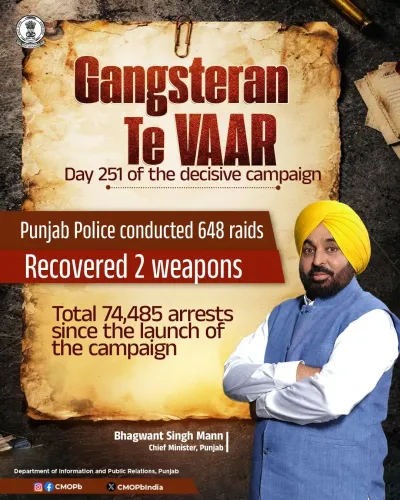
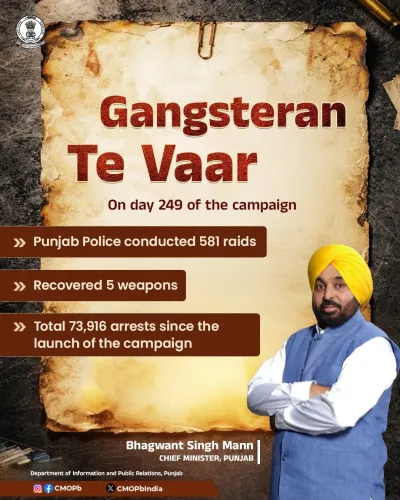
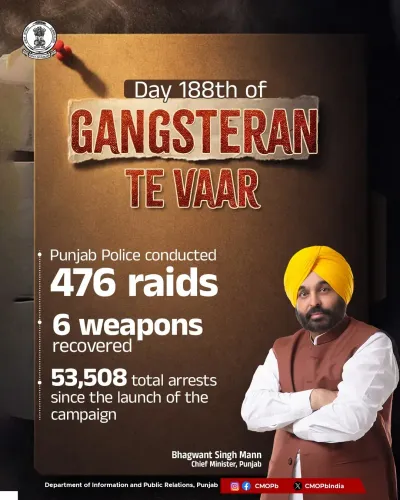
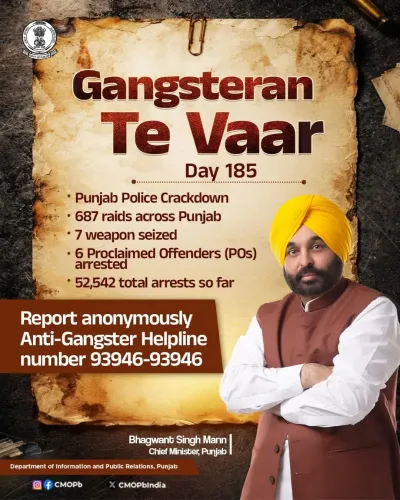
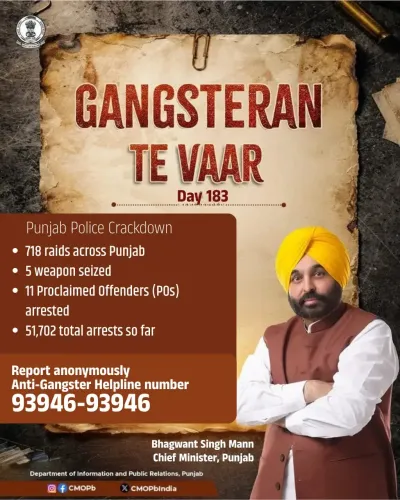
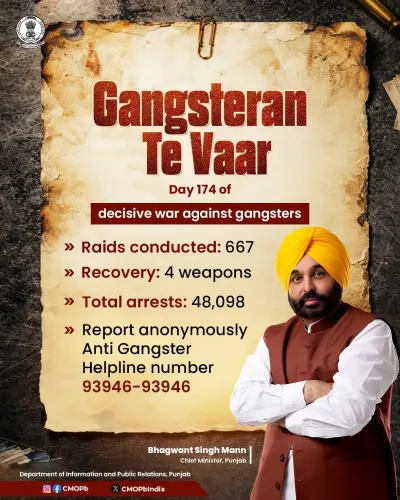
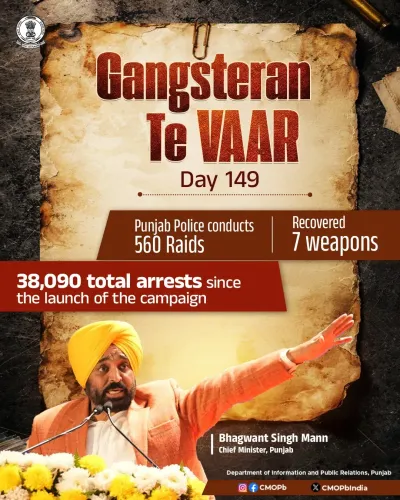
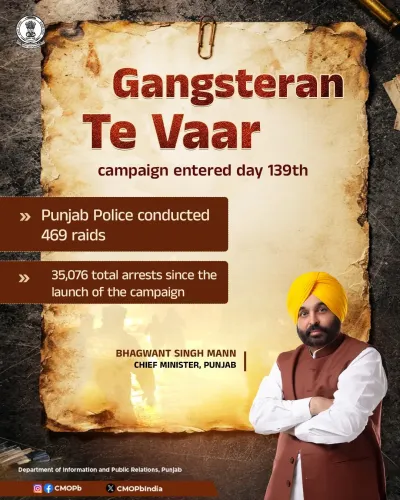
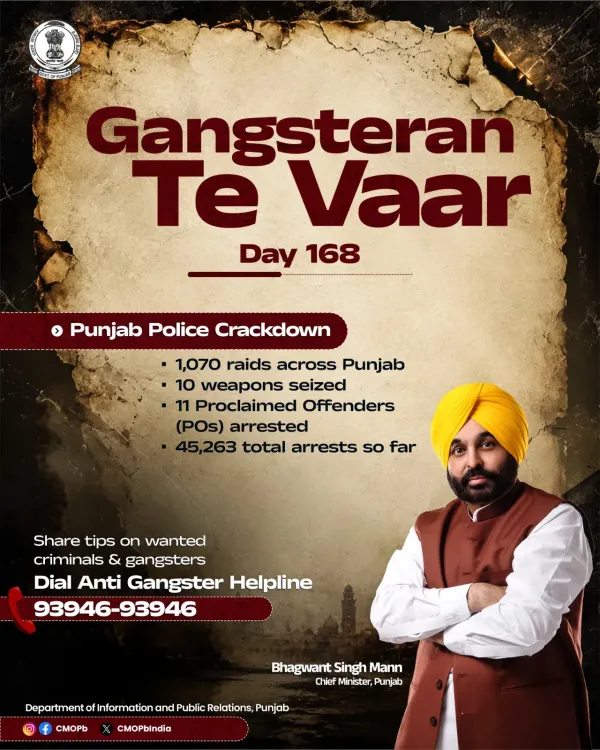
Punjab Police conducted 1,070 raids on Day 168 of the 'Gangsteran Te Vaar' anti-gangster campaign, arresting individuals with 10 weapons, nabbing 11 Proclaimed Offenders, and taking preventive action against 406 persons. Total arrests since the campaign's launch now stand at 45,263.
Key Takeaways
1,070 raids were conducted on Day 168 of the 'Gangsteran Te Vaar' campaign at mapped locations linked to gangster associates across Punjab.
10 weapons were seized during Day 168 arrests, adding to the campaign's cumulative arms recoveries.
The total number of arrests since the campaign's launch has reached 45,263 .
11 Proclaimed Offenders (POs) were arrested during Day 168 operations.
Preventive action was taken against 406 persons on the same day.
The campaign was launched under the AAP government's zero-tolerance policy against organised crime, announced after the 2022 Punjab assembly elections .
The Chief Minister's Office of Punjab announced on Wednesday, July 8, 2026, that the state's sweeping anti-gangster drive, 'Gangsteran Te Vaar', has entered its 168th day, with Punjab Police carrying out 1,070 raids at identified and mapped locations linked to associates of gangsters across the state.
What Happened on Day 168
On the 168th day of the campaign, police teams arrested individuals along with the seizure of 10 weapons. The day's operations also saw the arrest of 11 Proclaimed Offenders (POs), individuals who had previously evaded court appearances or police custody. Additionally, preventive action was taken against 406 persons during the same period.
The cumulative arrest tally since the campaign's launch now stands at 45,263, according to the official post. The CMO described the operation as 'decisive' — ਮੁੱਖ_ਮੰਤਰੀ_ਦਫ਼ਤਰ_ਪੰਜਾਬ [Chief Minister's Office of Punjab] — signalling continued political ownership of the crackdown.
Context: Punjab's Organised Crime Problem
Punjab has long grappled with organised criminal networks involved in extortion, contract killings, and drug trafficking, many with overseas connections. These syndicates have operated with relative impunity by exploiting cross-border supply chains and leveraging political and police contacts built up over decades.
Successive state governments attempted targeted police operations against gangster networks through the 2010s and early 2020s, but critics argued those drives lacked sustained momentum. The scale and duration of the current campaign mark a departure from earlier episodic enforcement.
Policy Backdrop: AAP's Zero-Tolerance Pledge
After the Aam Aadmi Party swept the 2022 Punjab assembly elections, Chief Minister Bhagwant Mann announced a zero-tolerance approach to organised crime and drug mafias as a central governance commitment. The 'Gangsteran Te Vaar' campaign — roughly translated as 'Strike Against Gangsters' — was launched as the operational expression of that pledge.
The drive involves systematic mapping of locations associated with known gangster networks, enabling targeted raids rather than reactive policing. The use of mapped intelligence and preventive detention provisions reflects a shift toward structured, intelligence-led enforcement in the state.
Stakeholders and Impact
For Punjab residents, particularly in districts historically affected by gang violence, the sustained pace of raids and arrests represents a visible change in law-enforcement presence. Families of victims of extortion and contract killings have long demanded more consistent action against syndicate structures.
The arrest of Proclaimed Offenders is especially significant: POs are individuals who have evaded the judicial process and whose apprehension signals improved coordination between police and courts. The seizure of 10 weapons on a single day also points to continued efforts to disrupt the arms supply chains that sustain gang operations.
What's Next
The key test for the campaign will be the conversion of arrests into convictions. Legal observers and civil society groups have noted that high arrest numbers must be backed by robust prosecution to produce lasting deterrence. Any new legislation in the Punjab Assembly aimed at strengthening anti-gangster provisions — such as enhanced asset-forfeiture rules or stricter bail conditions for organised-crime accused — could further reinforce the campaign's impact.
With the operation now past the 168-day mark and showing no sign of winding down, the AAP government appears committed to sustaining enforcement pressure as a defining element of its law-and-order record ahead of future electoral cycles.
Point of View
263 cumulative arrests — signals that the AAP government in Punjab is treating anti-gangster enforcement as a long-term governance project rather than a short-term optics exercise. The daily disclosure of operational metrics through the CMO's official channel reflects a deliberate communications strategy, keeping law-and-order performance visible to the public. However, the campaign's ultimate credibility will hinge on prosecution outcomes: large arrest numbers that do not translate into convictions risk being dismissed as performative policing. The broader pattern also fits Punjab's historical cycle of intensive crackdowns that ebb and flow with political cycles, making institutional reforms — not just raids — the real measure of lasting change.
NationPress
7 Oct 2026
Frequently Asked Questions
What is the 'Gangsteran Te Vaar' campaign in Punjab?
'Gangsteran Te Vaar' — meaning 'Strike Against Gangsters' — is an ongoing Punjab Police campaign launched under the AAP government involving systematic, intelligence-led raids on locations mapped to gangster associates across the state.
How many total arrests have been made in the Gangsteran Te Vaar campaign?
As of Day 168 of the campaign, the total number of arrests stands at 45,263 , according to the Chief Minister's Office of Punjab.
What happened on Day 168 of the Gangsteran Te Vaar operation?
On Day 168, Punjab Police conducted 1,070 raids , arrested individuals with 10 weapons , nabbed 11 Proclaimed Offenders , and took preventive action against 406 persons .
Who is overseeing the anti-gangster campaign in Punjab?
The campaign is being executed by Punjab Police under the political direction of Chief Minister Bhagwant Mann and the AAP government, which pledged zero tolerance for organised crime after winning the 2022 assembly elections.
What are Proclaimed Offenders and why does arresting them matter?
Proclaimed Offenders (POs) are individuals who have evaded court summons or police custody and been formally declared as such by a court. Arresting them signals improved coordination between law enforcement and the judiciary in tracking fugitives.