Punjab Police Hits Day 271 of 'Gangsteran Te Vaar' Campaign
Synopsis
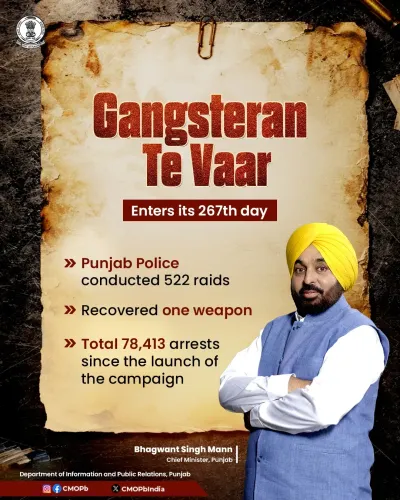
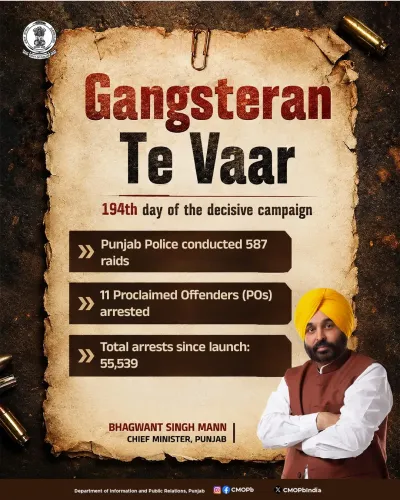
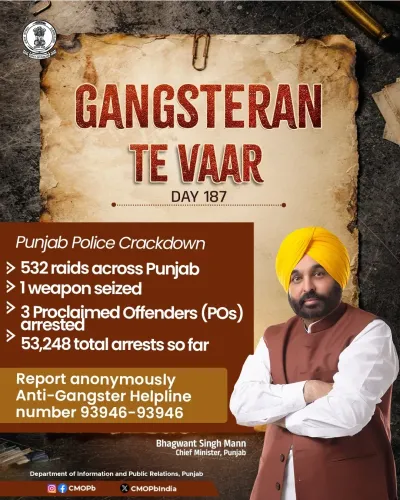
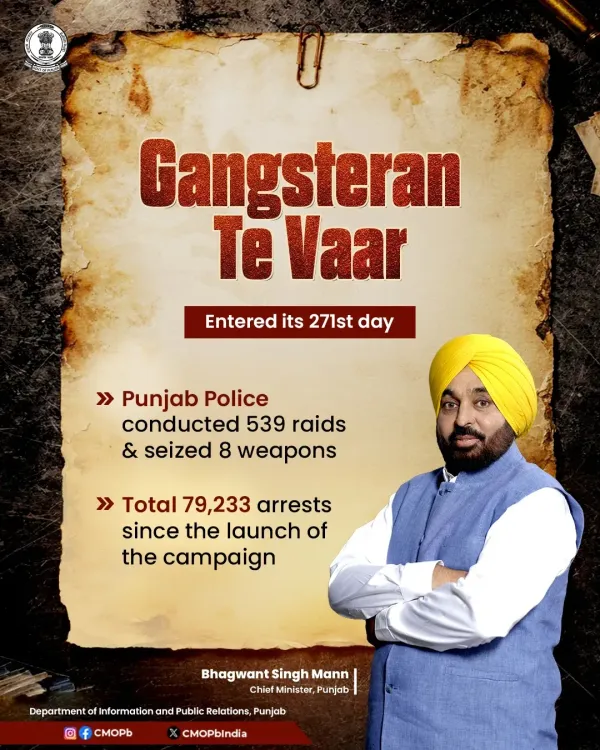
On Day 271 of Punjab's 'Gangsteran Te Vaar' campaign, police conducted 539 raids across the state, recovered eight weapons, and pushed cumulative arrests to 79,233 — marking another high-volume day in the government's sustained crackdown on gangster networks.
Key Takeaways
539 raids were conducted across Punjab on Day 271 of the Gangsteran Te Vaar campaign.
Eight weapons were recovered during the Day 271 operations.
Cumulative arrests since the campaign's launch have reached 79,233 .
The campaign targets mapped locations linked to gangster associates, not just principal suspects.
Chief Minister Bhagwant Mann's AAP government has maintained a high-volume, sustained operational tempo since taking office in March 2022 .
Punjab's organised crime networks span extortion, contract killings and drug trafficking, often with cross-border dimensions.
Nearly nine months into a relentless crackdown on organised crime, Punjab Police conducted 539 raids on a single day — Day 271 of the Gangsteran Te Vaar ('Strike Against Gangsters') campaign — targeting locations linked to gangster associates mapped across the state. The Chief Minister's Office of Punjab announced on Monday, October 19, 2026, that the day's operations added fresh arrests and the recovery of eight weapons, pushing the campaign's cumulative arrest total to 79,233.
What one day of raiding looks like across Punjab
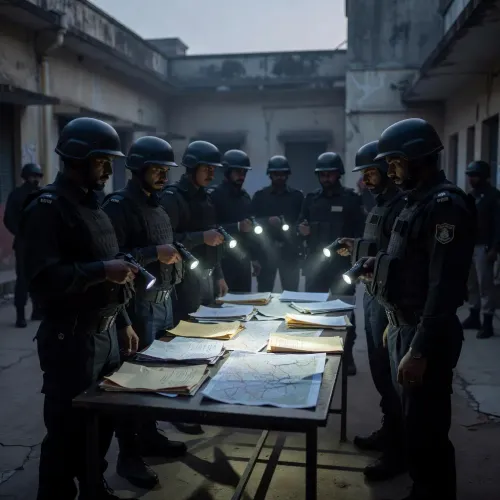
Five hundred and thirty-nine raids in a single day is not a number that happens by accident. It signals an intelligence-backed, pre-mapped operation — police teams fanning out simultaneously across the state to locations that have already been identified as nodes in gangster networks. The recovery of eight weapons on Day 271 alone underlines that these are not dry runs; active assets are still being seized from active networks.
The campaign's architecture — pre-mapped associate locations, coordinated multi-team raids, rolling daily tallies — reflects a doctrine designed to deny gangsters the ground-level support structures they depend on: safe houses, weapons caches, and loyalists who move money, messages, and men.
79,233 arrests and what they reveal about Punjab's organised crime landscape
A cumulative arrest figure of 79,233 since the campaign's launch speaks to the sheer scale of the ecosystem Punjab authorities are targeting. Punjab has for years contended with organised crime networks whose tentacles reach into extortion, contract killings and drug trafficking — often with cross-border dimensions that complicate enforcement. Successive state governments have mounted sustained police campaigns, but the current drive under Chief Minister Bhagwant Mann of the Aam Aadmi Party, in office since March 2022, has emphasised persistent, high-volume operational tempo rather than episodic surges.
The logic is attrition: strip away associates, cut supply lines, confiscate weapons, and the upper rungs of gangster hierarchies become progressively harder to sustain. Whether that logic is translating into measurable drops in extortion calls or contract violence is the question Punjab residents will keep asking as the campaign advances toward its one-year mark.
The pressure on Punjab Police to sustain momentum
Punjab Police now faces the institutional challenge that every long-running campaign confronts — maintaining operational intensity, intelligence freshness and officer morale well past the initial surge of publicity. The upcoming release of state crime statistics will be a critical test: high arrest counts must eventually correlate with lower indices of gang-related violence to validate the campaign's depth rather than just its breadth. Legislation on organised crime and witness protection, flagged as policy measures still under consideration, could give the campaign a durable legal architecture beyond the current enforcement-heavy approach.
For now, Day 271 adds another data point to a campaign that Punjab's government is clearly determined to keep in the public eye — and on the ground.
Point of View
Which has staked law-and-order credibility on visible, rolling enforcement. A cumulative arrest count exceeding 79,000 is a powerful headline metric, but it also raises a harder question: whether volume is outpacing verification and whether the courts and prisons can absorb this throughput without systemic strain. The campaign fits into a longer arc of Punjab governments using high-intensity policing to signal control over a state whose reputation has been shadowed by gang violence and cross-border crime networks. The real measure of success will arrive not in daily raid tallies but in the next credible crime-rate data — and in whether witness protection and organised-crime legislation give these arrests lasting legal weight.
NationPress
19 Oct 2026
Frequently Asked Questions
What is the Gangsteran Te Vaar campaign in Punjab?
'Gangsteran Te Vaar' — meaning 'Strike Against Gangsters' — is an ongoing Punjab Police operation launched under the Bhagwant Mann government to conduct raids, arrests and weapon seizures targeting gangsters and their associate networks across the state.
How many arrests have been made under Gangsteran Te Vaar?
As of Day 271 of the campaign, Punjab Police have made a cumulative total of 79,233 arrests since the operation's launch, according to the Chief Minister's Office of Punjab.
How many raids did Punjab Police conduct on Day 271?
Punjab Police conducted 539 raids on Day 271 of the Gangsteran Te Vaar campaign, targeting pre-identified and mapped locations linked to gangster associates across the state.
Who is overseeing the anti-gangster campaign in Punjab?
Chief Minister Bhagwant Mann, heading the Aam Aadmi Party government in Punjab since March 2022, oversees the state's law-and-order initiatives including the Gangsteran Te Vaar campaign.
Why does Punjab have a gangster problem?
Punjab has long faced organised crime networks involved in extortion, contract killings and drug trafficking, often with cross-border dimensions. Successive state governments have mounted sustained police campaigns to address these networks.