Puri recalls hockey heartbreak and glory after Modi honours Rajinder Singh Senior
Synopsis
Union Petroleum Minister Hardeep Singh Puri shared a deeply personal reflection on Indian hockey after PM Modi honoured 1980 Moscow Olympic gold medallist and RoundGlass Hockey Academy mentor Rajinder Singh Senior on the 138th edition of Mann Ki Baat, tracing the sport's arc from childhood heartbreak to a modernising grassroots ecosystem.
Key Takeaways
PM Narendra Modi highlighted hockey legend Rajinder Singh Senior on the 138th edition of Mann Ki Baat on 27 September 2026 .
Rajinder Singh Senior was a member of India's 1980 Moscow Olympics gold-winning hockey team — the country's last Olympic gold in the sport.
He later coached India to its first Men's Junior World Cup title in 2001 and the Senior Asia Cup in 2003 .
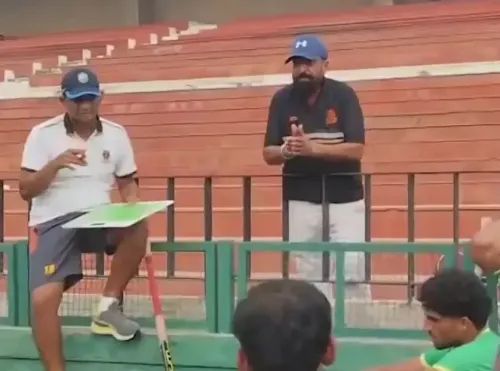
He continues grassroots work through the RoundGlass Hockey Academy , identifying village talent and building training infrastructure.
Minister Hardeep Singh Puri traced his personal connection to Indian hockey from age eight, when he first learned of the 1960 Rome Olympics loss while studying at a German school.
Government initiative Khelo India , launched in 2017 , has added institutional support to grassroots talent pipelines in hockey and other sports.
An eight-year-old boy in a German classroom, devastated to learn India had lost Olympic gold in Rome in 1960 — that is the personal memory Union Petroleum Minister Hardeep Singh Puri reached back to on Sunday, 27 September 2026, after Prime Minister Narendra Modi used the 138th edition of Mann Ki Baat to pay tribute to hockey legend Rajinder Singh Senior, a hero of India's last Olympic gold in Moscow 1980.
The gold that took twenty years to return
Puri's recollection traces a precise emotional arc across two decades of Indian hockey. The 1960 Rome Olympics ended India's streak; Tokyo 1964 brought the gold back; and then came the long wait — until Moscow 1980, when India claimed its eighth and, to date, last Olympic title. 'Hearing Rajinder Singh Senior, one of the heroes of that historic victory, being remembered today brought those memories vividly back,' Puri wrote, grounding a national sporting narrative in something intimate and generational.
From Moscow medallist to Junior World Cup architect
Rajinder Singh Senior was a member of that 1980 Moscow gold-winning squad — a team that carried Indian hockey through what would become a long post-Olympic drought. His contribution, however, did not freeze in time. He went on to coach the sides that won India's first Men's Junior World Cup in 2001 and the Senior Asia Cup in 2003, two landmarks that quietly signalled the sport's renewal even as cricket began to dominate the national imagination.
RoundGlass Hockey Academy and the village pipeline
What makes Rajinder Singh Senior's story particularly resonant is its third act. Through the RoundGlass Hockey Academy, he continues to scout talent in India's villages, improve training infrastructure, and mentor the next wave of players. Puri framed it as a continuum — 'from winning for India to building India's hockey future' — situating one man's decades-long service within a broader, modernising sporting ecosystem. Government programmes such as Khelo India, launched in 2017 to identify and support grassroots talent, have added institutional heft to efforts that figures like Rajinder Singh Senior pioneered through personal commitment.
Mann Ki Baat as a platform for hockey's unsung architects
PM Modi's monthly radio programme has become a recurring stage for shining a light on non-cricket sporting figures — athletes and coaches whose contributions rarely command prime-time attention. By invoking Rajinder Singh Senior in this edition, the programme reinforced a deliberate policy signal: that India's sporting ambitions depend as much on the coaches and talent-scouts working in relative obscurity as on the medal-winners themselves. For Puri, a former career diplomat whose formative hockey memory was formed abroad, the moment clearly struck something personal — and, he suggests, generational.
India's hockey ecosystem is visibly evolving, with a world-class national programme, improving junior ranks, and grassroots pipelines now backed by both private academies and state funding. Whether that momentum translates to an Olympic podium in the next cycle will be the real measure of whether the builders — men like Rajinder Singh Senior — have finished what they started.
Point of View
Puri humanises the government's sports-recognition agenda without making it feel like a press release. The framing of Rajinder Singh Senior as both Olympian and institution-builder also implicitly endorses the private-academy model — such as RoundGlass — as a complement to state-led schemes. Watch whether this renewed public attention translates into greater resource allocation or visibility for hockey ahead of the next Olympic cycle.
NationPress
27 Sept 2026
Frequently Asked Questions
Who is Rajinder Singh Senior in Indian hockey?
Rajinder Singh Senior is a former Indian hockey player who was part of the 1980 Moscow Olympics gold-winning team — India's last Olympic hockey gold. He later coached India to the Men's Junior World Cup in 2001 and the Senior Asia Cup in 2003 , and continues to develop grassroots talent through the RoundGlass Hockey Academy .
Why did PM Modi mention Rajinder Singh Senior on Mann Ki Baat?
PM Narendra Modi highlighted Rajinder Singh Senior's contributions to Indian hockey — as an Olympian, a coach of title-winning teams, and a grassroots mentor — on the 138th edition of Mann Ki Baat on 27 September 2026 , as part of the programme's recurring focus on non-cricket sporting figures.
When did India last win Olympic gold in hockey?
India last won Olympic gold in hockey at the 1980 Moscow Olympics , making it the country's eighth and most recent title. Prior golds also came at Rome 1960 (lost that edition) and Tokyo 1964 , as recalled by Minister Hardeep Singh Puri in his post.
What is the RoundGlass Hockey Academy?
The RoundGlass Hockey Academy is an initiative through which Rajinder Singh Senior identifies hockey talent in Indian villages, provides access to better training facilities, and nurtures young players, complementing government schemes like Khelo India .
What is Khelo India and how does it support hockey?
Khelo India is a government scheme launched in 2017 to identify and develop grassroots sporting talent across India, including hockey. It funds infrastructure and athlete support programmes, working alongside private academies to build a stronger pipeline of young players.