Is Putin’s Arrival a Geopolitical Signal in the Current Global Order?
Synopsis
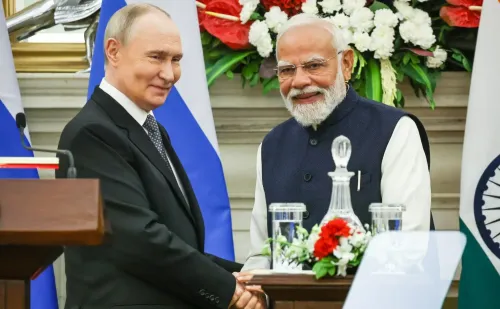
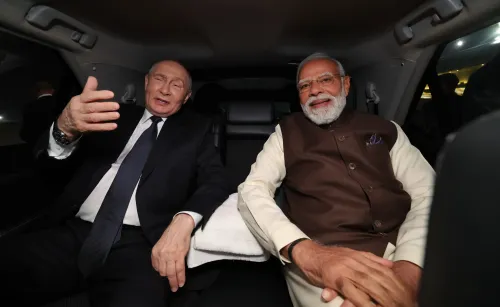
The arrival of Russian President Vladimir Putin in New Delhi, personally welcomed by Prime Minister Narendra Modi, signifies a critical moment in India-Russia relations amidst global geopolitical tensions. This meeting, part of the 23rd India-Russia Annual Summit, highlights a deep-rooted partnership that navigates contemporary challenges, including Western sanctions and international alliances.
Key Takeaways
Putin's visit signifies strong India-Russia ties.
Collaboration in defense and space sectors is a key agenda.
RT India launch marks a new phase in media cooperation.
Both nations navigate complex geopolitical landscapes.
BRICS and SCO highlight collaborative frameworks.
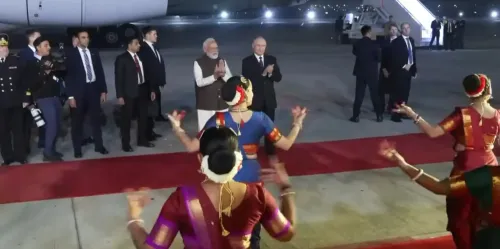
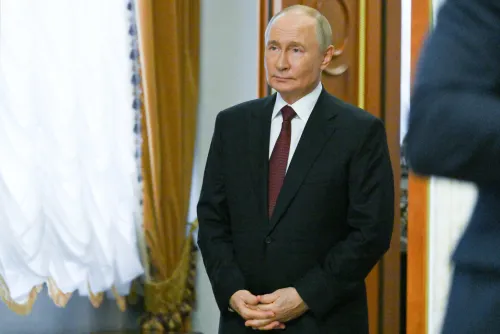
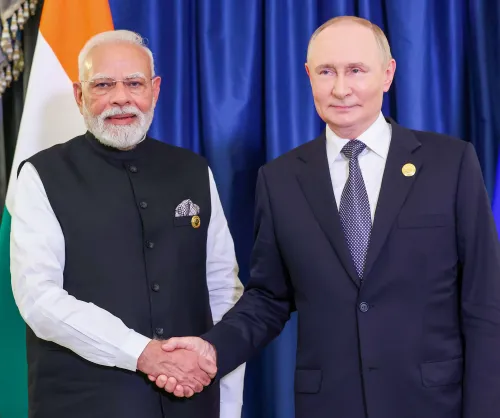
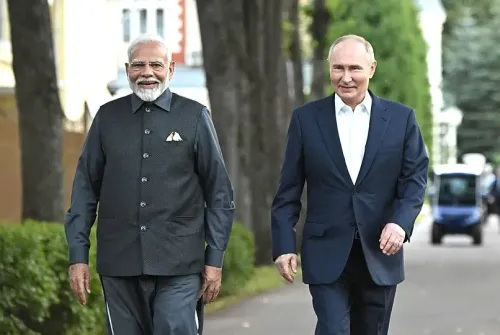
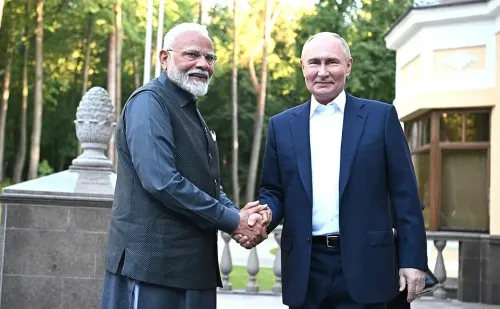
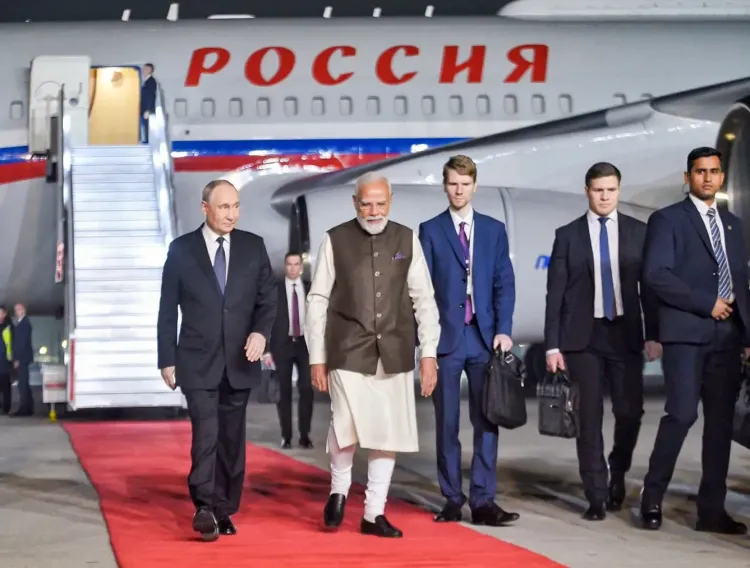
New Delhi, Dec 4 (NationPress) As the aircraft carrying Russian President Vladimir Putin landed at Delhi’s Palam Airport, he might not have realized that Prime Minister Narendra Modi was personally present at the red carpet to greet him.
According to state-sponsored RT, previously known as Russia Today, "Modi has deviated from standard protocol to personally welcome the Russian leader, whom he refers to as his friend, upon his arrival."
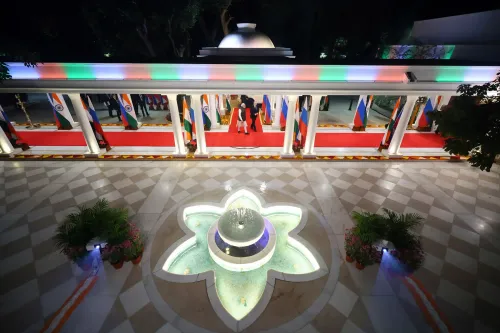
In honor of this significant occasion marking the 23rd India-Russia Annual Summit, a tradition that started in 2000, Putin will officially launch RT India on Friday, December 5.
This Moscow-based global news network plans to introduce four daily news programs in English, aiming to strengthen the long-standing ties between India and Russia as both nations increase their influence in a multipolar global landscape, as reported.
As Kremlin spokesman Dmitry Peskov stated regarding Putin's visit to India, the relationships between Russia and India are strong in "very sensitive areas."
The agenda for the visit includes collaboration discussions in the defence and space sectors, including the joint production of Sukhoi Su-57 fighter jets.
In connection with Putin’s visit, the India-Russia Business Forum is also taking place on December 4-5. A former bureaucrat highlighted that to meet domestic needs, New Delhi procures equipment and machinery from various global sources.
Western manufacturers or suppliers are known for their professionalism and timely support. However, Russian partners are recognized for their hands-on approach in explaining operational and maintenance intricacies. This narrative reflects the intrinsic nature of bilateral ties, which have been resilient since the USSR era.
During the 1971 war against Pakistan, the United States dispatched the Seventh Fleet to exert pressure on India for a ceasefire. In response to New Delhi's request, Moscow promptly sent its Black Fleet to the Arabian Sea, compelling Washington to withdraw its naval forces to avoid escalating tensions.
At the G-20 Summit in New Delhi in 2023, the initial draft explicitly mentioned "Russian aggression" in Ukraine, but India successfully negotiated a shift to the more neutral term "war in Ukraine."
This contrasted with the 2022 G20 Bali Declaration, which expressed "deep concern" over Russia's invasion and the humanitarian crisis that ensued. The updated language reframed the situation as a conflict impacting global stability instead of one solely attributing blame to Russia.
During Operation Sindoor, Russia's S-400 air defense system played a crucial role in countering Pakistani aerial attacks within Indian territory. Following its success, India is now considering the acquisition of Moscow's advanced S-500 Prometheus system to further enhance its air defense capabilities.
New Delhi and Moscow also collaborate in various international forums, including the Quad or Quadrilateral Security Dialogue, alongside Australia, Japan, and the United States.
Another platform is BRICS, an intergovernmental organization consisting of Brazil, Russia, India, China, and South Africa, along with newer members like Egypt, Ethiopia, Indonesia, Iran, Saudi Arabia, and the United Arab Emirates.
BRICS has recently emerged as a key platform for political and economic collaboration among its members, seeking to enhance their global influence and promote development in the Global South.
India is also a member of the SCO, or Shanghai Cooperation Organisation, an intergovernmental organization founded in 2001 by China, Russia, Kazakhstan, Kyrgyzstan, Tajikistan, and Uzbekistan. Its main aim is to foster cooperation and peace among member states while advocating for a fair and rational international political and economic order.
Currently, Russia is facing Western sanctions due to the war in Ukraine, while India is navigating tariff pressures from the US and fluctuations in global energy markets.
In light of these circumstances, Putin’s visit to New Delhi serves as both a diplomatic affirmation and a significant geopolitical signal.
Point of View
This visit underscores the enduring partnership between India and Russia amidst a complex global landscape. With both nations facing external pressures, the reaffirmation of ties is crucial for stability and collaboration in sensitive sectors like defense and trade.
NationPress
2 Oct 2026
Frequently Asked Questions
What is the significance of Putin's visit?
Putin's visit emphasizes the strong bilateral ties between India and Russia, highlighting collaboration in defense, space, and economic sectors amidst global geopolitical shifts.
How does this visit impact India-Russia relations?
This visit reinforces long-standing partnerships and enhances cooperation in sensitive areas, crucial for both nations facing external pressures.
What agreements are expected from this summit?
Discussions are likely to focus on defense collaboration, including joint production of fighter jets and the acquisition of advanced air defense systems.
What role does BRICS play in this context?
BRICS serves as a platform for political and economic cooperation among member states, enhancing their influence in global affairs.
How does the G-20 Summit relate to this visit?
The G-20 Summit's declarations reflect India's diplomatic balancing act, shifting language on Russia's actions in Ukraine to maintain relations while addressing global concerns.