Raghav Chadha backs Public Examination Amendment Bill 2026
Synopsis
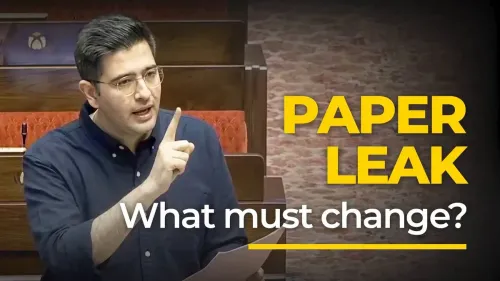
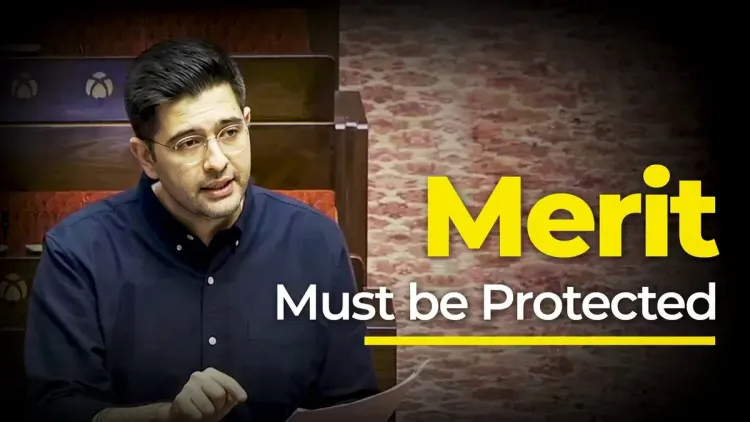
AAP MP Raghav Chadha backed the Public Examination Amendment Bill 2026 in Parliament on 31 July, framing it as India's first statutory institutional answer to chronic paper-leak scandals that have long undermined merit-based exams like NEET and JEE.
Key Takeaways
Raghav Chadha , AAP Rajya Sabha MP, declared support for the Public Examination Amendment Bill 2026 on 31 July 2026 .
He compared ad-hoc political responses to paper leaks to treating cancer with Crocin — a pointed argument for structural reform over soundbites.
The bill builds on the Public Examinations (Prevention of Unfair Means) Act passed in February 2024 , which first introduced statutory penalties for exam fraud.
The National Testing Agency (NTA) , which conducts NEET and JEE , has faced repeated paper-leak controversies that triggered student protests nationwide.
Chadha's cross-party support signals that exam integrity has emerged as a rare area of legislative consensus in Parliament.
Implementation rules, state-level adoption, and potential legal challenges remain the key tests of the amendment's real-world impact.
Paper leaks have haunted India's competitive exam ecosystem for years — costing lakhs of students a fair shot and costing the system its credibility. On 31 July 2026, AAP Rajya Sabha MP Raghav Chadha declared his support for the Public Examination Amendment Bill 2026, calling it India's first real institutional answer to a crisis that soundbites alone could never fix.
The diagnosis: why slogans weren't enough
Chadha's framing was surgical. 'Cancer is not cured by Crocin. Paper leak is not cured by soundbites,' he wrote, drawing a sharp line between political theatre and legislative action. The analogy cut to the core of a problem that has repeatedly derailed lakhs of aspirants — from state board exams to national-level tests conducted by the National Testing Agency (NTA).
Recurring scandals around NEET and JEE have triggered student protests across the country and eroded public trust in merit-based selection. Each leak spawned a new round of outrage, a few transfers, and then — silence. The cycle repeated.
From the 2024 Act to the 2026 Amendment
The legislative groundwork began in February 2024, when Parliament passed the Public Examinations (Prevention of Unfair Means) Act — introducing statutory penalties for paper leaks and unfair practices for the first time. The 2026 Amendment Bill now builds on that foundation, positioning itself as a deeper institutional fix rather than another reactive patch.
Chadha's decision to cross-support the bill — an AAP MP backing a measure in a Parliament where coalition arithmetic is rarely straightforward — signals that the exam-integrity issue has moved beyond partisan lines. 'Today we gave it one,' he wrote, using the collective 'we' to claim shared ownership of the reform.
What the amendment means for India's 2 crore exam aspirants
The stakes are enormous. Millions of young Indians — preparing for UPSC, NEET, JEE, SSC, banking, and railway recruitment exams — pour years of their lives into a system whose integrity they cannot take for granted. Every paper leak is not just a headline; it is a deferred dream, a wasted year, a family's savings spent on coaching that counted for nothing.
The amendment, if implemented robustly, promises to move the response mechanism from damage-control to deterrence — from reacting to leaks to structurally preventing them through institutional safeguards.
The bill has cleared Parliament. Now the harder work begins: notifying implementation rules, ensuring state-level adoption, and proving to a generation of students that the system can actually keep its promise.
Point of View
And backing a legislative fix for paper leaks reinforces that identity without requiring the party to own the bill's authorship. The 2024 Act was a first step; the 2026 amendment tests whether Parliament can move from symbolic deterrence to genuine institutional architecture. The broader pattern here is one of incremental statutory layering — each scandal producing a tighter legal response — but the real measure will be enforcement, not enactment. If implementation stalls, the amendment risks becoming another headline that the next paper leak will bury.
NationPress
31 Jul 2026
Frequently Asked Questions
What is the Public Examination Amendment Bill 2026?
The Public Examination Amendment Bill 2026 is a parliamentary bill aimed at strengthening India's legal framework against paper leaks and unfair practices in public examinations. It amends the Public Examinations (Prevention of Unfair Means) Act passed in February 2024, which first introduced statutory penalties for exam fraud.
Why did Raghav Chadha support the Public Examination Amendment Bill 2026?
AAP Rajya Sabha MP Raghav Chadha said he supported the bill because India needed a real institutional fix for paper leaks — not political soundbites. He argued that recurring exam scandals could only be addressed through structural legislative reform, not ad-hoc responses.
What is the Public Examinations (Prevention of Unfair Means) Act 2024?
Passed by Parliament in February 2024, this Act was India's first dedicated legislation introducing criminal penalties for paper leaks and unfair means in public examinations, targeting exams conducted by bodies like the National Testing Agency.
How have paper leaks affected NEET and JEE students in India?
Repeated paper-leak scandals in NEET and JEE have triggered nationwide student protests, forced exam cancellations or re-tests, and deeply eroded trust in the merit-based selection process, costing aspirants an entire year of preparation in many cases.
What happens next after the Public Examination Amendment Bill 2026 passes?
After passage, the government must notify implementation rules under the amended Act. Key steps include state-level adoption of the framework and potential legal challenges. Effective enforcement — not just enactment — will determine whether the law actually deters future paper leaks.