Raghav Chadha flags 2016 Karnataka paper leak, targets Congress
Synopsis
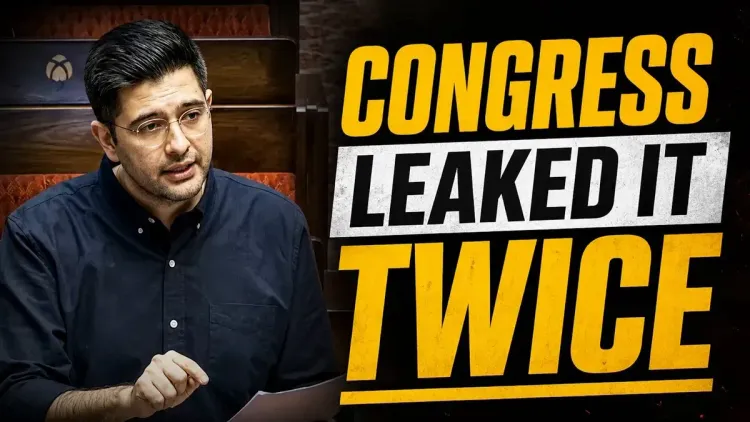
AAP Rajya Sabha MP Raghav Chadha has alleged that a Congress minister whose personal assistant was arrested by the CID for leaking Karnataka's Class 12 Chemistry paper twice in 2016 — forcing two exam cancellations — is now heading the same department again under the current Congress government in Karnataka.
Key Takeaways
In 2016 , Karnataka's Class 12 Chemistry board exam paper leaked twice under a Congress government, forcing two cancellations.
The CID arrested the personal assistant of a minister whose office was identified as the leak source.
No ministerial resignation followed the arrests, according to Chadha's account.
AAP Rajya Sabha MP Raghav Chadha alleges the same minister now heads the same department under the 2026 Karnataka Congress government .
Karnataka Congress has not yet responded to the specific allegation; the minister's identity remains unverified by NationPress.
A 2016 Karnataka exam scandal — where a Class 12 Chemistry paper leaked not once but twice, forcing two cancellations and leaving thousands of students in limbo — has resurfaced as a political flashpoint. AAP Rajya Sabha MP Raghav Chadha on Friday, 31 July 2026, called it 'the most damning paper leak story in this entire debate,' pointing directly at a sitting Congress minister whose personal assistant was arrested by the CID for leaking the papers.
The 2016 double leak that shook Karnataka's board exams
The sequence of events Chadha outlined is stark. Under a Congress government in Karnataka, the Class 12 Chemistry board paper leaked ahead of the scheduled exam. Authorities ordered a re-examination — and that paper leaked too. The exam was cancelled twice. As Chadha put it: 'Leak double, trauma triple.' Karnataka's Criminal Investigation Department (CID) subsequently arrested the personal assistant (PA) of a minister whose own office was identified as the source of the leak.
What followed — or rather, what did not follow — is the crux of Chadha's attack. No ministerial resignation came. The minister in question offered an excuse and stayed in office, a pattern critics of the Congress have cited repeatedly when discussing accountability in education administration.
Same minister, same department, a decade later
Chadha's sharpest punch lands here: he alleges that the same minister now heads the same department under the current Congress government in Karnataka in 2026. 'These are the standards of accountability of the Congress,' he said, framing the decade-long arc as evidence of a systemic indifference to consequences. The identity of the minister has not been independently verified by NationPress, and Karnataka Congress is yet to respond to the specific allegation.
The broader context matters. Exam paper leaks have become a recurring governance flashpoint across Indian states, with opposition parties — regardless of their own records — routinely deploying such cases to question rivals' fitness to govern. Chadha's post is a sharp entry into that ongoing national debate, timed to a moment when paper leak accountability is already under scrutiny across multiple states.
Students caught in the crossfire — then and now
Lost in the political exchange are the students who sat through the chaos of 2016: two cancelled exams, repeated preparation cycles, and the anxiety of not knowing when a valid paper would finally be held. It is their experience that gives the political argument its moral weight — and it is their counterparts today who have the most at stake if the accountability gap Chadha describes is real.
With no official response yet from Karnataka's ruling party, the allegation stands as an open challenge. If the minister's identity and current portfolio are confirmed, the pressure for a formal clarification will only grow.
Point of View
He sidesteps the 'allegation' tag and forces Congress to defend a verifiable sequence of events. The 'same minister, same department' framing is designed to make accountability — not just the original leak — the story. Nationally, exam paper leaks have become a proxy battleground for the larger question of whether India's examination infrastructure is structurally compromised or politically shielded, and AAP has positioned itself as a party willing to call out both BJP and Congress on this front. If Karnataka Congress confirms or denies the minister's current portfolio, the response itself becomes the next news cycle.
NationPress
31 Jul 2026
Frequently Asked Questions
What happened in the 2016 Karnataka Class 12 Chemistry paper leak?
In 2016 , the Class 12 Chemistry board exam paper in Karnataka leaked before the scheduled exam. A re-examination was ordered, but that paper also leaked, forcing authorities to cancel the exam twice. Karnataka's CID arrested the personal assistant of a minister whose office was linked to the leak.
What is Raghav Chadha alleging about the Congress minister?
AAP Rajya Sabha MP Raghav Chadha alleges that the minister whose PA was arrested for the 2016 Karnataka paper leak never resigned, and that the same minister is now running the same education-related department again under the Congress government in Karnataka in 2026.
Did the Karnataka minister resign after the 2016 paper leak?
According to Chadha's post, no resignation followed the CID arrest of the minister's PA. The minister reportedly offered an excuse and continued in office.
What role did the CID play in the 2016 Karnataka paper leak case?
Karnataka's Criminal Investigation Department (CID) investigated the 2016 Class 12 Chemistry paper leak and arrested the personal assistant of a minister whose office was identified as the source of the leaked papers.
Why is Raghav Chadha raising the 2016 Karnataka paper leak in 2026?
Chadha raised the case as part of a broader national debate on exam paper leak accountability, using the 2016 Karnataka incident to argue that Congress has a pattern of shielding ministers from consequences — and that the same minister now being in charge of the same department illustrates that pattern.