Rahul Gandhi scripts Opposition surge as electoral integrity protests grow
Synopsis
Rahul Gandhi is steering the Opposition's protest campaign against alleged electoral manipulation with a director's eye — hand-picking coalition partners, positioning student leaders for optics, and keeping Congress at the centre even as regional heavyweights like Mamata Banerjee show signs of restlessness. The movement's 'unplanned' framing increasingly looks well-scripted.
Key Takeaways
Rahul Gandhi has emerged as the dominant face of Opposition protests in New Delhi against alleged electoral manipulation, as of 13 October 2026 .
Congress President Mallikarjun Kharge is providing organisational coordination and inter-party liaison support.
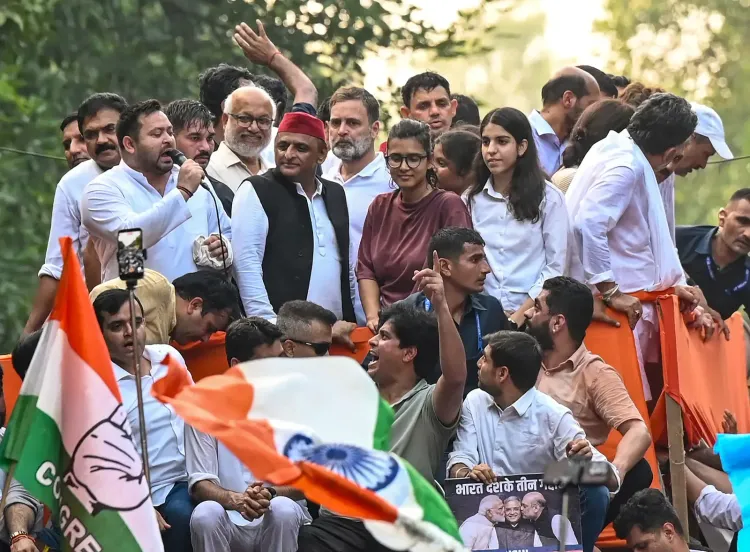
SP's Akhilesh Yadav and RJD's Tejaswi Yadav joined a Monday Constitution Club meeting and subsequent march to the Supreme Court at Congress's initiative.
TMC founder Mamata Banerjee attended the Constitution Club meeting but declined to join the march; she reportedly decided to carry the movement in West Bengal after CJI Surya Kant refused an audience.
Youth representation was ensured through Congress student leader Jannat Bishnoi and AISA President Neha Bora , providing a visible link to the originating CJP movement.
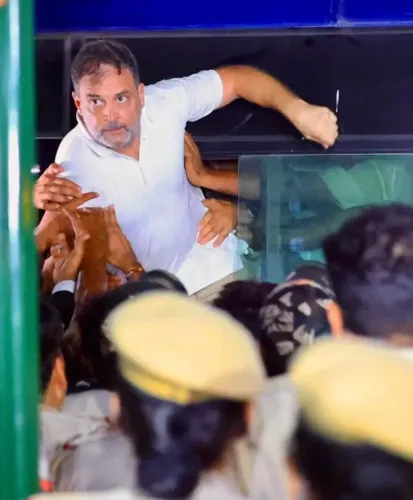
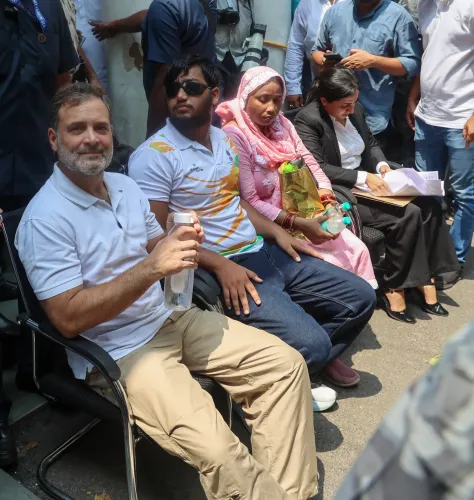
Leader of Opposition in Lok Sabha Rahul Gandhi has emerged as the central face of a widening Opposition campaign against alleged manipulation of electoral machinery, combining street-level mobilisation with a carefully calibrated push for unity across the Opposition bloc. With Congress President Mallikarjun Kharge providing organisational heft and inter-party coordination, the movement has taken on a structured character even as its architects project it as a spontaneous democratic response.
How the Movement Took Shape
The current protest wave traces its origins to the Cockroach Janta Party (CJP), an outfit initially conceived as a satirical political movement, which launched street demonstrations over examination paper leaks and education system reforms. Gandhi chose to express solidarity — but on his own terms, organising a sit-in protest in front of the Prime Minister's residence in a high-security zone, rather than joining the CJP at the designated protest venue of Jantar Mantar. The CJP subsequently escalated by leading a march to Parliament, then in session, drawing wide coverage and competing narratives.
Despite the CJP winning the narrative in that earlier round, Gandhi has consolidated his position as the principal face in the current phase of protests, which centres on alleged interference with electoral processes.
Building the Coalition on the Ground
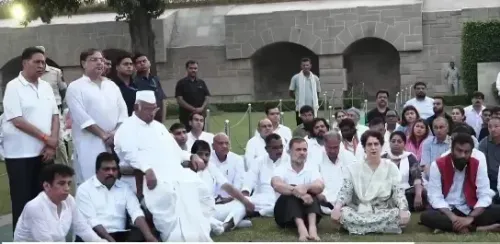
Earlier in this round of demonstrations, Samajwadi Party (SP) President Akhilesh Yadav and Rashtriya Janata Dal (RJD) leader Tejaswi Yadav were separately spearheading campaigns in their respective states of Uttar Pradesh and Bihar. However, Congress ensured both leaders were present at a Monday meeting at the Constitution Club and the subsequent march to the Supreme Court, projecting a unified national front.
Also present at the Constitution Club meeting was All India Trinamool Congress (TMC) founder Mamata Banerjee, who chose to withdraw and return home rather than join the march. Some of her colleagues suggested she would have participated had Chief Justice of India Surya Kant granted an audience and received their memorandum. When the CJI declined, 'Didi' — as Banerjee is widely known — reportedly decided to carry the movement forward in her home state of West Bengal. Some observers claimed she was reportedly displeased at the spotlight remaining focused on Gandhi while other leaders were being sidelined; there was, however, no official confirmation of this version.
Youth Representation and Symbolic Optics
Gandhi's approach to building his visible coalition extended to student and youth representation. He ensured prominent roles for Congress student-wing leader Jannat Bishnoi and All India Students Association (AISA) President Neha Bora, who is affiliated with Left parties. Bora's inclusion provided a visible CJP connection at a moment when critics were characterising the protests as a contest between Gandhi and youth leaders rather than a unified cause.
The visual language of the campaign — encompassing digital outreach, campus interactions, and town hall-style conversations — appears designed to connect electoral reform concerns with broader aspirations around democratic accountability, with younger voters and first-time political participants as a key target audience.
Kharge's Role and the Bigger Picture
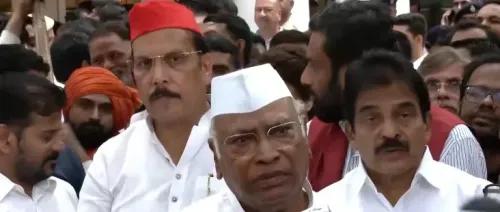
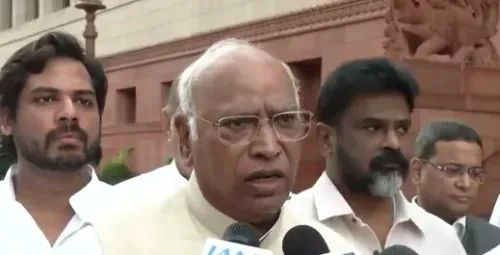
While Gandhi occupies the most visible public position, Kharge has functioned as organisational anchor, coordinating among allies and articulating institutional concerns at inter-party meetings. His interventions have lent the campaign the weight of experience and provided a senior statesman counterpoint to Gandhi's more kinetic public presence.
Opposition leaders privately acknowledge that internal fragmentation remains their greatest vulnerability. By holding together disparate regional parties under a common narrative of institutional accountability, they are laying groundwork that analysts say will become increasingly relevant as election cycles approach. How durable that unity proves — particularly given Banerjee's reported reservations — remains the central unanswered question.
Point of View
And has pulled regional satraps like Yadav and Yadav into a Congress-anchored frame. But the Mamata variable exposes the coalition's structural fragility: a multi-party protest movement where one partner feels sidelined is one press conference away from unravelling. More fundamentally, Opposition unity built around a personality rather than a platform tends to hold only until the next election arithmetic diverges. The real test is not whether Gandhi can dominate a protest cycle — he demonstrably can — but whether that dominance translates into durable institutional pressure or remains, as critics argue, a well-produced political spectacle.
NationPress
13 Oct 2026
Frequently Asked Questions
What are the Opposition protests in New Delhi about?
The protests are centred on alleged manipulation of electoral machinery and institutional accountability, with the Opposition — led visibly by Rahul Gandhi — marching to the Supreme Court to press their concerns. The movement grew out of earlier agitations by the Cockroach Janta Party (CJP) over examination paper leaks and education reform.
Why did Mamata Banerjee not join the Opposition march to the Supreme Court?
Mamata Banerjee attended the Constitution Club meeting but declined to join the subsequent march after Chief Justice of India Surya Kant refused to grant an audience to receive the Opposition's memorandum. Some colleagues suggested she was also reportedly displeased at the focus remaining on Rahul Gandhi, though there was no official confirmation of that version.
What role is Congress President Mallikarjun Kharge playing in the protests?
Kharge is functioning as the organisational backbone — coordinating among Opposition allies, articulating institutional concerns, and lending the campaign the authority of a senior statesman. His role is primarily logistical and diplomatic, complementing Gandhi's more public-facing street presence.
Who is the Cockroach Janta Party and how does it connect to the Congress-led protests?
The Cockroach Janta Party (CJP) was initially conceived as a satirical outfit that evolved into a political movement protesting examination paper leaks and education reforms. Congress subsequently aligned with and drew visibility from the CJP's grassroots momentum, with Gandhi eventually positioning himself as the broader Opposition's lead figure in the current electoral integrity campaign.
Which Opposition parties are participating in the current protest movement?
The coalition includes the Indian National Congress, Samajwadi Party (SP), Rashtriya Janata Dal (RJD), All India Trinamool Congress (TMC) — whose participation is now uncertain — and Left-affiliated student bodies including AISA. SP President Akhilesh Yadav and RJD leader Tejaswi Yadav joined the Monday Constitution Club meeting and the march to the Supreme Court.