Rajasthan CM Bhajan Lal Pushes Ease of Doing Business Reforms

Synopsis
The Chief Minister's Office of Rajasthan says CM Bhajan Lal Sharma's government has made significant Ease of Doing Business decisions, strengthening investor trust and drawing investment into the state — part of India's decade-long inter-state competition for capital.
Key Takeaways
The Chief Minister's Office of Rajasthan announced key Ease of Doing Business decisions on 10 August 2026 .
CM Bhajan Lal Sharma has been in office since December 2023 and has positioned regulatory reform as a central economic priority.
India's state-level Ease of Doing Business ranking framework has been in place since 2015 , designed to foster competitive federalism.
Rajasthan competes with states like Gujarat , Telangana , and Andhra Pradesh for top EoDB rankings and investment flows.
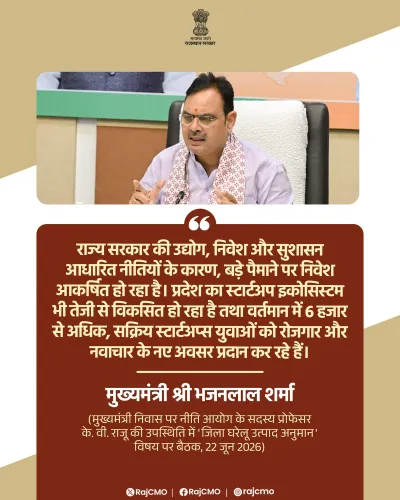
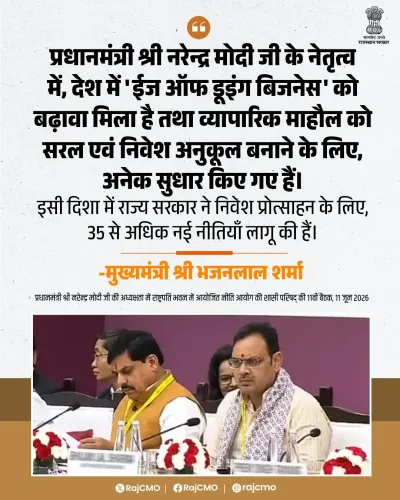
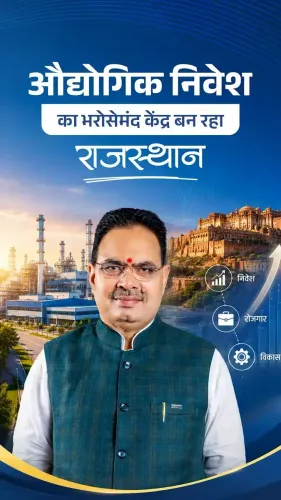
The CMO says industrialists and investors have shown strengthened confidence, with investment being attracted to the state.
Future state EoDB rankings and follow-up investment summits will be the real test of these reforms' impact.
Rajasthan is sending a clear signal to investors: the state is open for business. The Chief Minister's Office of Rajasthan announced on Monday, 10 August 2026 that the state government has taken significant decisions to strengthen the Ease of Doing Business environment across the state — moves the CMO says have already begun reinforcing the confidence of industrialists and investors.
The post, attributed to Chief Minister Bhajan Lal Sharma, stated: 'The state government has taken important decisions for Ease of Doing Business in the state, which has strengthened the trust of industrialists and investors and is attracting investment to the state.' The hashtag #आपणो_अग्रणी_राजस्थान ('Our Leading Rajasthan') underscores the BJP government's branding of Rajasthan as a front-runner in the national investment race.
Where Rajasthan Fits in India's Investment Race
The Ease of Doing Business framework is not new — the Government of India launched state-level rankings in 2015 to drive competitive federalism, pushing states to simplify regulations, cut red tape, and create single-window clearances. What followed was a decade-long sprint among states to outrank each other on metrics covering land acquisition, labour law flexibility, construction permits, and environmental clearances.
Rajasthan, a large state with significant mineral wealth and a growing manufacturing base, has historically had to work hard to shed a reputation for bureaucratic complexity. The Sharma government, which took office in December 2023, has positioned regulatory reform as a cornerstone of its economic agenda — part of the broader national push under Make in India and allied schemes designed to draw both domestic capital and foreign direct investment.
Why Investor Confidence Is the Real Metric
Stated reforms only count if they translate into actual investment flows. The CMO's framing — that trust among industrialists has 'strengthened' and investment is 'being attracted' — points to intent, but the proof will come in Rajasthan's next Ease of Doing Business ranking and in any follow-up investment summits or policy notifications the state issues. Indian states have increasingly learned that announcements must be backed by on-ground implementation to retain investor credibility.
The competitive pressure is real. States like Andhra Pradesh, Telangana, and Gujarat have consistently ranked at the top of EoDB tables, and Rajasthan's leadership knows that falling behind in the rankings means losing projects to neighbours. Every reform decision the Sharma government takes now is, in effect, a bid in that ongoing inter-state competition.
Rajasthan is betting that decisive early action in this term will compound into a stronger investment pipeline. Whether the numbers bear that out will be the real verdict.
Point of View
Giving the Rajasthan unit a concrete policy plank ahead of future electoral cycles. The framing of 'strengthened trust' is strategically significant — it positions the government as already delivering results, not merely promising them. However, without specific policy notifications or verifiable ranking improvements, the announcement remains aspirational; the real political dividend comes only when investment translates into jobs and growth that voters can feel. Rajasthan's performance on the next official EoDB ranking will be a credibility test the government cannot afford to fail.
NationPress
25 Sept 2026
Frequently Asked Questions
What is Ease of Doing Business and why does it matter for Rajasthan?
Ease of Doing Business is a Government of India framework, launched in 2015, that ranks states on how simple it is for companies to start, run, and expand businesses. A higher ranking helps Rajasthan attract domestic and foreign investment by signalling a low-friction regulatory environment.
What decisions has the Rajasthan government taken for Ease of Doing Business?
The Chief Minister's Office has stated that significant decisions have been made to improve the business environment, but the specific policy notifications have not been detailed in this announcement. Follow-up official notifications are expected to provide specifics.
Who is Bhajan Lal Sharma and when did he become Rajasthan Chief Minister?
Bhajan Lal Sharma is a BJP leader who became Chief Minister of Rajasthan in December 2023 after the party won the state assembly elections.
How does Rajasthan compare to other states on Ease of Doing Business?
Rajasthan competes with high-performing states such as Gujarat, Telangana, and Andhra Pradesh in national EoDB rankings. The Sharma government's reforms are aimed at improving the state's standing in this competitive ranking.
What is the hashtag 'Aapno Agrani Rajasthan' about?
'Aapno Agrani Rajasthan' translates to 'Our Leading Rajasthan' and is the BJP state government's campaign branding, positioning Rajasthan as a front-runner in development and investment attraction.