Rajasthan CM Bhajanlal's govt develops 51,790 km of roads
Synopsis
The Chief Minister's Office of Rajasthan says CM Bhajanlal Sharma's government has developed 51,790 km of roads spending over ₹37,527 crore through the Public Works Department, targeting rural and urban connectivity across the state.
Key Takeaways
51,790 kilometres of roads developed by Rajasthan's Public Works Department during the current government's tenure.
Total expenditure cited stands at over ₹37,527 crore .
The push covers both rural villages and urban centres, aiming at last-mile and economic connectivity.
Chief Minister Bhajanlal Sharma has led the BJP government in Rajasthan since December 2023 .
The drive aligns with the national Pradhan Mantri Gram Sadak Yojana framework for all-weather rural road access.
Independent audits of expenditure and road-quality maintenance remain key tests for these claims.
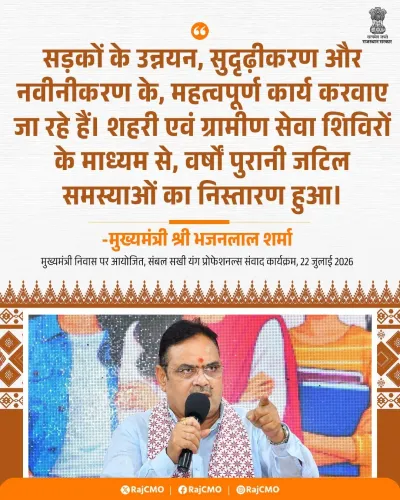
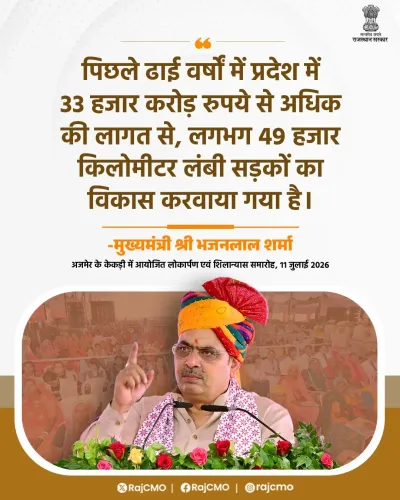
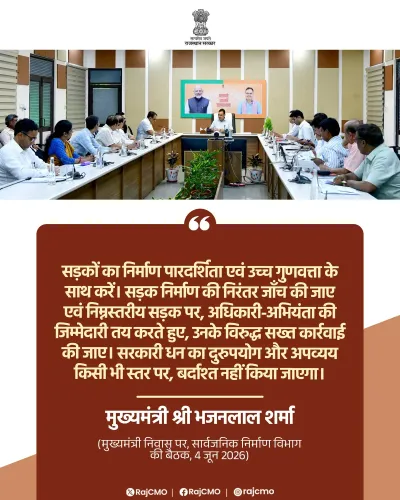
From remote villages to urban centres, Rajasthan is resurfacing its economic arteries — and the numbers the state government is putting forward are striking. The Chief Minister's Office of Rajasthan announced on Wednesday, 28 October 2026 that under the leadership of Chief Minister Bhajanlal Sharma, the state's Public Works Department (PWD) has developed 51,790 kilometres of roads at a total expenditure of over ₹37,527 crore during the current government's tenure.
What the PWD has built — and how fast
The CMO's post frames the push explicitly around two goals: 'सुगम आवागमन' (smooth mobility for ordinary people) and enabling economic activity across the state. The ₹37,527 crore outlay by the Public Works Department, the government claims, has produced a network expansion of over 51,790 km — a figure the administration describes as a 'significant achievement in road connectivity' for Rajasthan.
The Public Works Department of Rajasthan is the nodal state agency for planning, constructing, and maintaining roads, bridges, and government buildings. A spend of this scale, if borne out by independent audit, would represent one of the larger single-tenure road-building drives in the state's recent history.
Villages first — the connectivity logic behind the numbers
The announcement specifically calls out rural connectivity alongside urban links, echoing the long-standing national framework of the Pradhan Mantri Gram Sadak Yojana (PMGSY), launched in 2000, which set the template for connecting unconnected rural habitations with all-weather roads. Rajasthan, with its vast geography and dispersed settlements, has historically been one of the more challenging states to fully network.
Road investment in India's BJP-governed states since 2014 has increasingly been positioned not just as public works but as an economic multiplier — reducing freight costs, opening new markets for farmers, and pulling small towns into the mainstream commercial grid. Chief Minister Bhajanlal Sharma, who took office in December 2023 after the party's assembly election victory, has centred infrastructure development as a signature governance priority under the hashtag #आपणो_अग्रणी_राजस्थान ('Our Leading Rajasthan').
The riders — what independent scrutiny will test
State road-development announcements of this magnitude routinely face two questions: quality of construction and actual utilisation of disbursed funds. Watch points include the 2025-26 state budget allocations for road maintenance — because building a road and keeping it motorable over Rajasthan's punishing summer heat and monsoon cycle are two separate challenges — and any independent audit reports on project delivery timelines.
The beneficiaries the government names are unambiguous: rural residents gaining all-weather access, traders moving goods, and daily commuters navigating a state that covers over 342,000 square kilometres. If the headline figures hold up to scrutiny, the road laid under this government's watch could meaningfully tilt the connectivity equation for millions across the desert state.
Rajasthan's road story is, ultimately, also an economic bet — and the next budget cycle will tell us whether the state is doubling down.
Point of View
A clear beneficiary narrative, and a ready-made campaign slogan. For the BJP administration, which swept to power in December 2023 partly on a development platform, translating ₹37,527 crore into visible tarmac is essential proof-of-delivery ahead of future electoral cycles. The broader pattern — BJP-governed states racing to post infrastructure milestones — also reflects a national playbook where road kilometres have become a primary governance metric. The real test, however, is not the ribbon-cutting but the maintenance budget: Rajasthan's climate is brutal on roads, and how the PWD allocates funds in 2025-26 and beyond will determine whether today's achievement remains one.
NationPress
28 Oct 2026
Frequently Asked Questions
How many kilometres of roads has the Rajasthan government built under CM Bhajanlal Sharma?
The Chief Minister's Office of Rajasthan states that 51,790 kilometres of roads have been developed by the Public Works Department during the current government's tenure under CM Bhajanlal Sharma.
How much money has Rajasthan spent on road development under the current government?
According to the CMO's announcement, the Rajasthan Public Works Department has spent over ₹37,527 crore on road development during Chief Minister Bhajanlal Sharma's tenure.
When did Bhajanlal Sharma become Chief Minister of Rajasthan?
Bhajanlal Sharma took charge as Chief Minister of Rajasthan in December 2023 after the BJP won the state assembly elections.
What is the role of Rajasthan's Public Works Department in road construction?
The Public Works Department (PWD) of Rajasthan is the state agency responsible for planning, constructing, and maintaining roads, bridges, and government buildings across the state.
What is Pradhan Mantri Gram Sadak Yojana and how does it relate to Rajasthan roads?
Pradhan Mantri Gram Sadak Yojana (PMGSY) , launched in 2000 , is a national scheme to connect rural habitations with all-weather roads. Rajasthan has participated in this programme, and the current road expansion drive aligns with its goal of last-mile rural connectivity.