Rajasthan CMO Sanctions Rs 882.54 Cr for 137 Road Works Across 29 Districts
Synopsis
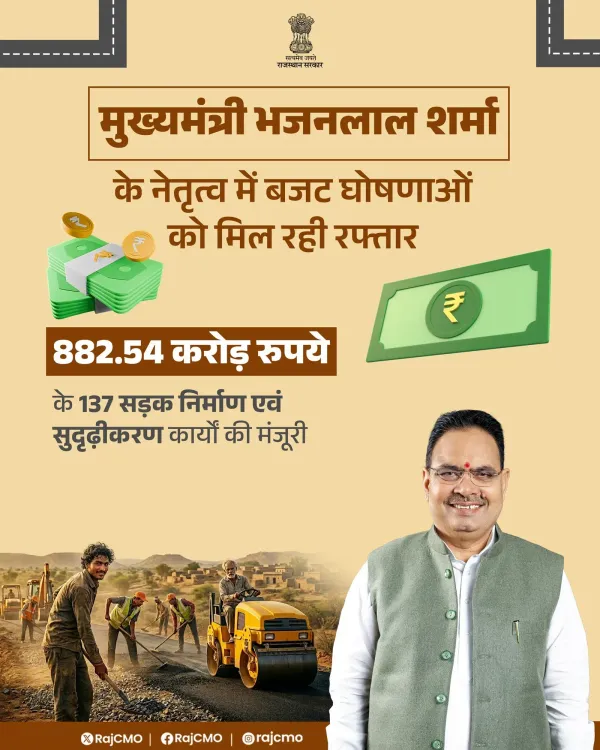
The Rajasthan Chief Minister's Office has sanctioned Rs 882.54 crore for 137 road construction and strengthening projects across 29 districts. Announced under CM Bhajanlal Sharma's leadership, the approvals translate budget promises into financial concurrence, with tender processes set to begin shortly across districts ranging from Jodhpur and Barmer to Alwar, Jaipur and Dhaulpur.
Key Takeaways
Financial concurrence of Rs 882.54 crore approved for 137 road construction and strengthening works .
Works span 29 districts , including newly created ones like Balotra , Salumbar and Khairthal-Tijara .
Announcement made by the Chief Minister's Office of Rajasthan on 3 June 2026 under CM Bhajanlal Sharma .
Tender process for the sanctioned works is to begin shortly.
Move operationalises earlier state budget announcements on road infrastructure.
Post tagged with the slogan Aapno Agrani Rajasthan (Our Leading Rajasthan).
The Chief Minister's Office of Rajasthan announced on 3 June 2026 that the state government, under Chief Minister Bhajanlal Sharma, has accorded financial concurrence of Rs 882.54 crore for 137 road construction and strengthening works across 29 districts. The sanction operationalises budget commitments aimed at expanding intra-district connectivity, with tendering set to begin shortly.
In its post, the CMO said the state administration is taking 'continuous and effective steps' for the strengthening of infrastructure and the time-bound implementation of budget announcements. The communication added that the approved works will impart 'new momentum' to the expansion and reinforcement of basic facilities in the listed districts, and was tagged with the campaign slogan Aapno Agrani Rajasthan (Our Leading Rajasthan).
Context
The approvals span a wide geographical sweep of Rajasthan, covering both legacy districts and several of the newly reorganised ones. The listed districts are Phalodi, Jodhpur, Beawar, Alwar, Barmer, Balotra, Dausa, Dungarpur, Hanumangarh, Jhunjhunu, Karauli, Nagaur, Pali, Sawai Madhopur, Sikar, Salumbar, Churu, Didwana-Kuchaman, Jalore, Baran, Sriganganagar, Jhalawar, Jaipur, Bharatpur, Pratapgarh, Banswara, Khairthal-Tijara, Kotputli-Behror and Dhaulpur.
The inclusion of recently created districts such as Balotra, Salumbar, Didwana-Kuchaman, Khairthal-Tijara and Kotputli-Behror suggests the government is layering road sanctions onto the state's evolving administrative map. The CMO indicated that the tender process for these 137 works will commence shortly.
Policy backdrop
Rajasthan's annual budgets since 2023 have consistently carried multi-district allocations for road construction and strengthening, reflecting a sustained focus on improving the state's road network. The latest concurrence translates such budget announcements into formal financial sanctions, the standard precursor to floating tenders and awarding contracts.
The CMO framed the move as part of a broader effort to ensure that budget promises are not left as paper commitments but are converted into on-ground works within defined timelines. The emphasis on 'time-bound implementation' echoes a recurring theme of the Bhajanlal Sharma government, which took office in December 2023.
Stakeholders and impact
The primary beneficiaries are district residents and local commuters who depend on the state road network for daily mobility, access to markets, schools, and health facilities. Better road links in districts such as Barmer, Jodhpur, Pali and Nagaur can shorten travel times for agricultural produce reaching mandis, while works in Jaipur, Alwar, Bharatpur and Dausa intersect with the densely trafficked corridors of the National Capital Region's periphery.
Contractors, engineering consultancies and construction labour stand to gain from the upcoming tender cycle. Local-body representatives and district-level officials in the Public Works Department will be tasked with execution oversight, project quality and adherence to costs.
What's next
The immediate next step is the launch of the tender process for the 137 sanctioned works. Progress will be measurable through award timelines, work-order issuance and the pace of physical construction at the district level.
Follow-up disclosures during the next session of the Rajasthan Legislative Assembly are likely to focus on utilisation of the Rs 882.54 crore outlay and the share of works that move from sanction to actual execution. For a government that has placed infrastructure delivery at the centre of its governance pitch, the conversion rate from financial concurrence to ribbon-cutting will be a key test.
Point of View
Where road sanctions function as both development delivery and political signalling across a sprawling, regionally diverse state. By spreading approvals across 29 districts, including several newly carved ones, the Bhajanlal Sharma government is balancing geographical equity with a visible push on budget execution. The real test, however, lies beyond the sanction order: tender award timelines, contractor performance and on-ground completion will determine whether this becomes a credible delivery story or another line item awaiting follow-up. For an administration approaching the midpoint of its term, the conversion rate from concurrence to construction will shape its infrastructure narrative.
NationPress
21 Oct 2026
Frequently Asked Questions
How much has the Rajasthan government sanctioned for road works?
The Rajasthan government has accorded financial concurrence of Rs 882.54 crore for 137 road construction and strengthening works across the state.
Which districts will get the new road projects in Rajasthan?
The approved works cover 29 districts, including Phalodi, Jodhpur, Beawar, Alwar, Barmer, Balotra, Dausa, Dungarpur, Hanumangarh, Jhunjhunu, Karauli, Nagaur, Pali, Sawai Madhopur, Sikar, Salumbar, Churu, Didwana-Kuchaman, Jalore, Baran, Sriganganagar, Jhalawar, Jaipur, Bharatpur, Pratapgarh, Banswara, Khairthal-Tijara, Kotputli-Behror and Dhaulpur.
When will tenders be floated for the 137 sanctioned road works?
According to the Chief Minister's Office, the tender process for the 137 sanctioned road construction and strengthening works will be initiated shortly.
Who is the Chief Minister of Rajasthan in 2026?
Bhajanlal Sharma is the Chief Minister of Rajasthan, having taken charge in December 2023 as head of the BJP state government.
What does 'Aapno Agrani Rajasthan' mean?
'Aapno Agrani Rajasthan' is a Rajasthani-language slogan used by the state government that translates roughly to 'Our Leading Rajasthan', signalling its development-focused branding.