CM Bhajanlal's office flags tech-led clean city push in Rajasthan
Synopsis
The Chief Minister's Office of Rajasthan on 31 May 2026 reaffirmed CM Bhajan Lal Sharma's commitment to building clean, beautiful and well-organised cities using technology, transparency and accountability, continuing the BJP government's urban governance agenda since December 2023.
Key Takeaways
The Rajasthan CMO posted on 31 May 2026 reaffirming the state government's urban clean-city agenda under CM Bhajan Lal Sharma .
The stated pillars are technology, transparency and accountability for building clean, beautiful and well-organised cities.
The message was tagged under #आपणो_अग्रणी_राजस्थान ('Our Leading Rajasthan'), the government's development branding.
Rajasthan's urban push is backed by national schemes including Swachh Bharat Mission , Smart Cities Mission (covering 4 cities ), and AMRUT (covering 29 towns ).
Next Swachh Survekshan rankings and AMRUT 2.0 allocations will be key indicators of on-ground progress.
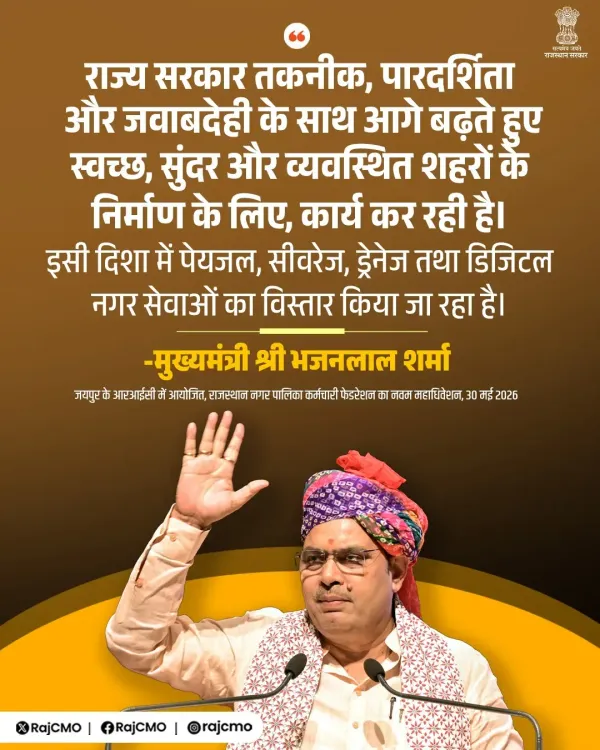
The Chief Minister's Office of Rajasthan on Sunday, 1 June 2026, reaffirmed the state government's commitment to building clean, beautiful and well-ordered cities through technology, transparency and accountability, citing Chief Minister Bhajan Lal Sharma in the post.
The post, shared on the official CMO handle, stated in Hindi: 'राज्य सरकार तकनीक, पारदर्शिता और जवाबदेही के साथ आगे बढ़ते हुए स्वच्छ, सुंदर और व्यवस्थित शहरों के निर्माण के लिए, कार्य कर रही है' — translated: 'The state government is working to build clean, beautiful and well-organised cities, moving forward with technology, transparency and accountability.' The message was tagged under the hashtag #आपणो_अग्रणी_राजस्थान ('Our Leading Rajasthan'), a branding phrase the government uses to signal its development agenda.
Context
The BJP government in Rajasthan, led by Chief Minister Bhajan Lal Sharma, assumed office in December 2023 after the party's victory in the state assembly elections. Urban governance and digital transparency have been recurring themes in the administration's public communications since then. The CMO's messaging on 31 May 2026 continues that pattern, positioning the government as a technology-first administration on civic matters.
The three pillars cited — technology, transparency and accountability — align closely with the framework used by central and state governments when reporting progress on cleanliness rankings and smart-city outcomes. Rajasthan's municipal bodies have historically been evaluated under the annual Swachh Survekshan survey, which ranks cities on sanitation, waste management and citizen feedback.
Policy Backdrop
Rajasthan's urban improvement drive is nested within several long-running national programmes. The Swachh Bharat Mission (Urban), launched in 2014, set targets for open-defecation-free cities and improved solid-waste processing across the country. The Smart Cities Mission, started in 2015, selected four Rajasthan cities for integrated, technology-enabled area development.
Separately, the Atal Mission for Rejuvenation and Urban Transformation (AMRUT), also from 2015, channelled funds for water supply, sewerage and green-space projects across 29 Rajasthan towns. The state had also initiated e-governance and transparency portal projects for municipal services as early as 2016–17. The current government's stated direction builds on this policy lineage rather than departing from it.
Stakeholders and Impact
Urban residents across Rajasthan's towns and cities are the primary stakeholders in any clean-city initiative. Improved waste management, digital grievance redressal and transparent municipal procurement directly affect daily civic life, from garbage collection schedules to property-tax processing. Municipal bodies bear the operational responsibility for translating policy commitments into on-ground outcomes.
The broader pattern of BJP-governed states publishing periodic urban-governance updates also carries a competitive dimension: Swachh Survekshan rankings are publicly released and closely watched by state administrations, making cleanliness messaging both a policy signal and a reputational exercise ahead of each annual survey cycle.
What's Next
Observers will watch for concrete follow-through in the form of new municipal project tenders, fresh AMRUT 2.0 allocations for Rajasthan cities, or improved rankings in the next Swachh Survekshan assessment. Any announcement of specific technology deployments — such as smart-waste monitoring, digital dashboards for civic services, or e-procurement mandates for urban local bodies — would give substance to the broad commitment articulated in Sunday's post. The government's ability to translate this messaging into measurable outcomes will ultimately determine its credibility on urban governance ahead of the next electoral cycle.
Point of View
Reinforcing CM Bhajan Lal Sharma's administration as a technology-forward, accountability-driven government less than three years into its term. By invoking transparency and accountability alongside cleanliness, the messaging attempts to differentiate the current dispensation from its predecessor on urban governance — a domain where Rajasthan has had mixed Swachh Survekshan performances historically. The 'Our Leading Rajasthan' hashtag signals an effort to build a cohesive development narrative ahead of future electoral cycles. Without specific project announcements or data points, however, such posts function primarily as intent signals rather than policy milestones.
NationPress
15 Oct 2026
Frequently Asked Questions
What did the Rajasthan CMO post about on 31 May 2026?
The Rajasthan CMO posted that the state government is working to build clean, beautiful and well-organised cities using technology, transparency and accountability, tagging Chief Minister Bhajan Lal Sharma.
Who is the Chief Minister of Rajasthan in 2026?
Bhajan Lal Sharma of the BJP is the Chief Minister of Rajasthan, having assumed office in December 2023 after the party won the state assembly elections.
What is the Swachh Survekshan and how does it affect Rajasthan?
Swachh Survekshan is an annual central government survey that ranks Indian cities on sanitation, waste management and citizen feedback. Rajasthan's cities are evaluated under this survey, and rankings influence both funding and the government's public image on urban cleanliness.
Which central schemes support Rajasthan's urban development?
Three key central schemes support Rajasthan's urban agenda: the Swachh Bharat Mission (Urban) launched in 2014, the Smart Cities Mission from 2015 covering four Rajasthan cities, and AMRUT from 2015 covering 29 Rajasthan towns for water, sewerage and green-space projects.
What does 'Aapno Agrani Rajasthan' mean?
'Aapno Agrani Rajasthan' translates to 'Our Leading Rajasthan' in English. It is a branding hashtag used by the Bhajan Lal Sharma government to project a forward-looking development identity for the state.