Rajasthan CMO credits PM Modi's green schemes on World Environment Day
Synopsis
The Chief Minister's Office of Rajasthan marked World Environment Day 2026 by crediting five of PM Narendra Modi's flagship schemes — Swachh Bharat Abhiyan, Mission LiFE, Namami Gange, the National Clean Air Programme, and PM Surya Ghar Yojana — with advancing conservation and promotion of India's natural resources.
Key Takeaways
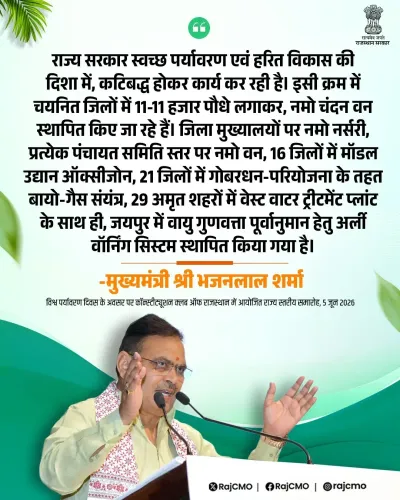
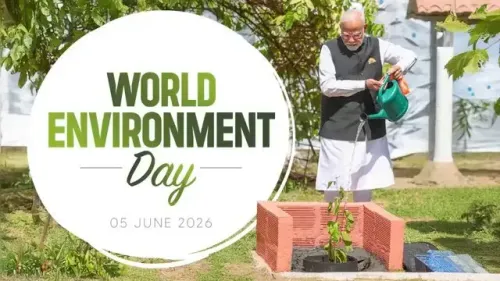
The Rajasthan CMO posted on World Environment Day, 6 June 2026 , tagging Chief Minister Bhajan Lal Sharma .
Five central schemes were cited: Swachh Bharat Abhiyan, Mission LiFE, Namami Gange, the National Clean Air Programme, and PM Surya Ghar Yojana.
Swachh Bharat Abhiyan and Namami Gange were both launched in 2014 ; the National Clean Air Programme followed in 2019 covering 131 cities.
Mission LiFE was introduced in 2022 to foster pro-environment individual behaviour globally.
PM Surya Ghar Yojana subsidises rooftop solar panels for households, directly relevant to solar-rich Rajasthan .
The messaging aligns Rajasthan's governance posture with India's commitments under the Paris Agreement and UN SDGs .
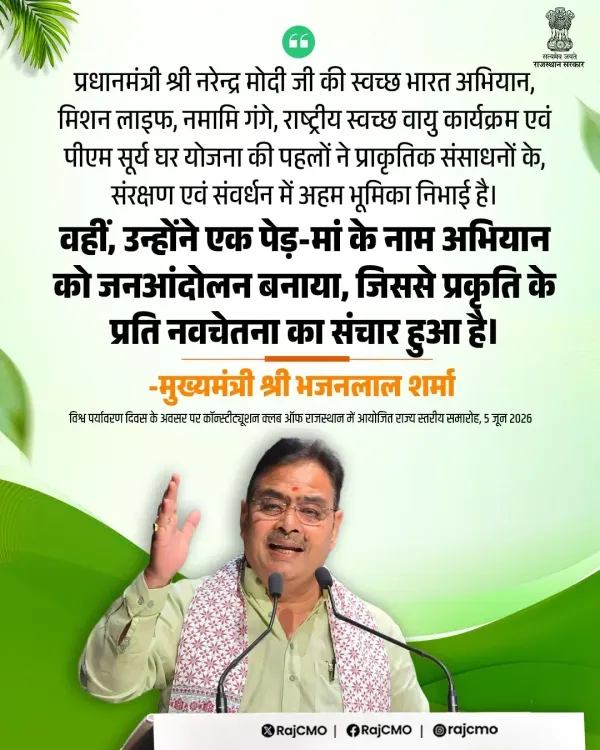
The Chief Minister's Office of Rajasthan on Saturday, 6 June 2026, marked World Environment Day by highlighting five flagship central environmental initiatives led by Prime Minister Narendra Modi, crediting them with playing a significant role in the conservation and enhancement of natural resources.
The post, shared on the official CMO handle and tagging Chief Minister Bhajan Lal Sharma, stated: 'Pradhan Mantri Shri Narendra Modi ji ki Swachh Bharat Abhiyan, Mission LiFE, Namami Gange, Rashtriya Swachh Vayu Karyakram evam PM Surya Ghar Yojana ki pahalon ne prakritik sansadhanon ke, sanrakshan evam samvardhan mein aham bhumika nibhai hai.' In English: 'Prime Minister Narendra Modi's initiatives — Swachh Bharat Abhiyan, Mission LiFE, Namami Gange, the National Clean Air Programme, and PM Surya Ghar Yojana — have played an important role in the conservation and promotion of natural resources.'
Context
World Environment Day, observed annually on 5 June, is the United Nations' principal vehicle for encouraging global awareness and action on environmental protection. State governments across India routinely use the occasion to align their public messaging with national and international sustainability goals. The Rajasthan CMO's post follows this pattern, foregrounding the central government's programme architecture rather than state-specific measures.
Policy Backdrop
Swachh Bharat Abhiyan, launched in 2014, set out to transform sanitation and waste management across urban and rural India. In the same year, the Namami Gange programme was approved as an integrated mission to rejuvenate the Ganga river, addressing pollution and ecological degradation along its banks.
The National Clean Air Programme, introduced in 2019, targets particulate pollution reduction across 131 cities with specific air quality improvement goals. Mission LiFE — Lifestyle for Environment — was launched in 2022 to promote pro-environment individual behaviours globally, positioning citizens as active participants in climate action rather than passive recipients of policy.
PM Surya Ghar Yojana extends the renewable energy push to the household level, offering subsidies for rooftop solar panel installations to reduce dependence on conventional power sources and lower energy costs for families.
Stakeholders and Impact
Together, these five schemes touch a wide cross-section of Indian society: urban residents benefit from cleaner air and better waste infrastructure, while rural households gain from improved sanitation and affordable solar energy access. River-dependent communities along the Ganga basin stand to gain from the ecological restoration work under Namami Gange.
India's broader environmental commitments — including targets under the Paris Agreement and the UN Sustainable Development Goals — provide the international framework within which these domestic programmes are situated. The CMO's messaging reinforces the alignment between state-level governance in Rajasthan and the Centre's sustainability agenda.
What's Next
Attention will now turn to state-level implementation data, particularly progress on rooftop solar installations under PM Surya Ghar Yojana in Rajasthan — a state with high solar potential — and city-specific air quality outcomes under the National Clean Air Programme. How Rajasthan translates the Centre's environmental framework into on-ground results will be the measure of the messaging's substance.
Point of View
The BJP-governed state signals ideological solidarity with the Centre while riding the visibility of a globally observed day. The absence of any Rajasthan-specific data or targets keeps the messaging aspirational rather than accountable. This pattern — state governments amplifying central schemes on high-profile occasions without citing local benchmarks — is a recurring feature of India's federal political communication. The real test will come when implementation figures on rooftop solar uptake and air quality improvement in Rajasthan's cities are placed in the public domain.
NationPress
21 Oct 2026
Frequently Asked Questions
What did the Rajasthan CMO post on World Environment Day 2026?
The Rajasthan CMO posted on 6 June 2026 crediting five of PM Narendra Modi's environmental initiatives — Swachh Bharat Abhiyan, Mission LiFE, Namami Gange, the National Clean Air Programme, and PM Surya Ghar Yojana — for conserving and promoting natural resources.
What is PM Surya Ghar Yojana?
PM Surya Ghar Yojana is a central government scheme that provides subsidies to households for installing rooftop solar panels, aimed at boosting renewable energy adoption and reducing electricity costs for families.
What is Mission LiFE?
Mission LiFE (Lifestyle for Environment) was launched by PM Modi in 2022 to encourage individuals worldwide to adopt pro-environment daily behaviours, positioning citizens as active contributors to climate action.
What is the National Clean Air Programme?
The National Clean Air Programme, launched in 2019, is a central initiative targeting the reduction of particulate matter pollution across 131 Indian cities through city-specific action plans and monitoring.
Why do state governments highlight central environmental schemes on World Environment Day?
State governments routinely use World Environment Day to align their public messaging with national sustainability goals, signal political solidarity with the Centre, and reinforce awareness of flagship schemes among their populations.