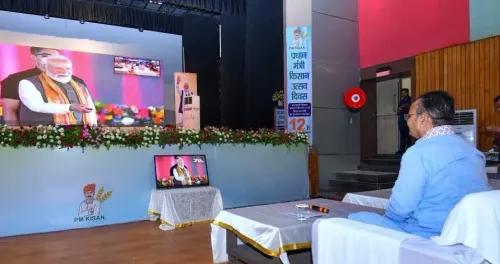
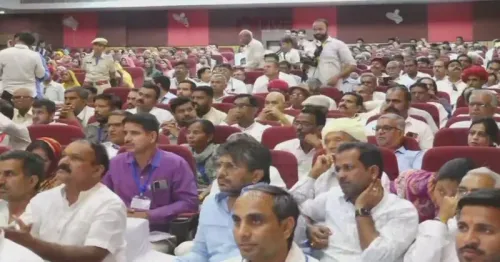
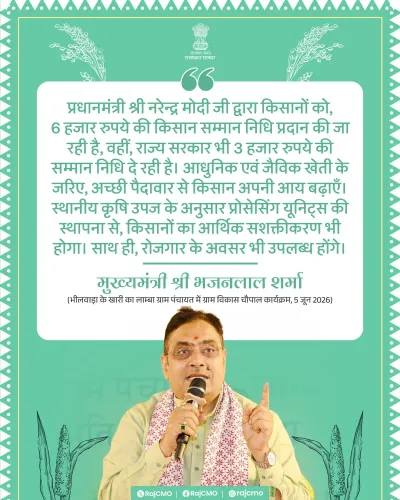
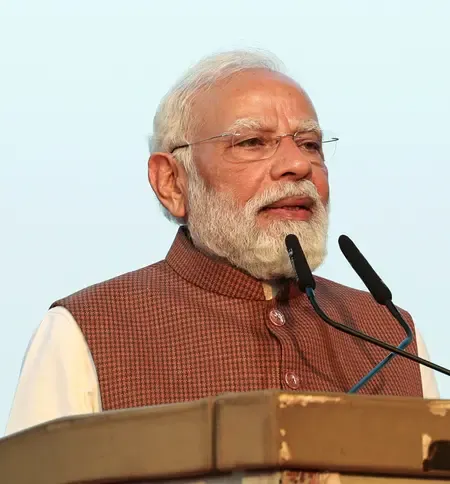
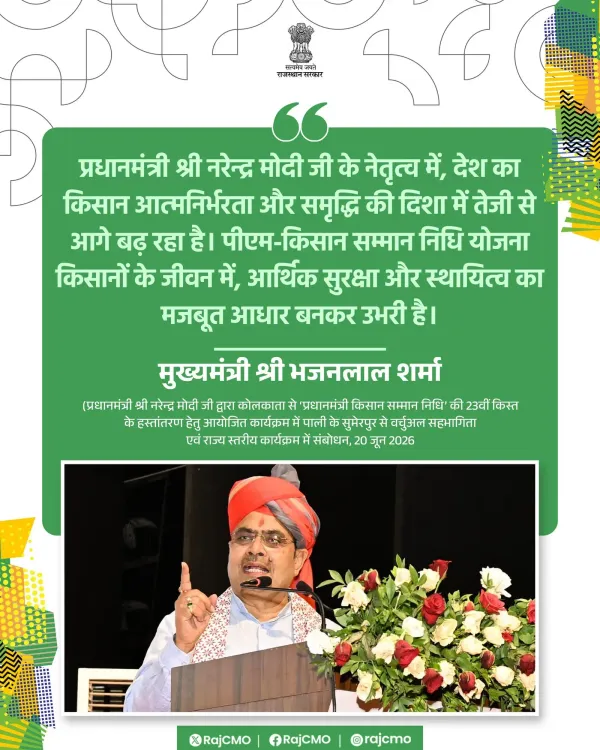
CM Bhajanlal backs PM-KISAN as pillar of farmer security
Synopsis
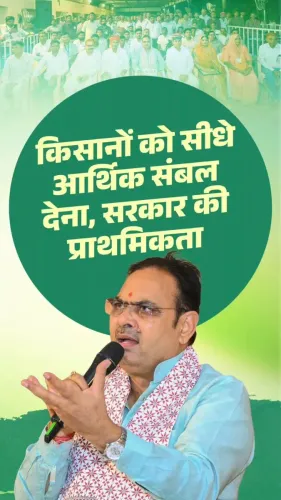
The Chief Minister's Office of Rajasthan promoted PM-KISAN Samman Nidhi Yojana on 21 June 2026, calling it a strong pillar of economic security for farmers. The post, tagged to CM Bhajanlal Sharma, was shared under the state's Shahri Seva Shivir 2026 outreach campaign.
Key Takeaways
The Rajasthan CMO on 21 June 2026 described PM-KISAN as a 'strong foundation of economic security and stability' for farmers.
PM-KISAN Samman Nidhi Yojana provides ₹6,000 per year in direct income support to eligible small and marginal farmer families in three instalments.
The scheme was launched by the central government in February 2019 as a direct benefit transfer programme.
The post was shared under the #ShahriSevaShivir2026 hashtag, indicating an active state-level public outreach drive.
Chief Minister Bhajanlal Sharma was tagged, signalling state leadership's alignment with the scheme's promotion.
Rajasthan has a large agrarian economy, making central farmer welfare schemes particularly significant for its rural population.
The Chief Minister's Office of Rajasthan on Sunday, 21 June 2026 highlighted the PM-KISAN Samman Nidhi Yojana as a foundational source of economic security and stability for farmers, tagging Chief Minister Bhajanlal Sharma in the post shared under the state's ongoing urban outreach initiative.
The post, in Hindi, states that the scheme has emerged as 'arthik suraksha aur sthayitva ka mazboot aadhar' ('a strong foundation of economic security and stability') in the lives of farmers. The message was shared alongside the hashtags #ShahriSevaShivir2026 (Urban Service Camp 2026) and #AapnoAgrani Rajasthan (Our Pioneering Rajasthan), indicating it was part of a broader state-level public outreach drive.
Context
The PM-KISAN Samman Nidhi Yojana is a central government scheme launched in February 2019 that provides eligible small and marginal farmer families with ₹6,000 per year in direct income support, disbursed in three equal instalments of ₹2,000 each. The scheme operates as a direct benefit transfer, crediting funds directly into the bank accounts of registered beneficiaries without intermediaries.
Rajasthan has a predominantly agrarian economy, with a significant share of its rural population dependent on rain-fed agriculture. The state has consistently been among the larger beneficiary bases for central agricultural welfare programmes.
Policy Backdrop
Since its launch, PM-KISAN has been one of the flagship instruments of the central government's approach to agricultural income support, prioritising direct cash transfers over subsidy-linked interventions. The scheme targets small and marginal farmers — those holding cultivable land up to two hectares — who are most vulnerable to income volatility from erratic monsoons and fluctuating market prices.
State governments governed by the Bharatiya Janata Party have regularly amplified central welfare scheme messaging through official social media channels, aligning state communication with national priorities on farmer welfare and direct benefit transfers. The Rajasthan CMO's post fits within this established pattern of scheme promotion.
Stakeholders and Impact
The primary beneficiaries of PM-KISAN are small and marginal farmers across India, including those in Rajasthan's rural districts where agriculture remains the primary livelihood. The ₹6,000 annual transfer is intended to help farmer families meet input costs such as seeds, fertilisers, and basic household expenses ahead of sowing seasons.
Chief Minister Bhajanlal Sharma, who took office in December 2023 following the state assembly elections, has positioned farmer welfare as a core governance priority. The tagging of his official handle in the CMO post signals direct alignment between the state administration and the scheme's messaging.
What's Next
The reference to the Shahri Seva Shivir 2026 campaign suggests the Rajasthan government is conducting structured outreach camps aimed at connecting citizens — including farmers — with central and state welfare schemes. Tracking the coverage and beneficiary enrolment data from these camps will indicate how effectively PM-KISAN outreach is translating into on-ground registration in the state. Broader integration of PM-KISAN with Rajasthan's own rural support programmes could be a policy development to watch in the coming months.
Point of View
Reinforcing a unified political narrative on farmer income support. Framing the scheme as a 'foundation of stability' elevates it beyond a cash transfer into a symbol of governance credibility ahead of any electoral cycle. The linkage to Shahri Seva Shivir 2026 suggests the state is using structured camp-based outreach to build last-mile awareness — a model that also serves as a voter-connect exercise. The broader pattern points to an increasingly coordinated Centre-state messaging architecture around direct benefit transfer schemes.
NationPress
20 Sept 2026
Frequently Asked Questions
What is PM-KISAN Samman Nidhi Yojana?
PM-KISAN Samman Nidhi Yojana is a central government scheme launched in February 2019 that provides ₹6,000 per year in direct income support to eligible small and marginal farmer families, paid in three instalments of ₹2,000 each directly into their bank accounts.
Who is the Chief Minister of Rajasthan in 2026?
Bhajanlal Sharma of the Bharatiya Janata Party is the Chief Minister of Rajasthan, having been sworn in after the December 2023 state assembly elections.
What is Shahri Seva Shivir 2026 in Rajasthan?
Shahri Seva Shivir 2026 is an urban outreach camp initiative by the Rajasthan government under which officials connect citizens with central and state welfare schemes; the exact scope and schedule of the 2026 edition have not been independently verified.
How does PM-KISAN benefit farmers in Rajasthan?
Eligible small and marginal farmers in Rajasthan receive ₹6,000 annually under PM-KISAN as direct cash transfers, helping them meet agricultural input costs such as seeds and fertilisers, particularly important given the state's dependence on rain-fed farming.
Who is eligible for PM-KISAN Samman Nidhi?
Small and marginal farmer families holding cultivable land up to two hectares are generally eligible for PM-KISAN, subject to exclusion criteria set by the central government such as income tax payers and institutional landholders.