CM Rajasthan Directs Biometric Attendance, Safety Compliance Across All Institutions
Synopsis
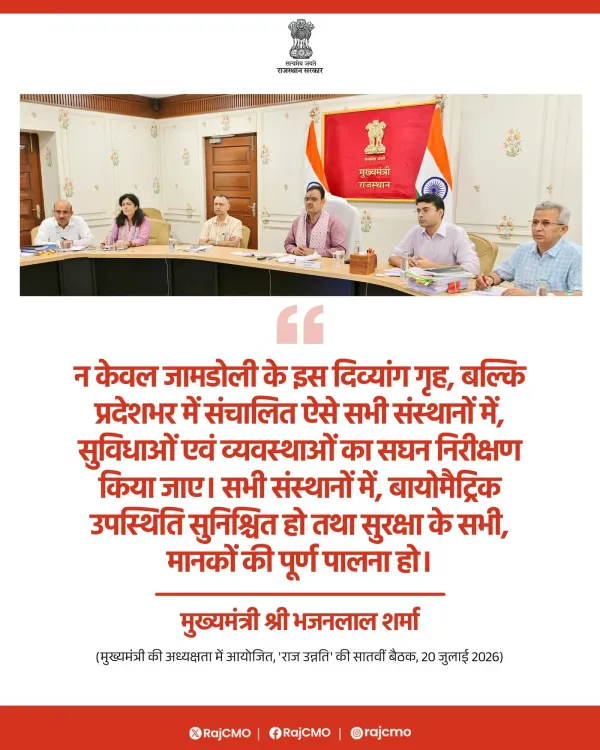
The Chief Minister's Office of Rajasthan on 21 July 2026 directed that biometric attendance be enforced in all state institutions and that safety standards be fully complied with, addressing the order to CM Bhajanlal Sharma under the 'Our Leading Rajasthan' governance banner.
Key Takeaways
The Chief Minister's Office of Rajasthan issued a directive on 21 July 2026 mandating biometric attendance across all state government institutions.
The order also requires full compliance with all prescribed safety standards at every institution.
The directive was addressed directly to Chief Minister Bhajanlal Sharma via his official X handle @BhajanlalBjp .
The post was published under the hashtag #आपणो_अग्रणी_राजस्थान ('Our Leading Rajasthan'), the CMO's governance branding theme.
The directive broadly covers government schools, hospitals, offices, and other public establishments across Rajasthan .
Enforcement and follow-through mechanisms — including audits and inspections — will determine the directive's real-world impact.
The Chief Minister's Office of Rajasthan issued a governance directive on Tuesday, 21 July 2026, instructing that biometric attendance be ensured across all government institutions in the state, alongside full compliance with every prescribed safety standard. The directive, posted on X and addressed to Chief Minister Bhajanlal Sharma, signals a fresh push by the Rajasthan government to tighten administrative accountability and institutional discipline.
The post, shared under the hashtag #आपणो_अग्रणी_राजस्थान ('Our Leading Rajasthan'), states: 'सभी संस्थानों में, बायोमैट्रिक उपस्थिति सुनिश्चित हो तथा सुरक्षा के सभी, मानकों की पूर्ण पालना हो' — 'In all institutions, biometric attendance must be ensured, and all safety standards must be fully complied with.' The directive is addressed directly to @BhajanlalBjp, the official handle of Chief Minister Bhajanlal Sharma.
Context
Biometric attendance systems have been a recurring instrument of governance reform across Indian states, aimed at reducing absenteeism among government employees and improving service delivery at public institutions. The Rajasthan government's renewed emphasis on this mechanism reflects ongoing concerns about attendance irregularities and lax enforcement of safety protocols in state-run bodies. The directive applies broadly to 'all institutions,' suggesting its scope covers schools, hospitals, government offices, and other public establishments.
The hashtag #आपणो_अग्रणी_राजस्थान — translating to 'Our Leading Rajasthan' — has been used by the Chief Minister's Office as a branding motif for the current government's development and governance agenda under Chief Minister Bhajanlal Sharma, who took office in December 2023 following the Bharatiya Janata Party's return to power in the state.
Policy Backdrop
Biometric attendance mandates are not new to Rajasthan or to Indian governance. The Government of India introduced the Aadhaar-Enabled Biometric Attendance System (AEBAS) for central government employees, and several state governments have adopted analogous frameworks. Rajasthan has periodically renewed such mandates, particularly for teachers, healthcare workers, and other frontline government staff, where absenteeism has historically been flagged by administrative reviews.
The pairing of biometric attendance with safety-standard compliance in a single directive is notable. It suggests the government is treating both as part of the same accountability framework — one focused on physical presence, the other on procedural adherence. Safety standards in government institutions typically cover fire safety, structural norms, sanitation, and occupational health requirements, all of which fall under different regulatory bodies at the state level.
Stakeholders and Impact
The directive, if enforced uniformly, would affect a large cross-section of Rajasthan's government workforce — spanning departments such as education, health, public works, and local administration. Teachers in government schools and staff at district hospitals are among the categories most directly affected by biometric attendance mandates in past implementation cycles. Compliance with safety standards would additionally concern building inspectors, fire departments, and departmental heads responsible for institutional upkeep.
For citizens, consistent staff attendance and adherence to safety norms at public institutions directly bears on the quality and reliability of services received. The directive, framed as an instruction to the Chief Minister himself, positions Bhajanlal Sharma as the primary accountability anchor for its implementation across the state machinery.
What's Next
The directive's practical impact will depend on the follow-through mechanisms the government puts in place — including inspection drives, departmental audits, and consequences for non-compliance. Rajasthan's administrative apparatus will be watched to see whether this announcement translates into measurable improvements in attendance records and safety audit outcomes across state institutions. If the government moves to publish compliance data or link attendance metrics to performance assessments, it could mark a meaningful step toward the 'leading Rajasthan' vision the CMO has been projecting.
Point of View
But its significance lies in the public framing — issuing it as a direct instruction to the Chief Minister signals an intent to place accountability at the top of the political hierarchy rather than delegating it to bureaucratic circulars. Chief Minister Bhajanlal Sharma's government, in power since December 2023, has consistently used the 'Aapno Agrani Rajasthan' hashtag to project a reform-oriented image, and this directive fits that pattern. The real test, as with most such administrative orders, is enforcement: Rajasthan has seen biometric mandates announced and quietly shelved in prior administrations. Whether this iteration is backed by audit mechanisms and consequences for non-compliance will determine whether it moves the needle on institutional accountability.
NationPress
20 Oct 2026
Frequently Asked Questions
What did the Rajasthan CMO direct on 21 July 2026?
The Chief Minister's Office of Rajasthan directed that biometric attendance be ensured across all government institutions in the state and that all safety standards be fully complied with.
Who is the directive addressed to?
The directive was addressed to Chief Minister Bhajanlal Sharma via his official X handle @BhajanlalBjp.
What does biometric attendance mean for Rajasthan government employees?
Biometric attendance requires government employees to register their presence using fingerprint or iris-based systems, reducing the scope for proxy attendance and absenteeism in public institutions.
What is the meaning of #आपणो_अग्रणी_राजस्थान?
The hashtag translates to 'Our Leading Rajasthan' and is used by the Chief Minister's Office as a branding motif for the Bhajanlal Sharma government's development and governance agenda.
Which institutions are covered by the Rajasthan biometric attendance order?
The directive refers to 'all institutions,' which in the context of state government directives typically covers government schools, hospitals, district offices, and other public establishments across Rajasthan.