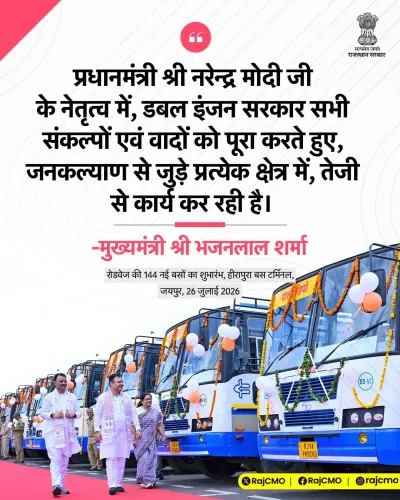
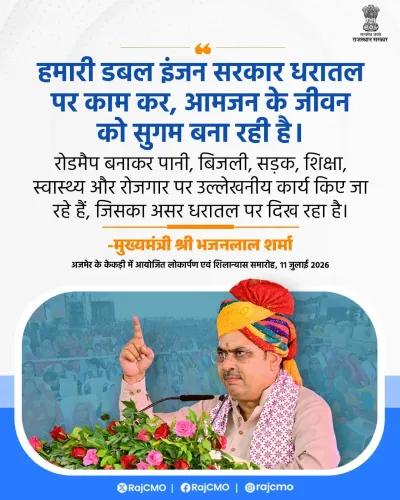
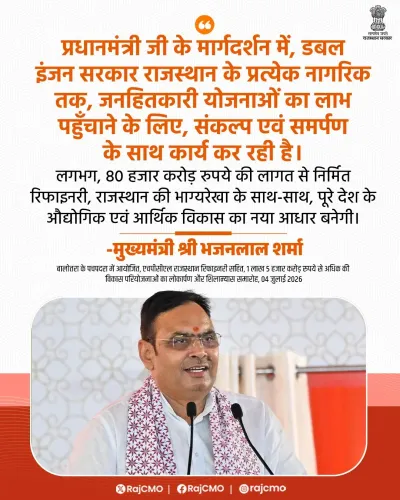
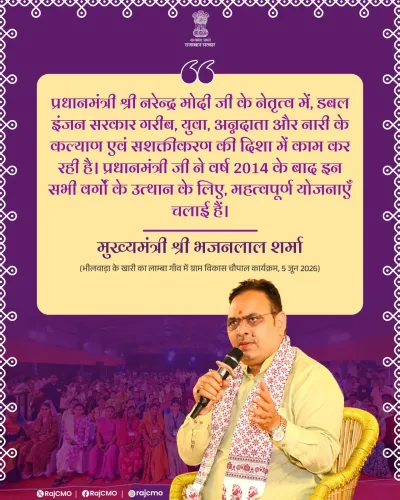
Rajasthan CM's Office reaffirms 'double engine' welfare pledge
Synopsis
The Rajasthan Chief Minister's Office reaffirmed on 2 November 2026 that the BJP's 'double engine government' is working dedicatedly for the welfare of farmers, the poor, women, and youth — invoking the party's core inclusive-development messaging under CM Bhajanlal Sharma.
Key Takeaways
The Rajasthan CMO posted on 2 November 2026 reaffirming the 'double engine government' welfare commitment.
Chief Minister Bhajanlal Sharma was tagged in the post, underlining personal political ownership of the message.
The four named beneficiary groups — farmers, the poor, women, and youth — mirror BJP's standard welfare-state framework across all its governed states.
The BJP has governed Rajasthan since December 2023 , enabling coordinated centre-state policy delivery.
No specific new scheme or statistic was announced; the post is a reaffirmation of existing governance intent.
The hashtag #आपणो_अग्रणी_राजस्थान ('Our Leading Rajasthan') is a recurring motif in the current government's public communications.
The Chief Minister's Office of Rajasthan invoked the BJP's signature 'double engine government' promise on Monday, 2 November 2026, declaring that the state administration is working with dedication for the well-being of every section of society — farmers, the poor, women, and youth.
The post, shared from the official Rajasthan CMO account and tagging Chief Minister Bhajanlal Sharma, carried the hashtag #आपणो_अग्रणी_राजस्थान ('Our Leading Rajasthan') — a recurring phrase in the current government's outreach. The message, brief but pointed, signals the administration's continued emphasis on inclusive welfare delivery as a political and governance priority.
What 'double engine' means in practice
The 'double engine government' phrase has been central to BJP's electoral and governance vocabulary since the party began winning state elections alongside its hold on the Centre. The idea is straightforward: when the same party runs both New Delhi and a state capital, central welfare schemes reach beneficiaries faster and with less political friction. Rajasthan came under BJP rule in December 2023, when Bhajanlal Sharma took office as Chief Minister following the party's assembly election victory — completing the double-engine alignment the party had campaigned on.
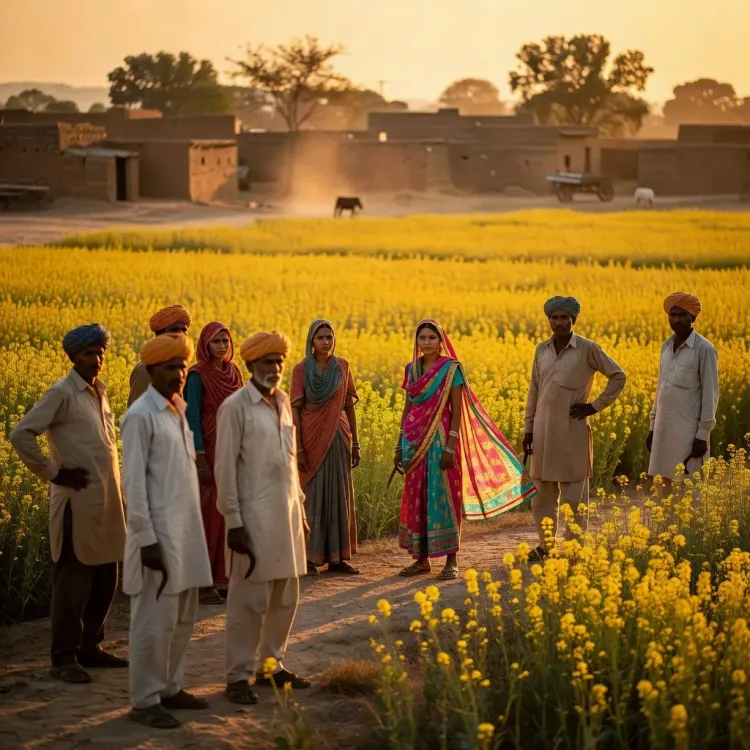
The four groups named — kisaan, garib, mahila aur yuva (farmers, the poor, women, and youth) — are the same constituencies the BJP has centred in welfare messaging across every state it governs, from Uttar Pradesh to Madhya Pradesh to Gujarat. It is a deliberate, tested framework: broad enough to signal universality, specific enough to name the groups most likely to decide state elections.
Rajasthan's governance stakes
Rajasthan is India's largest state by area, with a predominantly rural population and enduring development challenges around agriculture, water scarcity, and female literacy. For the BJP government, demonstrating welfare delivery to these four groups is not just rhetoric — it is the central test of the double-engine promise. How well central schemes such as PM-KISAN, PM Awas Yojana, and Beti Bachao Beti Padhao are implemented and amplified at the state level will define whether the alignment translates into tangible outcomes.
No new scheme or specific statistic was announced in today's post. The message reads as a periodic reaffirmation of political commitment rather than a fresh policy signal — but in the BJP's communications playbook, consistent repetition of welfare intent is itself a governance signal, keeping the administration's stated priorities visible to its core base.
The next concrete test will come at the state's budget presentation, where spending allocations for agriculture support, women's welfare programmes, and youth employment schemes will either validate or challenge the promise behind the slogan.
Point of View
The poor, women, and youth in a single breath, the administration signals breadth of intent while avoiding the accountability that specific targets invite. The post's timing, mid-term between the 2023 victory and the next election cycle, suggests a deliberate effort to keep welfare credentials warm in the public mind. Whether the rhetoric converts into verifiable delivery will be the defining question for Bhajanlal Sharma's tenure.
NationPress
2 Nov 2026
Frequently Asked Questions
What is the 'double engine government' in Rajasthan?
'Double engine government' refers to the BJP simultaneously holding power at the Centre in New Delhi and in Rajasthan's state government, allowing faster and more coordinated delivery of welfare schemes. The BJP has used this phrase since it began winning states while in power nationally, and it was a central campaign slogan in the 2023 Rajasthan assembly elections.
Who is the Chief Minister of Rajasthan in 2026?
Bhajanlal Sharma is the Chief Minister of Rajasthan. He assumed office in December 2023 after the BJP won the Rajasthan state assembly elections.
What does #आपणो_अग्रणी_राजस्थान mean?
The hashtag translates from Rajasthani and Hindi as 'Our Leading Rajasthan.' It is a recurring slogan used by the current BJP state government in its public communications to project a vision of Rajasthan as a progressive, frontrunning state.
Which groups does the Rajasthan government say it is working for?
According to the 2 November 2026 post, the Rajasthan government says it is working for the well-being of farmers, the poor, women, and youth — four categories that form the cornerstone of the BJP's welfare messaging across all its governed states.
When did the BJP come to power in Rajasthan?
The BJP formed the government in Rajasthan in December 2023 following its victory in the state assembly elections, with Bhajanlal Sharma sworn in as Chief Minister.