Anurag Thakur Targets Opposition Over Religious Doublespeak
Synopsis
BJP MP Anurag Thakur accused some opposition leaders of chanting Ali at night and Bajrangbali by day, alleging cynical religious flip-flopping for electoral advantage. The 14-word Hindi post deploys a well-worn but sharp BJP rhetorical frame ahead of what appears to be an active election period.
Key Takeaways
BJP MP Anurag Thakur posted on X on 2 November 2026 accusing some opposition leaders of invoking different religious figures — Ali and Bajrangbali — for different audiences.
The Hindi phrase 'raat ko Ali-Ali aur din mein Bajrangbali' ('Ali at night, Bajrangbali by day') is a deliberate rhetorical device targeting perceived religious opportunism.
No specific opposition leader was named, widening the accusation's reach across rival parties.
The charge fits a recurring BJP electoral communication pattern that frames opposition religious outreach as insincere minority appeasement.
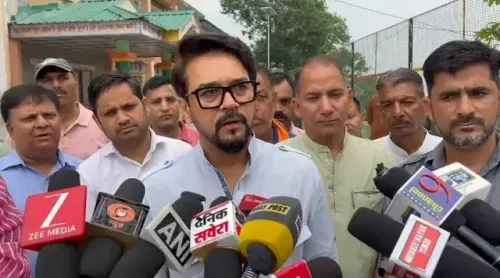
Thakur is a Lok Sabha MP from Hamirpur, Himachal Pradesh and former Union Minister, regarded as one of BJP's most combative political communicators.
In the sharp idiom of Indian electoral combat, BJP MP Anurag Thakur levelled a pointed accusation at opposition leaders on Monday, 2 November 2026, charging them with playing to different religious galleries depending on the hour of the day.
Posting in Hindi on X, Thakur said: 'Vipaksh ke kuch neta raat ko Ali-Ali aur din mein Bajrangbali karte hain' — 'Some opposition leaders chant Ali at night and Bajrangbali by day.' The line is a deliberate rhetorical device: invoking Ali as a symbol of Muslim devotion and Bajrangbali (Lord Hanuman) as a symbol of Hindu faith to allege that certain leaders flip their religious messaging to suit the audience in front of them.
A Familiar Blade in BJP's Electoral Arsenal
The charge is not new, but its timing is. BJP leaders have deployed variations of this argument across multiple election cycles, framing opposition outreach to Muslim voters as cynical minority appeasement while labelling any subsequent display of Hindu religiosity as opportunism. The formulation is designed to do two things at once: consolidate the Hindu vote by casting rivals as insincere, and undercut opposition credibility with both communities simultaneously. Thakur, a two-term Lok Sabha MP from Hamirpur, Himachal Pradesh, has been one of the BJP's most aggressive communicators — a role he sharpened during his tenure as Union Minister of Information & Broadcasting. His posts rarely land without an electoral subtext, and this one, arriving in the early afternoon news cycle, reads as a pre-emptive frame ahead of any assembly or by-election mobilisation.Opposition Unnamed, But the Target Is Unmistakable
Thakur names no individual, which is itself a technique — it casts the widest possible net, leaving opposition parties to either own the accusation or spend news cycles denying it. No specific response from any opposition leader had been issued at the time of publication. The broader pattern this post fits into is one of competitive religious signalling that has defined Indian electoral politics across party lines. Critics of the BJP argue that the party is itself a practitioner of faith-based mobilisation; supporters counter that the BJP's appeal is ideologically consistent rather than transactional. Thakur's post plants a flag firmly on the BJP's side of that argument — in 14 crisp Hindi words.Point of View
Quotable contrast and let the opposition carry the burden of denial. By leaving names out, the charge functions as a blanket indictment rather than a targeted attack, maximising political surface area. It signals that the party intends to keep religious credibility at the centre of its electoral narrative going into what appears to be an active campaign season. Whether the opposition responds — and how — will determine whether this framing sticks or evaporates in the 24-hour news cycle.
NationPress
2 Nov 2026
Frequently Asked Questions
What did Anurag Thakur say about the opposition and religion?
Anurag Thakur posted in Hindi that 'some opposition leaders chant Ali at night and Bajrangbali by day,' accusing them of switching their religious appeals depending on the audience for electoral benefit.
What does 'Ali-Ali aur Bajrangbali' mean in Indian political context?
It is a rhetorical shorthand used by BJP leaders to allege that certain opposition politicians selectively invoke Islamic devotion (Ali) before Muslim audiences and Hindu devotion (Bajrangbali/Lord Hanuman) before Hindu audiences, implying insincerity in both.
Which opposition leaders did Anurag Thakur name in his post?
Thakur named no specific opposition leader, keeping the accusation broad and directed at 'some opposition leaders' generally.
Who is Anurag Thakur?
Anurag Thakur is a BJP Lok Sabha MP from Hamirpur, Himachal Pradesh. He previously served as Union Minister of Information and Broadcasting and Union Minister of Youth Affairs and Sports.
Why do BJP leaders use religious doublespeak accusations against the opposition?
BJP leaders argue that opposition parties make transactional religious appeals — courting Muslim voters with one message and Hindu voters with another — rather than maintaining a consistent ideological position. The accusation is a recurring tool to consolidate Hindu voters and undercut rival credibility.