CM Majhi Announces Cyclone Arnab Relief for Odisha's Livestock Farmers

Synopsis
Odisha CM Mohan Charan Majhi has announced a multi-pronged relief package for livestock keepers, dairy farmers, and poultry farmers hit by Cyclone Arnab, covering death compensation, draught animal support, new animal purchase subsidies, cattle feed supply, and poultry farm rehabilitation.
Key Takeaways
Odisha CM Mohan Charan Majhi announced Cyclone Arnab relief on November 2, 2026 targeting rural animal husbandry communities.
The package includes compensation for livestock deaths caused directly by the cyclone.
Separate financial support has been earmarked for draught animals — bullocks and working animals critical to farming operations.
Subsidies for purchasing new animals and supply of cattle feed are included to accelerate livelihood recovery.
Damaged poultry farms will receive dedicated rehabilitation support under the package.
The move continues Odisha's established post-cyclone rural welfare protocol, last seen at scale after Cyclone Fani in 2019 .
When a cyclone tears through Odisha's coast, the devastation does not end when the winds die down — it lingers in every empty cattle shed and flattened poultry farm for months afterward. Odisha Chief Minister Mohan Charan Majhi, on Monday, November 2, 2026, announced a targeted relief package for livestock keepers, dairy farmers, and poultry farmers whose livelihoods were upended by Cyclone Arnab.
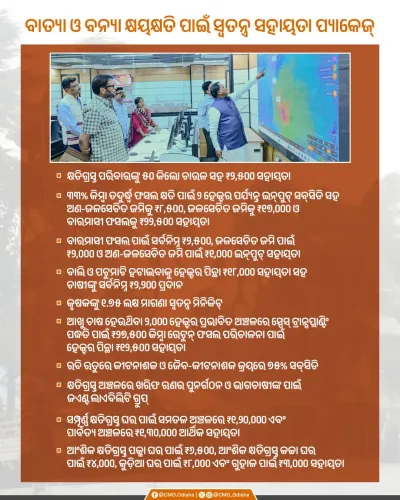
Posting in Odia, CM Majhi wrote that 'the people's government has announced various forms of assistance for the livelihood recovery of animal husbandry workers, dairy farmers, and poultry farmers affected by Cyclone Arnab.' The package covers compensation for livestock deaths, financial support for draught animals, subsidies for purchasing new animals, supply of cattle feed, and dedicated rehabilitation assistance for damaged poultry farms.What the Package Covers — Livestock, Poultry, and Draught Animals
The relief spans four distinct categories of rural distress. Farmers who lost animals to the storm will receive direct monetary compensation. Those who depend on draught animals — bullocks and horses used for agriculture and transport — will get separate financial support, recognising that losing a working animal is not just a loss of livestock but a disruption to the entire farming calendar.
New animal purchase subsidies address a deeper problem: even after debris is cleared, a farmer without capital cannot restart. By underwriting the cost of replacement animals, the government shortens the recovery timeline considerably. Alongside this, cattle feed supply ensures surviving animals remain productive while their owners get back on their feet. Poultry farmers — whose infrastructure of sheds and equipment is highly vulnerable to wind damage — have been specifically included, with rehabilitation support earmarked for damaged farms.
Odisha's Long History of Post-Cyclone Animal Husbandry Relief
This announcement follows a well-established Odisha state protocol. After Cyclone Fani in 2019, the state government similarly rolled out livestock compensation, input subsidies, and ex-gratia payments for rural communities across the affected belt. Successive administrations — cutting across party lines — have maintained these response frameworks, a practical necessity for a state that sits directly in the Bay of Bengal's cyclone corridor.
Odisha is one of India's most cyclone-exposed states, and repeated disruptions to animal husbandry have made targeted post-storm welfare a core part of disaster response here — not an exceptional measure, but an expected one. CM Majhi took charge of the state in June 2024 after the BJP's victory in the assembly elections, and this announcement marks his government continuing that institutional reflex.
What to Watch as Relief Rolls Out
The immediate question now is execution: how quickly compensation claims are processed, whether subsidy disbursements reach marginal and small farmers before the next planting cycle, and what the official district-level damage assessment ultimately shows. In past cyclone recoveries in Odisha, the gap between announced packages and actual on-ground disbursement has been the critical variable — and rural livelihoods hinge on closing it fast.
For thousands of families whose herds and flocks were their only cushion against poverty, the race against the calendar has already begun.
Point of View
But no less politically important for that. By explicitly naming livestock keepers, dairy farmers, and poultry farmers as separate beneficiary categories, the government signals granular attention to rural distress rather than a one-size package. For the BJP, which flipped Odisha in 2024, sustaining farmer confidence in the coastal districts remains essential electoral arithmetic. The real test will be disbursement speed: Odisha's challenge has historically not been announcing relief, but delivering it before the next crop season closes the window.
NationPress
2 Nov 2026
Frequently Asked Questions
What relief has the Odisha government announced for Cyclone Arnab victims?
The Odisha government has announced compensation for livestock deaths, financial support for draught animals, subsidies to purchase new animals, cattle feed supply, and rehabilitation assistance for damaged poultry farms to help animal husbandry workers, dairy farmers, and poultry farmers recover from Cyclone Arnab.
Who is eligible for the Cyclone Arnab livestock relief in Odisha?
Animal husbandry workers, dairy farmers, and poultry farmers whose livestock, draught animals, or poultry farms were damaged or destroyed by Cyclone Arnab are the primary eligible groups under the relief package announced by CM Mohan Charan Majhi.
Has Odisha given livestock relief after cyclones before?
Yes. After Cyclone Fani in 2019, Odisha announced similar compensation packages covering livestock losses and rehabilitation for affected farmers. Successive state governments have maintained protocols for ex-gratia payments and input subsidies after major cyclones.
Who is Mohan Charan Majhi?
Mohan Charan Majhi is the Chief Minister of Odisha and a BJP leader. He assumed office in June 2024 following the BJP's victory in the Odisha state assembly elections.
Why is Odisha so frequently affected by cyclones?
Odisha is a coastal state on the eastern coast of India bordering the Bay of Bengal, which is one of the world's most active zones for tropical cyclone formation. This geographic exposure makes the state highly vulnerable to recurring cyclone damage to agriculture, infrastructure, and rural livelihoods.