Anurag Thakur: Congress Has Lost Mandate, 'Regime Change' Plans Will Fail
Synopsis
BJP MP Anurag Thakur, posting from Delhi, dismissed opposition 'regime change' rhetoric as futile and pointed to Congress's successive electoral collapses as proof the party has exhausted its democratic credibility, reigniting the perennial EVM-versus-ballot debate.
Key Takeaways
Anurag Thakur posted from New Delhi on October 29, 2026 , rejecting the opposition's 'regime change' framing as undemocratic.
He argued that the Modi government holds a legitimate mandate conferred by voters in free elections.
Thakur explicitly referenced the EVM vs ballot paper debate, saying Congress loses under both systems.
He said Congress has destroyed both its public trust and its voter base through serial election defeats.
The BJP's strategy of citing repeated mandates — including the landmark wins of 2014 and 2019 — underpins this messaging pattern.
Electoral reform and EVM audit demands are likely to resurface in the upcoming winter session of Parliament .
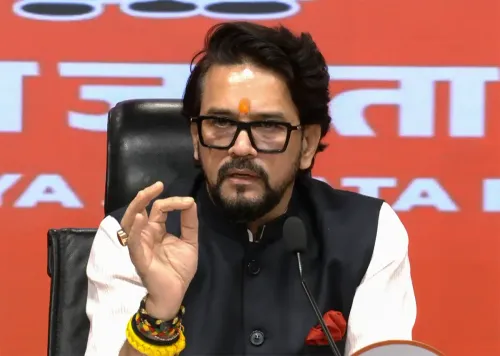
The democratic mandate of the people cannot be undone by sloganeering — that is the sharp message BJP MP Anurag Thakur fired from New Delhi on Thursday, October 29, 2026, taking direct aim at the opposition's 'regime change' rhetoric and Congress's mounting electoral losses.
Posting in Hindi on X, Thakur wrote: 'Modi sarkar ko desh ki janta ne loktantrik tarike se chuna hai, vipaksh ka "regime change" ke mansoobe kabhi kamyab nahin honge.' — 'The Modi government has been democratically elected by the people of this country; the opposition's designs of a regime change will never succeed.' He went further, pointing to consecutive election cycles as evidence of Congress's collapse: whether by EVM or by ballot paper, he argued, the party has exhausted both its credibility and its voter base.
The 'Regime Change' Charge — and What It Targets
The phrase 'regime change' has gained currency in Indian opposition discourse, with Congress and allied parties arguing that institutional and administrative mechanisms have tilted the playing field against them. Thakur's post is a direct counter-punch: by invoking the democratic process itself — loktantrik tarike se chuna — he frames the opposition's narrative as an assault on the voters' own verdict, not just on the government.
It is a well-worn but effective BJP line of attack, one that has anchored the party's communication strategy since its landmark victory in the 2014 Lok Sabha elections, when Congress recorded its lowest-ever seat tally, and was reinforced in 2019, when the BJP returned with an even larger majority. Repeated mandates, the argument goes, are the definitive answer to any question of legitimacy.
EVM vs Ballot — A Debate That Won't Quit
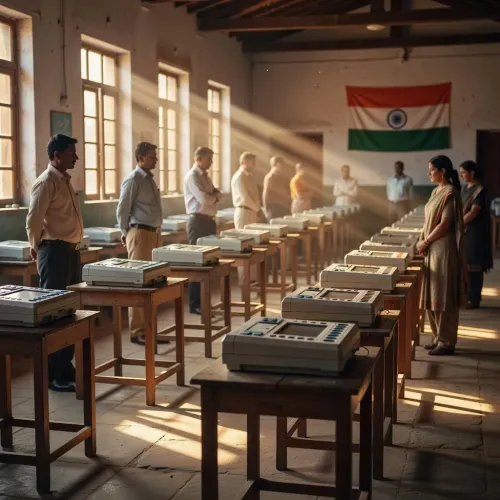
Thakur's pointed reference to EVMs is not incidental. Opposition demands for a return to paper ballots — or for independent audits of Electronic Voting Machines — have simmered in Indian political debate for well over a decade, resurfacing sharply after every major electoral setback for the Congress. By lumping EVMs and ballot papers together — 'EVM ho ya ballot' — Thakur's formulation is designed to pre-empt that argument entirely: the machines are not the variable, he implies; the voters' preference is.
Congress's Shrinking Electoral Footprint
The numbers do lend weight to the BJP's messaging. From its pre-2014 position as the governing party to a sub-ten-percent Lok Sabha presence after 2019, Congress has faced successive setbacks at both the national and state levels. Thakur's post describes this trajectory as the party having finished itself off — losing both vishwas (trust) and janaadhar (voter base) simultaneously. Whether that verdict holds going into future cycles remains the central question for the principal opposition.
With the winter session of Parliament approaching, electoral reform — including any renewed debate on EVM audits — is likely to test both sides' arguments all over again. The BJP holds the mandate; Congress will insist the fight is far from over.
Point of View
And every opposition challenge to that legitimacy is, by definition, anti-democratic. By weaving the EVM debate into the same dismissal, the BJP pre-empts a process argument with an outcome argument — effectively saying the scoreboard renders the referee irrelevant. The 'regime change' framing is also significant: it subtly aligns domestic opposition with foreign-interference narratives, a rhetorical move that has grown more common in ruling-party communications globally. For Congress, the challenge is now twofold — contest the process narrative while rebuilding the electoral ground game that could make the outcome narrative obsolete.
NationPress
29 Oct 2026
Frequently Asked Questions
What did Anurag Thakur say about regime change?
Anurag Thakur said the opposition's plans for a 'regime change' will never succeed because the Modi government was democratically elected by the people of India.
Why is the EVM vs ballot paper debate relevant here?
Thakur used the debate to argue that Congress loses elections regardless of the voting method — EVMs or paper ballots — suggesting the party's problem is political, not procedural.
How have Congress's electoral results changed since 2014?
In the 2014 Lok Sabha elections Congress recorded its lowest-ever seat tally, and in 2019 the party remained below ten percent of total seats while the BJP increased its majority.
What does 'janaadhar' mean in Thakur's post?
'Janaadhar' means voter base or popular support in Hindi. Thakur argued Congress has simultaneously lost both public trust and its voter base across successive elections.
What is the BJP's broader argument against the opposition's regime change narrative?
The BJP consistently argues that repeated democratic mandates — most notably in 2014 and 2019 — legitimise the Modi government and that any 'regime change' framing undermines the electorate's own verdict.