Anurag Thakur: HP Local Body Polls a Verdict Against Congress
Synopsis
BJP MP Anurag Thakur declared that Himachal Pradesh's panchayat and municipal elections delivered a verdict against the Congress government, warning that the same sentiment would shape the 2027 assembly race while urging panchayat leaders to become active rural development planners.
Key Takeaways
BJP MP Anurag Thakur stated that Himachal Pradesh's panchayati raj and nagar nikay election results amount to a public mandate against the state Congress government.
He predicted that this anti-Congress sentiment would carry over into the 2027 Himachal Pradesh assembly elections .
Thakur called for panchayat bhawans to function as village planning centres, not just administrative meeting spaces.
He credited the Modi government's rural development initiatives for accelerating progress at the grassroots level.
The post urges panchayat representatives to prioritise transparency, accountability, and public participation as bridges between citizens and administration.
Himachal Pradesh has a history of alternating party governments every five years; the Congress won the 2022 assembly election, making the next cycle due in 2027.
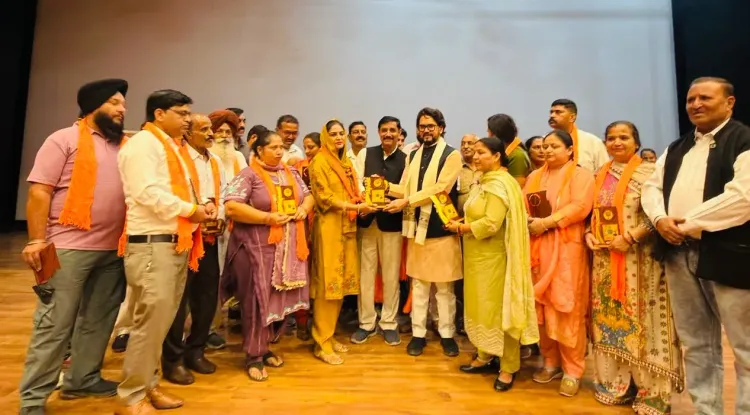
The ballot boxes from Himachal Pradesh's panchayati raj and urban local body elections had barely been counted when BJP MP Anurag Thakur framed the results as a direct indictment of the state's Congress government — and a preview of what 2027 might look like.
Posting on 23 October 2026, Thakur said the people of Himachal Pradesh had 'given their mandate against the Congress government in the panchayat and municipal body elections, and this same public sentiment will be seen in the upcoming assembly elections.' The statement did not quantify seat tallies but framed the outcome as a directional signal from grassroots voters.
Panchayat Bhawans as planning hubs, not just meeting rooms
Beyond the electoral needle, Thakur's post carried a pointed governance message. 'The panchayat bhawan should not merely be a place for meetings,' he wrote, 'but a centre for preparing the blueprints of a village's future.' It is a distinction with weight: India's 73rd Constitutional Amendment of 1992 mandated three-tier Panchayati Raj Institutions precisely to push planning and budgeting down to the village level — a promise that critics have long argued remains only partially fulfilled.
Thakur called on elected panchayat representatives to act as 'effective bridges between the public and the administration,' prioritising transparency, accountability, and people's participation. The framing positions local electeds not as passive conduits for state orders, but as active architects of rural development.
Modi government's rural push — and HP's political backdrop
Thakur credited 'the Modi government's unceasing efforts' for accelerating development in villages, arguing that active panchayat participation could make those efforts even more effective. This is consistent with the BJP's post-2014 playbook of linking centrally sponsored rural schemes — from Pradhan Mantri Gram Sadak Yojana to PMAY-Gramin — directly to the Prime Minister's brand, and using local body results to validate that narrative at the state level.
Himachal Pradesh has historically alternated between Congress and BJP governments every five years. The Congress returned to power in the 2022 assembly elections, defeating the incumbent BJP. Local body elections in the state have frequently served as the first political temperature check between assembly cycles, making the latest results significant for both camps as they calibrate strategy for the next assembly contest.
What Thakur's signal means for 2027
By drawing a straight line from panchayat poll results to assembly election sentiment, Thakur is doing two things at once: energising BJP ground workers and placing the Congress on the defensive about rural delivery. Whether the local-body results constitute a genuine statewide swing — or reflect hyper-local incumbency factors typical of gram panchayat contests — is a question the actual seat-by-seat data will have to answer.
What is clear is that the BJP's Hamirpur MP, with deep roots in Himachal's political terrain, is moving early. The 2027 Himachal Pradesh assembly elections are still over a year away, but the campaign, it appears, has already begun at the village square.
Point of View
He threads the needle between attack politics and constructive framing — useful for a party trying to rebuild cadre morale after the 2022 assembly loss. The invocation of the 73rd Amendment's original vision also lets the BJP claim the decentralisation mantle, a subtle dig at a Congress government it accuses of centralising power in Shimla. With assembly elections still over a year out, the real test will be whether this local-body narrative holds through the inevitable counter-campaign on state welfare schemes.
NationPress
23 Oct 2026
Frequently Asked Questions
What did Anurag Thakur say about Himachal Pradesh panchayat elections?
Anurag Thakur stated that the results of Himachal Pradesh's panchayati raj and nagar nikay elections reflect a public mandate against the state Congress government, and that this sentiment will be repeated in the upcoming assembly elections.
When are the next Himachal Pradesh assembly elections?
The next Himachal Pradesh assembly elections are expected in 2027 . The state has historically alternated between BJP and Congress governments every five years; Congress won the last election in 2022.
What is the 73rd Constitutional Amendment and how does it relate to this?
The 73rd Constitutional Amendment Act of 1992 established India's three-tier Panchayati Raj system, mandating devolution of planning and governance to village, block, and district levels. Thakur's post invokes this framework by arguing that panchayat bhawans should be genuine planning centres, not merely meeting venues.
Who is Anurag Thakur?
Anurag Thakur is a BJP Lok Sabha MP from Hamirpur constituency in Himachal Pradesh . He previously served as Union Minister of Information and Broadcasting and Union Minister of Youth Affairs and Sports under the Modi government.
What is BJP's political position in Himachal Pradesh currently?
BJP is the principal opposition party in Himachal Pradesh after losing the 2022 state assembly election to Congress. It is actively positioning itself for the next electoral cycle, expected in 2027.