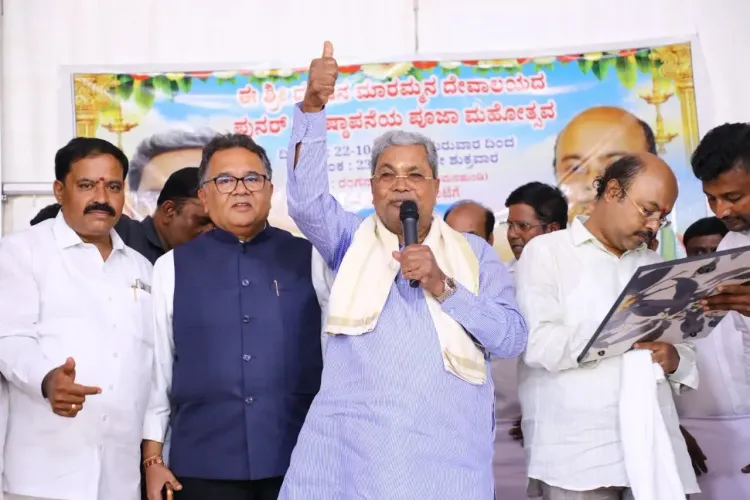
CM Siddaramaiah inaugurates Dandina Maramma temple in Mysore
Synopsis
Karnataka Chief Minister Siddaramaiah inaugurated the new Dandina Maramma temple in Rangnathapura, Mysore on 23 October 2026, and delivered a wide-ranging address linking faith, internal SC reservations, and education to Ambedkar's vision of equality.
Key Takeaways
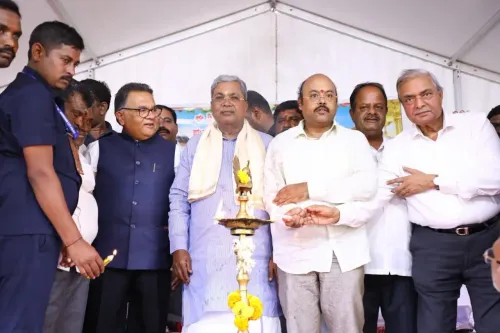
Siddaramaiah inaugurated the new building of Shri Dandina Maramma Devalaya in Rangnathapura, Varuna Hobli, Mysore Taluk on 23 October 2026 .
He declared that a temple is a symbol of devotion, not just a building, and that God resides in every heart — not only in places of worship.
The CM said he has contested 13 elections since his Taluk Board days, with Varuna Hobli's voters supporting him at every stage.
He claimed his government addressed a 30-year-old demand for internal SC reservations, benefiting communities including Lambani, Koli, Korama, and Koracha .
Citing his own rise from rural student to Chief Minister, he urged every child in the region to pursue education as the route to social and economic empowerment.
Ambedkar's dream of equality, saying it can only be realised when every individual is educated.
A village shrine rebuilt into a grand sanctuary — and a Chief Minister who says it was education, not power, that brought him there. Karnataka Chief Minister Siddaramaiah inaugurated the new building of Shri Dandina Maramma Devalaya in Rangnathapura, Varuna Hobli, Mysore Taluk on Friday, 23 October 2026, and used the occasion to deliver a sweeping address on faith, equality, and the transformative power of education.
Speaking at the punar pratishthapana mahotsava (temple re-consecration festival), the Chief Minister said in Kannada: 'It gives immense joy to have inaugurated the new building of the mother deity Dandina Maramma temple and to have participated in the consecration ceremony. Where once a small shrine stood, a magnificent temple has risen — this is a good fortune for all of us.'
Faith beyond the four walls
Siddaramaiah did not stop at the ritual. He drew a pointed philosophical line: 'A temple is not merely a building — it is a symbol of devotion and belief. God is not confined to a temple; God resides in every heart.' Going further, he argued that true devotion is not expressed through rituals alone but through '올바른 நடத்தை, பரஸ்பர காதல்' — good conduct, mutual love, trust, and humanity. 'In God's eyes there is no distinction of caste or religion,' he said. 'Seeing all as equal is the very essence of dharma.'
The message lands in a charged moment. Siddaramaiah has long fused cultural participation with Ambedkarite social philosophy, a combination that defines the Congress approach in Karnataka — attend the festival, then remind the gathering why equality is the real puja.
Varuna Hobli and a career that started here
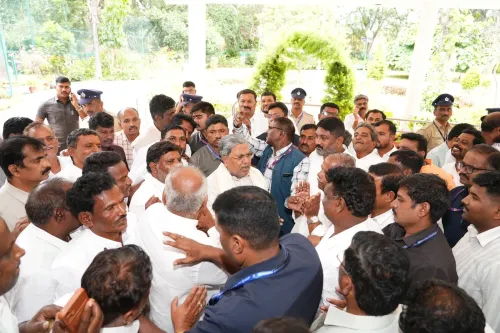
For Siddaramaiah, this is far more than a constituency stop. He told the crowd that his bond with this town is inseparable: 'Starting from the Taluk Board election, I have fought 13 elections. In every single one, the people of this town supported me with love and affection. I can never forget your trust and support.'
That personal history matters politically. Varuna Hobli in the Mysore belt has been Siddaramaiah's electoral bedrock across decades, and public events like this one simultaneously serve as community outreach and political homecoming.
30 years of internal reservation — and what came of it
The Chief Minister used the platform to claim credit for a policy milestone he called thirty years in the making. Karnataka has hosted a sustained movement for sub-quotas within Scheduled Castes — a demand that the benefits of reservation be distributed more equitably among sub-communities rather than concentrated in the most organised groups.
Siddaramaiah said his government responded to this demand and worked to ensure 'suitable representation' for communities including the left-hand and right-hand SC sections, Lambani, Koli, Korama, and Koracha. 'As a result of internal reservation, previously excluded communities are now gaining access to education and employment,' he said — framing the policy as a direct fulfilment of his tenure's central commitment.
Education as the non-negotiable equaliser
The address built toward a personal crescendo. Siddaramaiah tied his own biography directly to education's power: 'It is education that brought me to the stage of being an MLA, Deputy Chief Minister, Leader of the Opposition, and Chief Minister. Therefore, no child in our village should be deprived of education. Everyone must receive education and become socially and economically empowered.'
He invoked Dr B.R. Ambedkar to close the argument: 'Only when every individual is educated can Babasaheb Ambedkar's dream of equality become a reality.' The reference is deliberate — in Karnataka's political grammar, citing Ambedkar at a religious event is both a social signal and a policy pledge.
He signed off with a prayer: 'May mother Dandina Maramma bring goodness to all. May happiness, peace, and wellbeing reside in every family.' Power, he reminded the gathering, is not permanent — it is only a means to bring change to society.
For a Chief Minister who has now held the state's top office across multiple stints, the message from a village temple in Mysore is the same one he has delivered for three decades: the shrine is the occasion; equality is the agenda.
Point of View
He signals to marginalised sub-communities that religious outreach and policy delivery are inseparable parts of his governance identity. The explicit Ambedkar invocation at a Hindu ritual space is also a subtle ideological marker — distancing the Congress from both majoritarian religiosity and rigid secularism. With internal reservation still a contested work-in-progress, Siddaramaiah is clearly trying to cement its political ownership ahead of future electoral cycles in this Mysore belt stronghold.
NationPress
23 Oct 2026
Frequently Asked Questions
Which temple did CM Siddaramaiah inaugurate in October 2026?
Siddaramaiah inaugurated the new building of Shri Dandina Maramma Devalaya in Rangnathapura, Varuna Hobli, Mysore Taluk on 23 October 2026 , participating in the temple's re-consecration ceremony.
What is internal reservation for Scheduled Castes in Karnataka?
Internal reservation refers to the policy of creating sub-quotas within the broader Scheduled Caste reservation to ensure communities such as Lambani, Koli, Korama, Koracha , and left-hand and right-hand SC sections receive a fairer share of education and employment opportunities. This demand had been active in Karnataka for roughly 30 years before Siddaramaiah's government addressed it.
What did Siddaramaiah say about education at the Mysore temple event?
The Chief Minister said education was the single factor that enabled his own journey from a village student to MLA, Deputy Chief Minister, Leader of the Opposition, and Chief Minister , and called on every child in the region to pursue education to become socially and economically empowered.
Why did Siddaramaiah mention Dr B.R. Ambedkar at a temple inauguration?
Siddaramaiah invoked Ambedkar's dream of equality to argue that universal education is the only way to realise social justice — a consistent rhetorical link he draws between cultural events and his Ambedkarite policy commitments.
What is Varuna Hobli's significance to Siddaramaiah's political career?
Varuna Hobli in Mysore Taluk is Siddaramaiah's long-standing electoral base. He told the crowd he has fought 13 elections since his Taluk Board days and that the people of this area have supported him with 'love and affection' in every one of them.