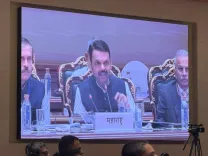
CM Siddaramaiah marks 3 years in office, lists temple grants

Synopsis
Karnataka Chief Minister Siddaramaiah marked three years in office on 24 May 2026, citing ₹411.28 crore in temple grants, the Bhoo Varaha Yojane for clearing encroachments on 328 temple properties, and a hike in religious institution stipends from ₹60,000 to ₹72,000.
Key Takeaways
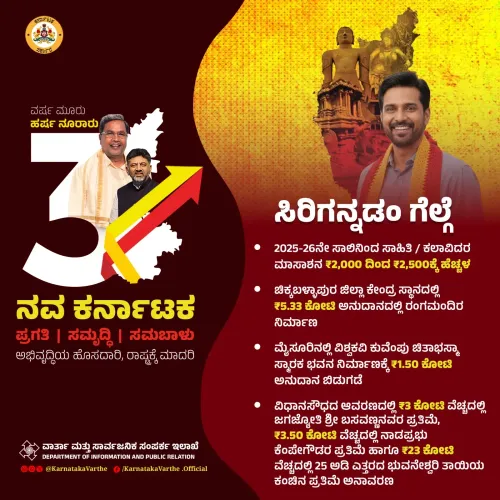
The Congress-led Karnataka government completed three years in office on 24 May 2026 , with CM Siddaramaiah crediting every Kannadiga for the administration's achievements. ₹411.28 crore in grants were released over three years for repair, renovation, and construction of temples, maths, and religious institutions across the state.
The Bhoo Varaha Yojane was implemented to clear encroachments and document the immovable property of 328 encroached temple sites.
Annual stipends ( tastik and varshashana ) paid to religious institutions under the Religious Endowments Department were raised from ₹60,000 to ₹72,000 .
Siddaramaiah said the government's efforts under the Nava Karnataka vision would become faster and more effective going forward.
Karnataka Chief Minister Siddaramaiah on Sunday, 24 May 2026 marked the completion of three years of his Congress-led government in office, crediting the state's people for the administration's achievements and reaffirming commitment to pre-election promises. In a post on X, the Chief Minister outlined a series of measures his government has taken for religious institutions across the state.
Context
The Congress government in Karnataka came to power in May 2023 after winning the state assembly elections, with Siddaramaiah returning as Chief Minister — a role he had previously held from 2013 to 2018. Posting in Kannada under the hashtags #3YearsOfNavaKarnataka and #NavaKarnataka, Siddaramaiah wrote that 'the credit for all the achievements of our government belongs to every Kannadiga,' and expressed pride that the administration had 'walked the talk' on its electoral commitments.
The post frames the three-year milestone as a moment of accountability, with the Chief Minister listing specific financial outlays and schemes directed at temples, maths, and religious bodies administered by the state's Religious Endowments Department — also known as the Muzrai or Dharmika Datti department.
Policy Backdrop
Among the measures cited, Siddaramaiah stated that ₹411.28 crore in grants had been released over the past three years under a general scheme for the repair, renovation, construction, and related works of temples, maths, and religious institutions across the state. He also highlighted the implementation of the Bhoo Varaha Yojane, a programme designed to survey, document, and clear encroachments on the properties of 328 temples whose assets had been encroached upon, and to formally record their immovable property.
Additionally, the post noted an increase in the tastik (annual stipend) and varshashana (yearly allowance) amounts paid to religious institutions and temples under the Religious Endowments Department — raised from ₹60,000 to ₹72,000. Karnataka governments across party lines have historically maintained dedicated endowments legislation and provided public funds for temple upkeep, making such measures a continuation of an established state policy tradition.
Stakeholders and Impact
The primary beneficiaries of these measures are temple trusts, maths, religious bodies, and the communities of devotees who depend on them. Encroachment clearance under the Bhoo Varaha Yojane is particularly significant for smaller, rural temples whose land assets have historically been vulnerable to illegal occupation.
The increase in annual stipends directly affects priests, archakas, and staff employed by institutions under the Religious Endowments Department, providing them a modest but formal raise in state support. Taken together, the announcements signal the government's intent to use the three-year mark as a platform to demonstrate delivery on cultural and welfare commitments made before the 2023 elections.
What's Next
The Chief Minister indicated that the government's efforts toward building a 'strong, prosperous, and self-respecting Karnataka' — the core of the Nava Karnataka vision — would accelerate going forward. Observers will watch for progress reports on the Bhoo Varaha Yojane's implementation across all 328 identified temples, as well as whether further grant revisions for religious institutions appear in the 2026-27 state budget cycle.
Point of View
Siddaramaiah is making a deliberate play to counter the opposition narrative that the Congress government is indifferent to Hindu religious institutions — a charge that has featured prominently in Karnataka's political discourse since 2023. The Bhoo Varaha Yojane and the stipend hike are low-cost, high-visibility signals to a constituency that rivals have traditionally claimed. The post also serves as an early framing exercise ahead of any mid-term political turbulence, establishing a deliverables-based record that the party can defend on the campaign trail.
NationPress
9 Oct 2026
Frequently Asked Questions
How many years has Siddaramaiah's government completed in Karnataka?
The Siddaramaiah-led Congress government in Karnataka completed three years in office as of 24 May 2026 , having come to power after winning the state assembly elections in May 2023.
What is the Bhoo Varaha Yojane in Karnataka?
The Bhoo Varaha Yojane is a Karnataka government scheme to survey, document, and clear encroachments on the land and immovable property of temples and religious institutions, targeting 328 temple properties identified as encroached.
How much grant did Karnataka give for temple renovation in three years?
The Karnataka government released ₹411.28 crore over three years under a general scheme for repair, renovation, construction, and related works at temples, maths, and religious institutions across the state.
What is the tastik and varshashana increase for Karnataka temples?
The Karnataka government raised the annual tastik (stipend) and varshashana (allowance) paid to religious institutions and temples under the Religious Endowments Department from ₹60,000 to ₹72,000 .
What is Nava Karnataka?
Nava Karnataka is the development slogan and governance vision promoted by the current Karnataka government, representing its agenda of welfare delivery, infrastructure development, and cultural preservation since taking office in May 2023.