CM Siddaramaiah marks 3 years in office with welfare data
Synopsis
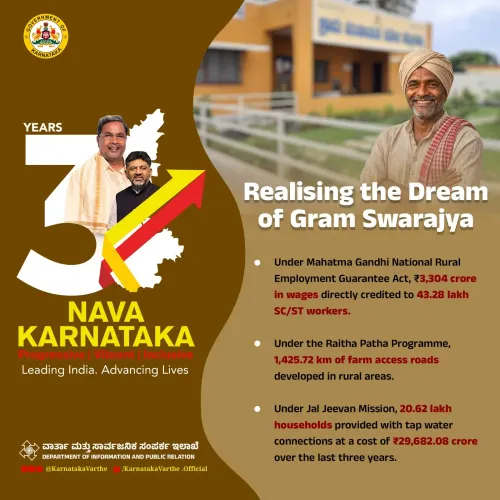
Karnataka Chief Minister Siddaramaiah marked three years in power on 22 May 2026, citing ₹3,304 crore in MGNREGA wages to over 43 lakh SC/ST workers, 1,425 km of farm roads under Raitha Path, and piped water to more than 20 lakh rural households under Jal Jeevan Mission.
Key Takeaways
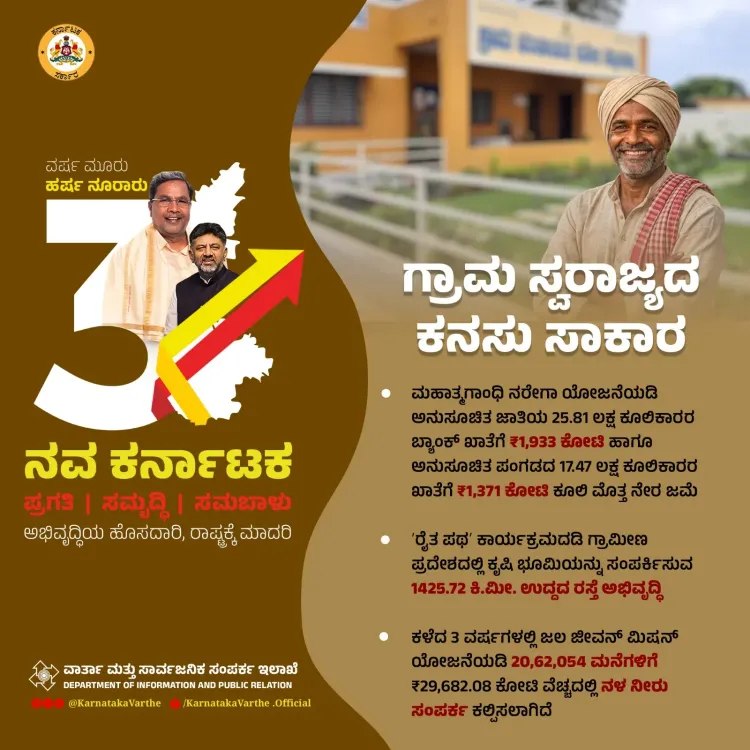
₹1,933 crore in MGNREGA wages credited directly to 25.81 lakh Scheduled Caste workers in Karnataka over three years. ₹1,371 crore transferred to 17.47 lakh Scheduled Tribe workers under MGNREGA during the same period.
1,425.72 km of rural roads developed under the Raitha Path programme to connect agricultural land.
20,62,054 rural households given piped water connections under Jal Jeevan Mission at a cost of ₹29,682.08 crore .
CM Siddaramaiah dedicated all achievements to the people of Karnataka and pledged faster delivery going forward.
The milestone marks three years since the Indian National Congress returned to power in Karnataka in May 2023 .
Karnataka Chief Minister Siddaramaiah on Friday, 22 May 2026, marked three years of his Congress government in office by posting a detailed account of rural welfare and infrastructure achievements on X, dedicating the milestone to every Kannadiga and reaffirming his government's commitment to pre-election promises.
Context
The post, written in Kannada, opens with the Chief Minister stating: 'ರಾಜ್ಯದ ಜನರ ಆಶೀರ್ವಾದದೊಂದಿಗೆ ನಾವು ಅಧಿಕಾರಕ್ಕೆ ಬಂದು ಮೂರು ವರ್ಷಗಳು ಪೂರೈಸುತ್ತಿರುವ ಈ ಸಾರ್ಥಕ ಸಂದರ್ಭದಲ್ಲಿ' ('On this meaningful occasion of completing three years in power with the blessings of the people of the state'). Siddaramaiah credited all achievements of his government to the people of Karnataka, and said the administration takes pride in having walked the talk on every promise made before the elections.
The Indian National Congress returned to power in Karnataka in May 2023 after winning the state assembly elections on a platform centred on rural welfare, social security and infrastructure development. Siddaramaiah, who previously served as Chief Minister from 2013 to 2018, leads the government with a stated focus on scheme delivery and direct benefit transfers.
Policy Backdrop
Among the figures cited in the post, the government claims that under the Mahatma Gandhi National Rural Employment Guarantee Act (MGNREGA), wages totalling ₹1,933 crore were directly credited to the bank accounts of 25.81 lakh Scheduled Caste workers, while ₹1,371 crore was transferred to 17.47 lakh Scheduled Tribe workers over the three-year period. MGNREGA, a central flagship programme operational since 2005, guarantees 100 days of wage employment annually to rural households, with Karnataka among its major implementing states.
On rural road connectivity, the post highlights development of 1,425.72 km of roads linking agricultural land in rural areas under the 'Raitha Path' (ರೈತ ಪಥ) programme — a state initiative aimed at improving last-mile farm access. Under the Jal Jeevan Mission, the central scheme launched in 2019 for universal rural tap-water coverage, the government states that 20,62,054 households have been provided piped water connections at a cost of ₹29,682.08 crore over the past three years.
Stakeholders and Impact
The figures cited directly concern three of Karnataka's most politically significant constituencies: rural wage labourers from Scheduled Caste and Scheduled Tribe communities, small and marginal farmers dependent on rural road access, and rural households lacking reliable drinking water. Together, these groups represent a substantial share of Karnataka's electorate, particularly in the northern and coastal districts where Congress made significant gains in 2023.
The government's use of direct benefit transfer data under MGNREGA underscores an effort to demonstrate accountability in fund flow to marginalised communities. The Jal Jeevan Mission connection count, if accurate, would represent a significant share of Karnataka's estimated rural household base, though the state had faced coverage gaps in earlier implementation phases.
What's Next
Siddaramaiah closed his post with a forward commitment: 'ನಮ್ಮ ಈ ಪ್ರಯತ್ನ ಮುಂದೆ ಇನ್ನಷ್ಟು ಶೀಘ್ರ ಹಾಗೂ ಪರಿಣಾಮಕಾರಿಯಾಗಿರಲಿದೆ' ('Our efforts will be even faster and more effective going forward'), signalling the government intends to accelerate delivery on its remaining agenda. Observers will watch the 2026-27 state budget session and scheme review meetings for revised targets on rural infrastructure, residual Jal Jeevan Mission coverage, and MGNREGA fund utilisation. With Karnataka's next assembly elections on the horizon, mid-term progress communication of this kind is likely to intensify as the Congress government builds its record for voters.
Point of View
Converting scheme implementation data into a political narrative of promise-keeping ahead of the next Karnataka assembly cycle. By anchoring the message in MGNREGA wage transfers and Jal Jeevan Mission connections — both central schemes — the Chief Minister simultaneously claims credit for delivery while implicitly positioning the state government as an effective executor of New Delhi's programmes. The focus on Scheduled Caste and Scheduled Tribe beneficiary counts signals a deliberate effort to consolidate the social coalition that delivered the 2023 victory. As Congress-ruled states increasingly use data-driven social-media updates to counter opposition narratives, Karnataka's communication strategy fits a broader pattern of competitive federalism playing out across India's state capitals.
NationPress
5 Oct 2026
Frequently Asked Questions
How long has Siddaramaiah been Chief Minister of Karnataka?
Siddaramaiah completed three years as Chief Minister of Karnataka on 22 May 2026, having assumed office after the Congress party won the May 2023 state assembly elections. He had previously served as Chief Minister from 2013 to 2018.
What is the Raitha Path programme in Karnataka?
'Raitha Path' is a Karnataka state initiative aimed at developing roads that connect agricultural land in rural areas to improve last-mile access for farmers. The government claims 1,425.72 km of such roads were built over the past three years.
How much was paid to SC and ST workers under MGNREGA in Karnataka?
According to CM Siddaramaiah's post, ₹1,933 crore was directly credited to 25.81 lakh Scheduled Caste workers and ₹1,371 crore to 17.47 lakh Scheduled Tribe workers under MGNREGA over the past three years.
How many households got tap water under Jal Jeevan Mission in Karnataka?
The Karnataka government claims 20,62,054 rural households were provided piped tap-water connections under the Jal Jeevan Mission at a total expenditure of ₹29,682.08 crore over three years.
What is the hashtag NavaKarnataka about?
'Nava Karnataka' translates to 'New Karnataka' and is the Congress government's branding for its governance agenda since 2023, emphasising reconstruction of a strong, prosperous and self-respecting Karnataka.